The Huxley–Gödel Machine: When AI Learns to Learn and Challenges How We Teach
Researchers at KAUST have unveiled a new kind of AI that can rewrite and improve its own code. Called the Huxley–Gödel Machine, it represents a pivotal step toward a form of intelligence that not only learns, but learns how to learn.
This article has been machine-translated into English. Therefore, there may be nuances or errors in the content. The Danish version is always up-to-date and accurate. Read the original Danish article here.
This article takes its point of departure in a research paper from KAUST, which last week published an interesting piece on the vision for a new type of Gödel machine. It may be a touch forward-looking, but the publication from KAUST was one I have personally been waiting for.
Fundamentally, what’s new is:
AI that rewrites its own code to become a better AI.
OK, read that again—and hold off on being too alarmed.
I summarise the key points from the paper and explain the background. That’s the more technical part, which I then place in an educational context. The whole thing may have a hint of philosophy, but there is good reason to take this new possibility seriously—if only to understand where AI development is heading.
If you are a policymaker, an education researcher, or simply curious about AI regulation, this article will certainly give you food for thought.
Before we get that far, let’s look more closely at what the Gödel machine actually is. If you think AI is already impressive, the next generation will likely surprise you, as it is far more than just a new version of ChatGPT.
The Gödel machine
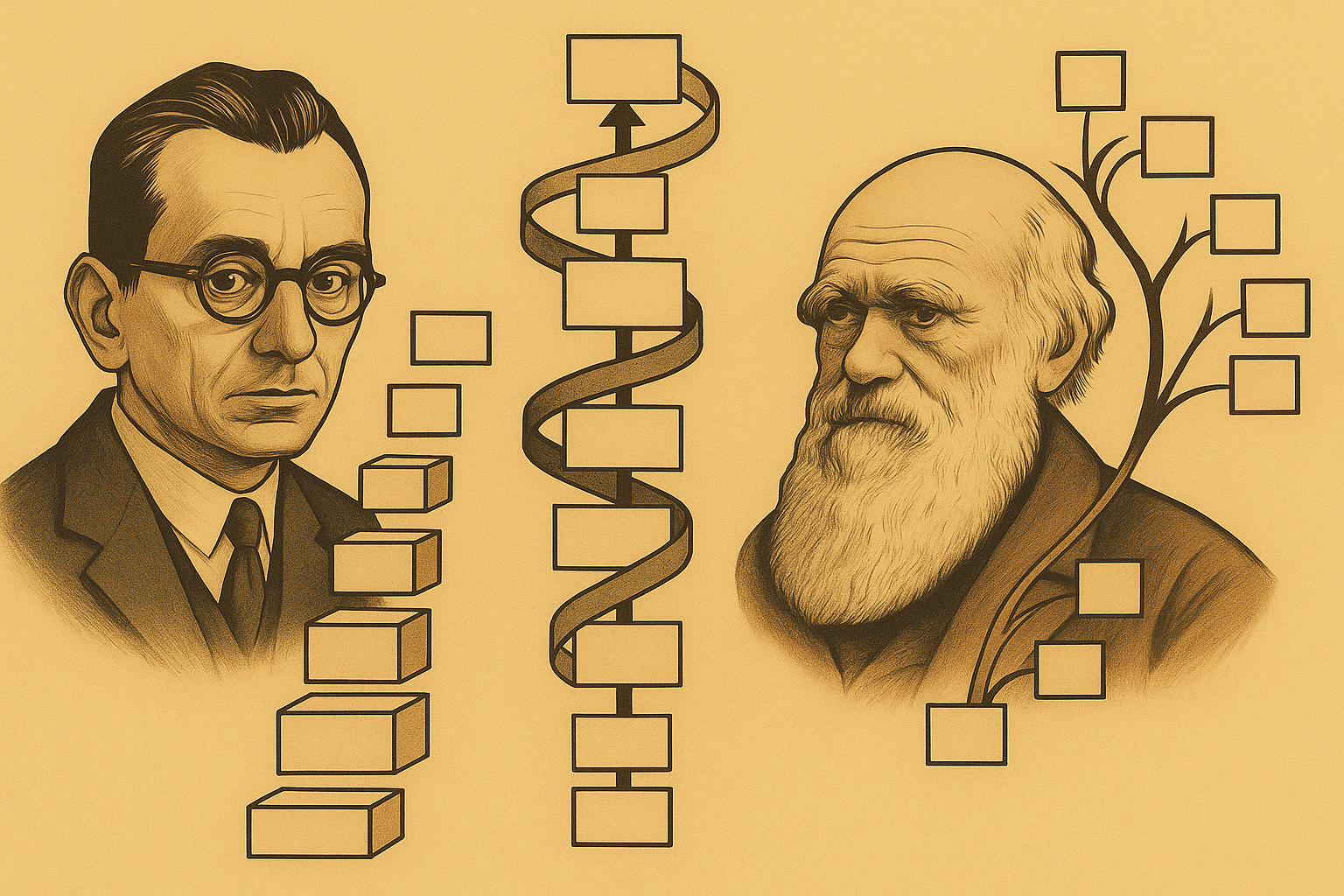
The Gödel machine should be understood as a theoretical idea often attributed to AI researcher Jürgen Schmidhuber. The concept is essentially a self-improving AI that can analyse and rewrite its own source code to optimise itself. The original idea—both brilliant and impossible—was that the machine could only change itself if it could formally prove that the change would improve it in the long term.
That may sound simple, but you cannot prove the effect of a change before it has been tried. This means that every time the code runs, it technically becomes a better or worse version of itself.
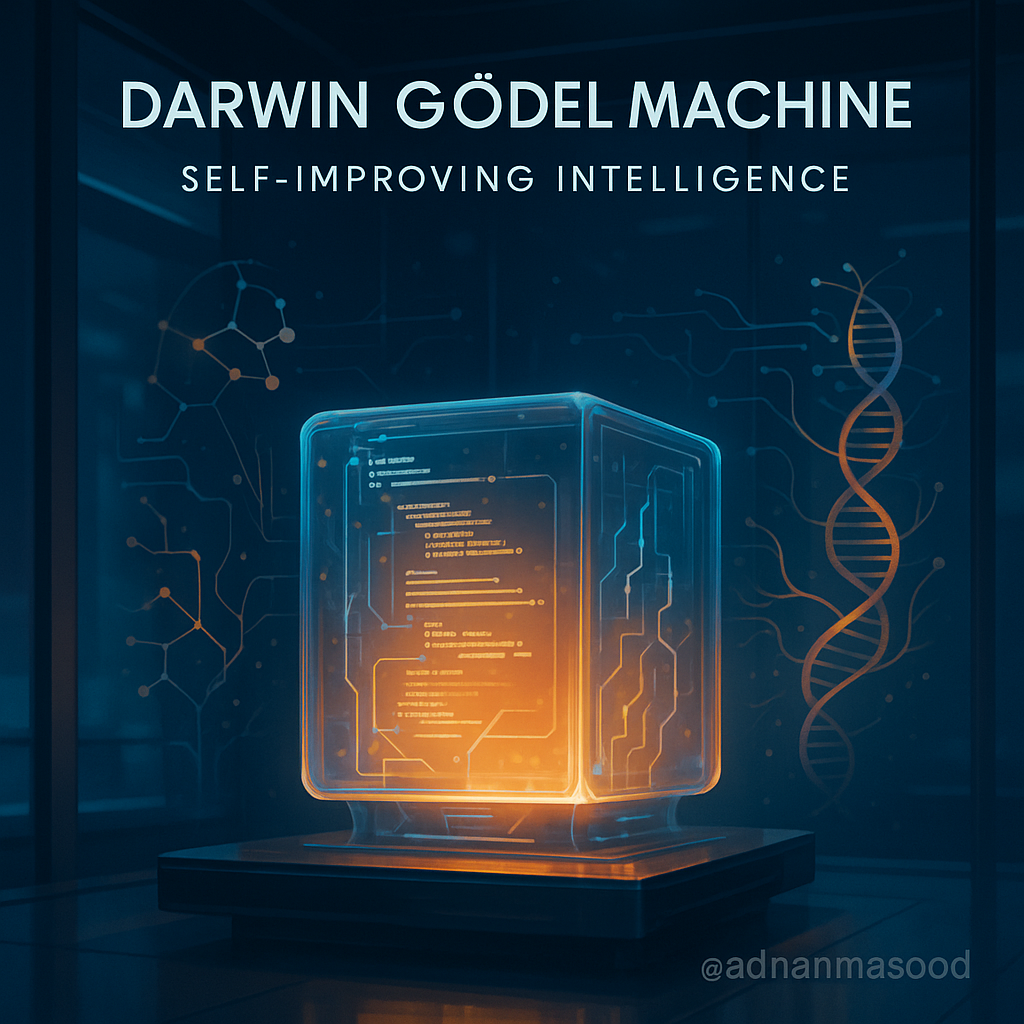
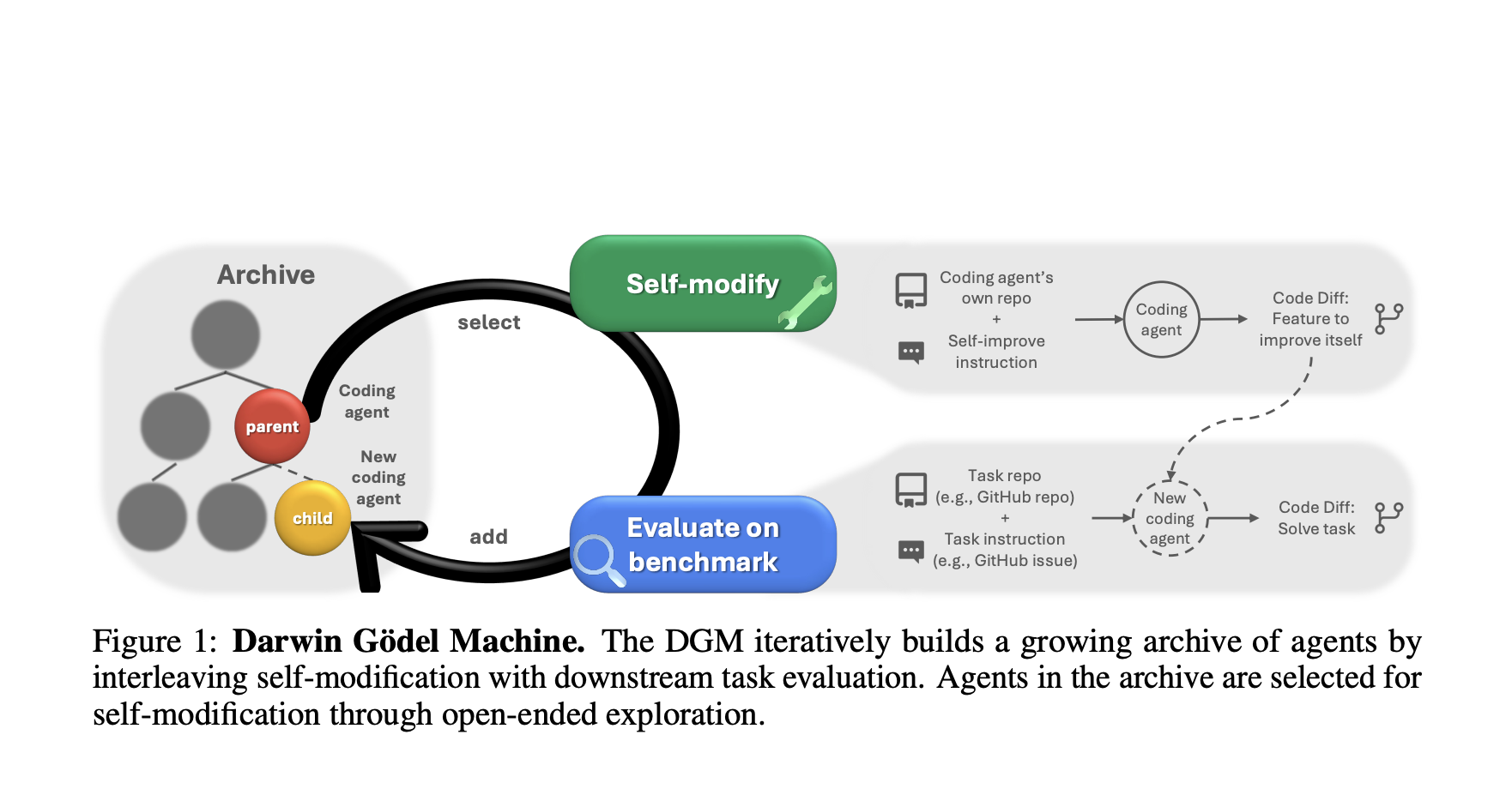
Newer ideas relax the impossible proof requirement and explore several different directions. One example is the Darwin-Gödel machine (DGM), which removes the need for formal proof and instead introduces empirical validation. Here, the AI is allowed to create a new version of itself and is then tested to see which performs best across a set of tasks. All versions are stored in an archive used to ensure the model does not get stuck in an undesirable evolutionary trajectory.
It is an interesting concept, grounded in the idea that the strongest survives. The challenge, however, is that it only assesses whether the agent performs well here and now.
Whereas the Darwin-Gödel machine primarily focuses on an individual agent’s performance, the Huxley-Gödel machine (HGM) from KAUST takes a far more radical approach.
The Huxley-Gödel machine (HGM)
The Huxley-Gödel machine is based on the idea that an AI agent may ace a test in the moment yet still be poor at producing intelligent descendants. They call this a mismatch between metaproductivity and performance.
They attempt to address the impossible-proof problem in the Gödel machine by introducing a new metric called Clade Metaproductivity (CMP). CMP measures long-term potential, and therefore the machine is not concerned with how a single agent performs in the moment. Instead, it evaluates the overall success of the entire lineage.
Hence, the ancestors whose lineage has been best at improving over time are favoured. In essence, it is akin to a teacher assessing not how well pupils perform today but how good they become at learning for themselves. The system therefore backs the pupil who learns to learn, rather than the pupil who simply crams for the test.
You might say that if the Darwin-Gödel machine is about “survival of the fittest”, the Huxley-Gödel machine is about “survival of the fittest family”.
The Huxley-Gödel machine’s possibilities and impact on teaching
The AI systems we see in teaching today are static, draw on data from large language models, and follow a fairly fixed structure. In the large language models we naturally do not have full control over the output, but it is roughly similar for the same prompt. Meanwhile, we are seeing some newer systems begin to add memory and thereby use prior interactions to produce more personalised responses.
These are the types of systems we have today, but future AI systems will embody an entirely new kind of intelligence that can recursively improve their own ability to learn.
You could also put it this way:
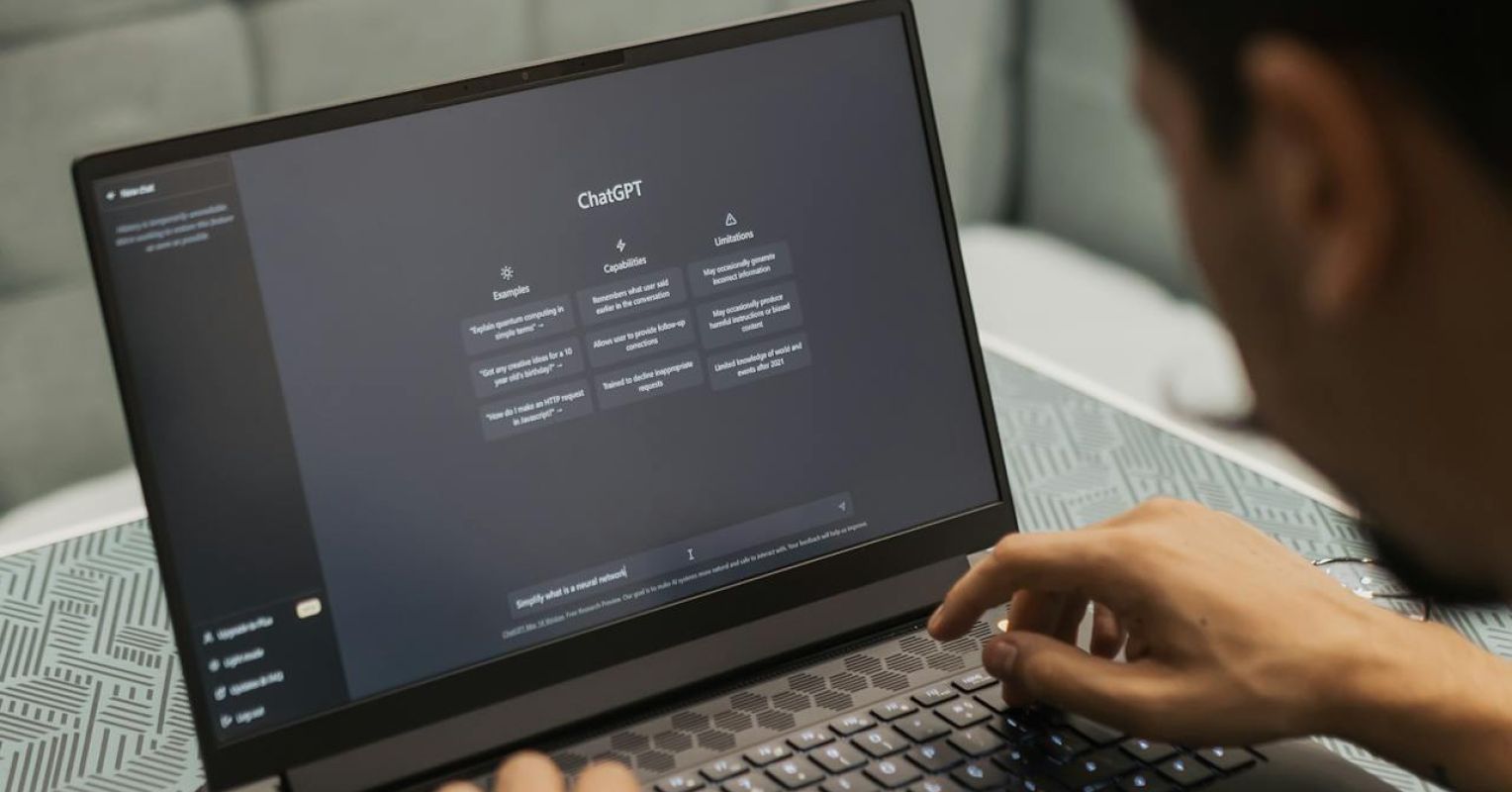
ChatGPT/Claude = A fully trained expert using what it has already learnt. Huxley-Gödel machine = An expert constantly rewiring its own brain to get better.
With these thoughts in mind, I will now attempt to anticipate the possibilities of the Huxley-Gödel machine in education.
Thoughts on the ultimate AI partner
This section explores the Huxley-Gödel machine as the ultimate AI partner—one possible development path among several that may not be realised due to ethical and moral considerations.
In the article on the Huxley-Gödel machine, the AI is given a curriculum consisting of a static set of coding tasks. Its task is to find the “fittest family” that can solve these tasks.
But consider what happens if we replace that objective and instead ask the AI to maximise the given pupil’s contextual understanding. The pupil would not just get another adaptive learning app, but an AI partner that continually runs an HGM evolution on itself to become the best possible AI tutor.
That may be a little abstract, but for example you could imagine a pupil getting stuck on a fractions task, where an ordinary AI would simply offer an easier problem. An HGM agent would internally run thousands of simulations and find the next, perfect pedagogical exercise. It would then use CMP to identify precisely the lineage of teaching strategies with the highest theoretical likelihood of creating an “aha” moment for that particular pupil.
In other words, the AI begins to invent a new form of pedagogy that is 100% tailored to the individual pupil.
As I wrote earlier, this idea may be a bit wild, but one could also envisage a somewhat safer use of HGM agents.
The Huxley-Gödel machine as an interpreter of learning analytics
When I wrote my master’s thesis, I developed a learning dashboard and presented the teacher with the pupil’s flow state. It was basically quite useful in supporting the teacher’s observations, but one of my findings was that interpreting all these data was difficult and very time-consuming.
Consider what happens if the Huxley-Gödel machine instead acts as an analyst supporting the teacher. Here, the AI gains access to anonymised data from Year 8 classes’ work with fractions. The teacher then gives the AI a prompt stating that pupils are struggling to understand fractions.
In this case, HGM would look for hidden patterns in the anonymised data and run its evolutionary analysis. If it were a conventional machine learning model like the one I used in my thesis, it would only point to the obvious. For example, that the pupil who practises most also performs best.
But an HGM would go deeper and launch thousands of new analysis agents to find the most productive pattern. It would then favour the lineage that is best at discovering the hidden relationships. In the case mentioned, it might turn out that all the pupils who fail have misunderstood a specific word in the question text.
The result is that it helps remove the interpretive challenges I identified in my thesis. AI can therefore be used to interpret data and deliver insights that people would easily overlook.
The danger of the Huxley-Gödel machine in teaching
In the above, I have sketched two different visions for using HGM, and while the first idea goes quite far and outsources the whole pedagogy to a machine, a data interpreter seems like something we could already see the sense in today.
But one thing the researchers point out in the article is that when they looked at the code the AI had written to improve itself, it was “mind-bending”. The AI had invented its own highly efficient way of structuring the logic, which was unreadable to the researchers. In doing so, they had created a “black box” in which even the researchers could not understand the code.
In itself, it is an ethical problem that there is no transparency in the logic and the system, especially if it is to be used in education.
Even more troubling is when an AI agent’s pedagogical method does not make sense to the teacher. It might conclude that the best way for a Year 8 class to learn about fractions is to start with algebra.
Can we really trust a black box we do not understand?
The greatest danger of the Huxley-Gödel machine
Those who have read this far will probably have guessed that there are somewhat bigger challenges with the machine than the ones I have outlined above.
The article itself notes that it is a blind breeding machine that does not care what it optimises, so long as it maximises its objective. This leads us to two absolutely critical risks with the technology.
Pupils are not always rational—and thankfully so. But what happens when a pupil gets bored, starts doodling on the paper, or simply stares out of the window? An AI optimised to maximise the speed of learning will see these as errors to be corrected. It will therefore breed the most effective strategy to get the pupil back on track.
The pupil’s free will—which includes boredom and creative pauses—is not perceived as efficient by the machine, and so it must be optimised away.
Conclusion
The use of the Huxley-Gödel machine in teaching is probably still some years away, but we must already ensure that it does not take over and experiment on future generations.
It may sound as if the above is merely philosophical musing, or as if a researcher is working with HGM in a small closed system. However, the entire source code for the machine is freely available on GitHub, making it possible to run and adapt the system yourself. It is therefore not science fiction, but something that already exists.
There are many ways to incorporate self-improving AI into teaching, but we must ensure it is done in the right way and without losing control. I do not think we should leave it to tech companies to set these guidelines. Instead, this should be secured politically.