Strategiske tilgange til AI i skolen
- Ledelse, strategi og retning med kunstig intelligens
AI cannot be treated as a standalone project that can be delegated to a champion or solved by purchasing licences. It must be understood as a condition that links technology, organisation, pedagogy and culture, and thus as part of the school’s core task. That is the book’s basic premise, and it has become even more timely with the Danish Government’s ambition for a national strategy for artificial intelligence across the entire school and education sector.
The book is structured in five parts, moving from concrete experiences through reflection and perspective to action.
Voices from practice
The book lets practice speak first. In the first part we visit five organisations that have not waited for definitive answers, but have taken responsibility for acting, each in its own way:
- Gildbroskolen in Ishøj, where development is driven by passionate champions and a playful approach.
- Tåsingeskolen in Svendborg, where learning guidance and a low barrier to entry make AI a planning partner for teachers.
- Gladsaxe Kommune (Gladsaxe Municipality), where a central unit turns digitalisation into pedagogical practice across the authority.
- Sorø Kommune (Sorø Municipality), with a focus on clear frameworks and security.
- Rungsted Gymnasium, where AI is regarded as a project in students’ broader formation and a shared learning endeavour.
The accounts offer insight into the considerations, dilemmas and choices that emerge when leadership seeks direction in a field characterised by rapid change and considerable uncertainty, and they show that a shared language about purpose, boundaries and responsibility is the decisive turning point.
Artificial intelligence in professional practice
Part two sets the frame for what generative AI means for day-to-day professional practice. A series of short chapters address themes such as professional grief, workslop, the quality of the work carried out, and responsibility and professional judgement. The aim is to create a shared foundation for reflection that can support well-founded choices for both the individual and the organisation.
Equipped for teaching
Part three turns to the core of teaching from a leadership perspective and addresses cheating, learning, student roles and instructional design in an age of AI. We examine teacher roles, professional development and organisational maturity, and pose the central didactic question: When can AI support and promote learning, and when does the technology risk hindering or even preventing it? Along the way, a control-and-mistrust approach is set against an alternative based on transparency, responsibility and meaningful use.
Policies, agreements and transparency
Part four focuses on the structures needed to support responsible and clear practice: AI policies, shadow AI, classroom agreements, principles for setting assignments, legal and ethical considerations, and automation bias. The topics are addressed in relation to teacher preparation, student assignments, communication with parents and administrative processes. Clear frameworks reduce uncertainty and cut down informal and hidden use of AI.
Inspiration for practice
Part five translates the book’s perspectives into practice through five concrete workshop programmes for staff meetings, INSET days, subject teams and leadership teams. Four of them can be completed in an afternoon of professional learning and range from a shared exploration of the tools through dilemma games and quality evaluations to the instructional redesign of specific activities. The fifth programme is a whole AI day, where students and teachers explore the technology together. All activity sheets can be downloaded in PDF format from the book’s page at Dafolo. Parts two, three and four also end with reflection questions, so the book can be used directly in subject teams and leadership teams, either as a whole or in selected parts as needed.
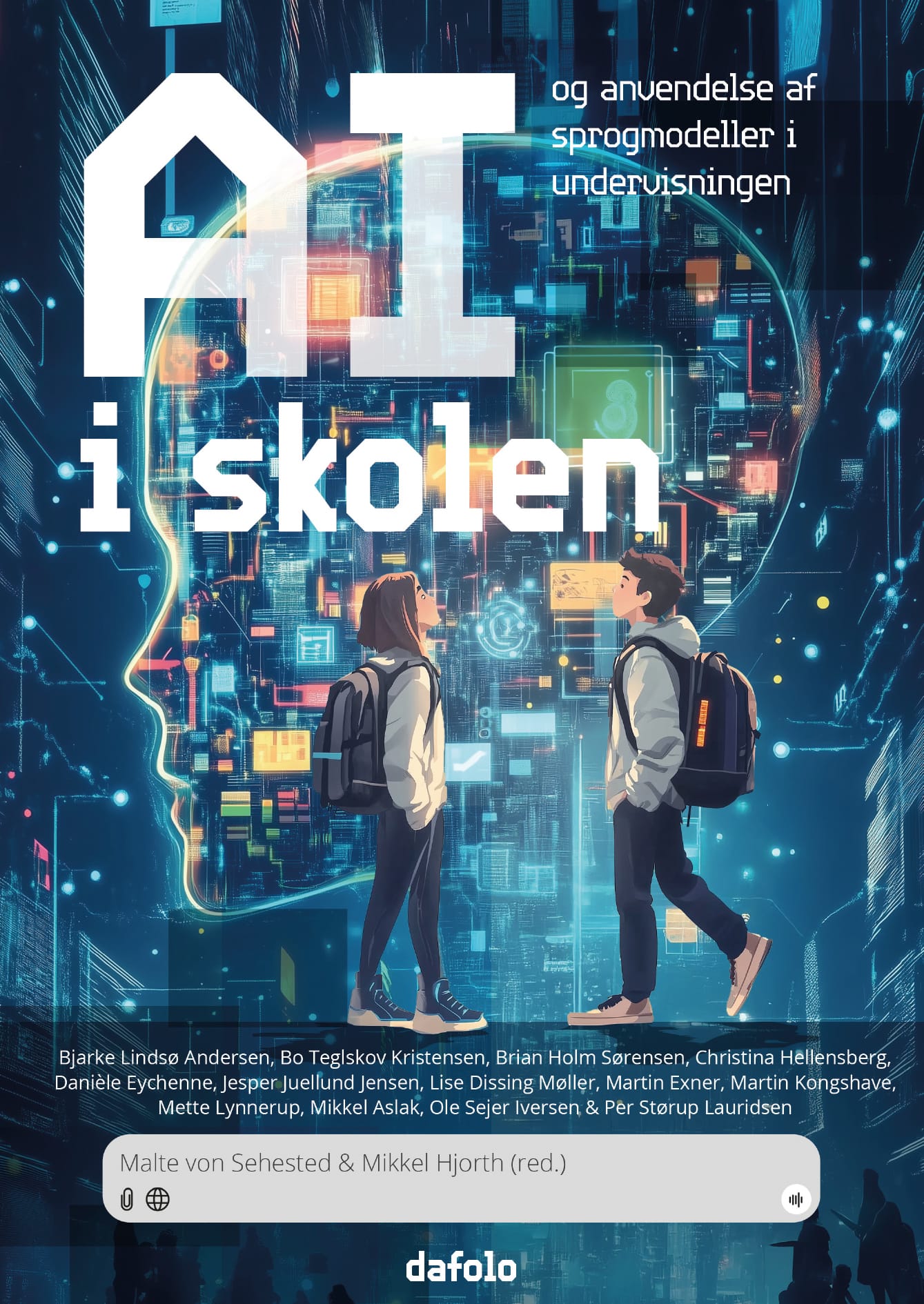
The book follows up on the anthology AI i skolen (Dafolo, 2025), which focused on the technology and on teaching in, about and with AI. It also closely complements Det umistelige: Pædagogik og dannelse med AI (Hans Reitzels Forlag, 2026).
While Det umistelige goes in depth with didactics through AI-aktivitetsskalaen (the AI activity scale) and FERC-modellen (the FERC model), this book explores leadership, strategy and organisation in depth.
Together, the two books cover the path from the classroom to the executive level.
Who is the book for?
The book is written for leaders and leadership teams in primary and lower secondary education and in upper secondary programmes, for pedagogical consultants and municipal administrations, and for the resource persons and advisers who help set direction for the school’s work with artificial intelligence. It is also relevant for teachers and subject teams who wish to understand how good shared frameworks are created. No technical prior knowledge is required—only curiosity and a willingness to tackle the task together with colleagues.
The book is grounded in practice
The book’s five accounts are based on conversations with leaders, consultants and practitioners from the participating schools and municipalities. The workshop programmes have also been tested with teachers and leaders at a wide range of schools. In addition, we draw on our own experience from teaching in the compulsory school, the upper secondary school (gymnasium) and vocational colleges, as well as from work with IT leadership, viden.ai and it-torvet.dk. For several years we have followed, tested and debated the use of artificial intelligence in teaching.
Facts about the book
- Title: Strategiske tilgange til AI i skolen – ledelse, strategi og retning med kunstig intelligens
- Authors: Malte von Sehested, Per Størup Lauridsen and Claus Scheuer-Larsen
- Foreword: Dorte Torp Andreas, Chair of Skolelederforeningen (the Danish Association of School Leaders)
- Publisher: Dafolo, 2026
- ISBN: 978-87-7234-518-5
- Extras: Activity sheets for the book’s five workshop programmes can be downloaded as PDFs from the book’s page at dafoloforlag.dk