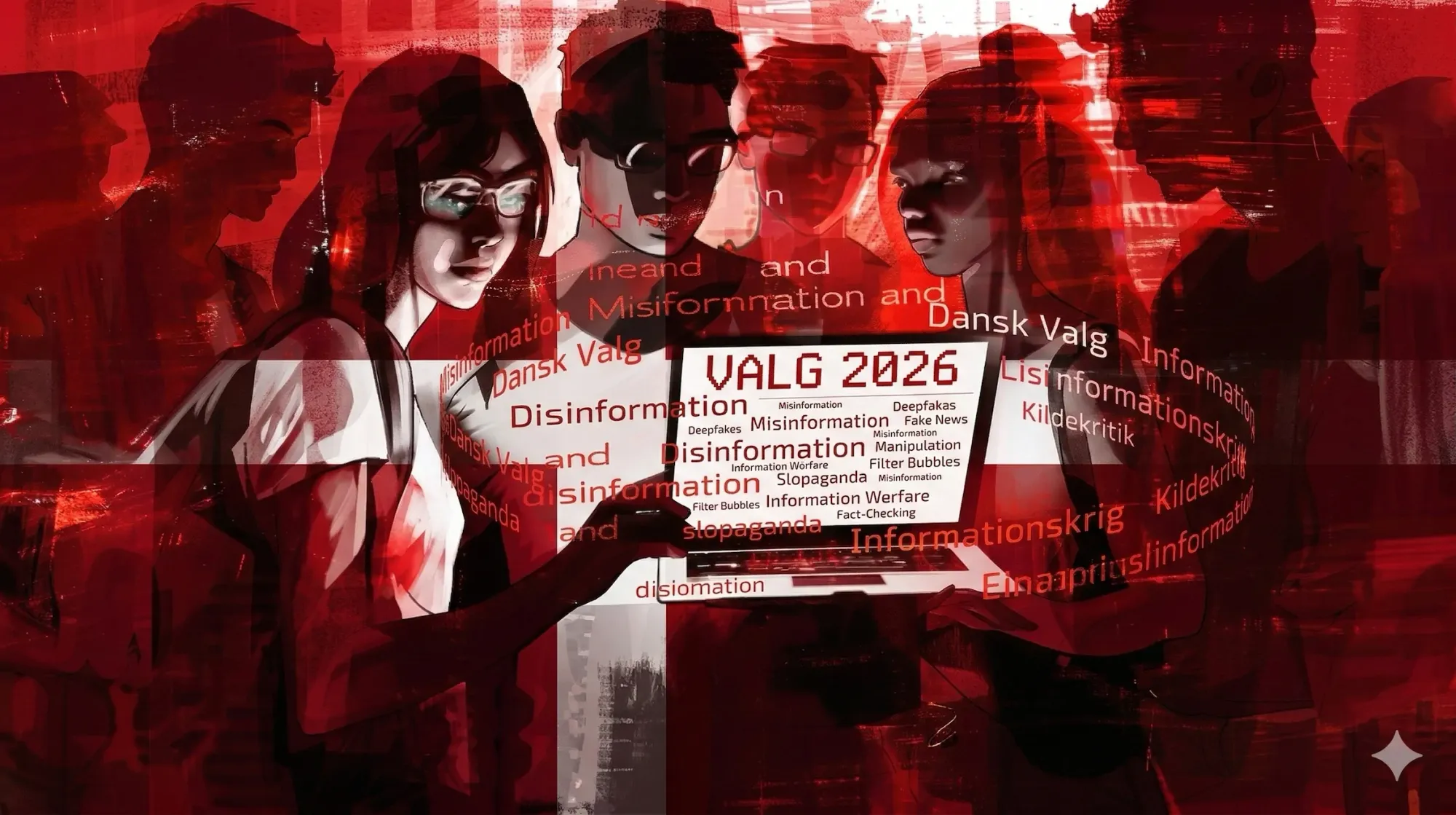
AI has become a central part of the modern election campaign. From humorous AI videos and chatbot recommendations to deepfakes and digital campaign assistants, the technology is changing the way voters encounter politics.
This article has been machine-translated into English. Therefore, there may be nuances or errors in the content. The Danish version is always up-to-date and accurate. Read the original Danish article here.
Artificial intelligence features prominently in the Danish election campaign and affects political communication, voter information and the spread of misinformation.
Several parties use AI to produce videos and other content on social media. Examples show politicians placed in humorous or fictional situations, which researchers call “slopaganda” – a blend of AI-generated content and political propaganda. The aim is particularly to reach young voters on platforms such as TikTok and Instagram, where traditional political messaging often struggles to cut through.
This is obvious teaching material across a wide range of subjects. Below, we have gathered a set of articles for use in teaching, focusing on how AI may influence the election.
In 2024 we wrote about mis- and disinformation, which can also prompt debate about AI and elections.
Social media and AI are creating a more fragmented media landscape in the election campaign, new SDU (University of Southern Denmark) study shows
Researchers from the Digital Democracy Centre have mapped how voters and politicians used digital media during the campaign leading up to the parliamentary election. Traditional media remain strong: 76 per cent obtained weekly information about the election through established news media, while 71 per cent say the same about social media. AI has also become part of voters’ information seeking. Almost one in five Danes – especially young people – have used a chatbot to learn about the election, and 5 per cent have used it to support their actual voting choice. At the same time, Danes are critical: 69 per cent dislike politicians using AI, and Associate Professor Curd Knüpfer, one of the researchers behind the study, describes a gap between voters’ scepticism and politicians’ actual use of the technology.
The study also points to a more segmented digital media landscape, where voters and politicians gather on different platforms depending on political alignment. Knüpfer explains that X and Telegram are used more by the right wing, while Bluesky is used by the left. The algorithms also favour well-known politicians, while local and less prominent candidates achieve limited attention. The researchers expect that political polarisation, the use of AI tools and the importance of influencers will all play a larger role in future elections.
AI videos and “slopaganda” mark the start of the election campaign
Rambo versions of Danish politicians and AI-generated videos are spreading on social media during the campaign. Researchers call the phenomenon “slopaganda” and point out that AI is changing the way political messages are communicated.
Parliamentary candidate uses AI as campaign manager
Can AI be a campaign manager in an election campaign? A Danish parliamentary candidate is now using artificial intelligence to write posts, develop strategy and produce campaign material.
Politics on social media requires more than slogans. A new analysis indicates that parties that understand the digital platforms find it easier to attract young voters.
Researchers warn: Chatbots can influence voters’ political choices
Can a chatbot influence where you put your cross? A test of ChatGPT and Snapchat’s MyAI shows that the answers may point towards particular parties. Researchers warn that the technology may affect voters’ decisions if used uncritically.
Google's AI may influence voters' understanding during the election campaign
Google's AI-generated answers now appear directly in searches about politics. But experts warn: the technology can both contain errors and be difficult to scrutinise. As a result, it could have a major impact on how voters orient themselves during an election campaign.
Deepfakes, fake news and thousands of automated profiles have influenced several European elections in recent years. Experts warn that Denmark’s parliamentary election in 2026 will take place in a new reality shaped by AI and digital influence campaigns.
AI-manipulated video featuring a Danish TV presenter used in Russian disinformation
A fake news item with an AI-manipulated voice of a Danish TV presenter was used in a pro-Russian campaign on social media. Experts warn that similar attempts at misinformation could become part of the Danish election campaign.
Should AI help you choose your candidate in an election? Democratic elections require personal judgement and critical thinking – something technology cannot replace.
An AI avatar has made it onto the ballot in Colombia. The project aims to use artificial intelligence to gather voters' views and translate them into policy decisions.
When voters ask a chatbot for help choosing a party, they may receive unexpected recommendations. A new study shows that Meta's AI highlights a much-debated election test that researchers consider politically biased.
Fictitious party with an AI leader aims to spotlight AI in politics
A new “party” with an AI leader has appeared in the middle of the election campaign. But the party is not real – it has been created as an experiment to show how quickly artificial intelligence can produce political content and spark debate about the role of technology in society.
Autonomous AI swarms can make political messages appear as genuine grassroots support. This can affect both voters' trust, perceptions of what the majority thinks, and the public debate.