Two Easy Solutions and One Hard Question from the 2026 Sorø Meeting
Impressions from the 2026 Sorø Meeting, where the education sector convened around AI. On the rapid-response package, technological literacy, and the tough question: What do we want school to be for?
This article has been machine-translated into English. Therefore, there may be nuances or errors in the content. The Danish version is always up-to-date and accurate. Read the original Danish article here.
On 6 and 7 August, the Minister for Children and Education, Magnus Heunicke, brought together around 130 people at Sorø Akademi (Sorø Academy) under the heading "AI in the education sector – the next steps". The entire sector was represented, from student union leaders and teachers to expert groups, subject committees and the social partners, and Birgitte Vedersø kept it all together as moderator.
In the participants' letter, the minister posed three questions that effectively formed the meeting’s agenda.
How do we support students’ competences in an age of AI?
What is the right balance between teaching with, in and without artificial intelligence?
How do we design examinations that still assess what we want them to?
I also took part in the meeting, and in what follows I will highlight some of the angles and perspectives that were discussed. For Claus Scheuer-Larsen and me, the days gained an extra dimension. Our new book, Det umistelige – pædagogik og dannelse med AI, was published on the very day the Sorø meeting started.
Stop the bleeding
When the minister took the floor, the message was clear. The bleeding had to be stopped here and now, and students are above all cheating themselves. This year’s advertising banners on lorries also jarred clearly in the minister’s eyes, especially those that advertised how ChatGPT had helped students. That same morning, the ministry had published its rapid-response package against AI cheating in the upper secondary school (gymnasium), including an oral defence of the SSO in hf, an encouragement to use screen monitoring during examinations and to have more written assignments produced at school.
One sentence in the minister’s justification for the rapid-response package stood out. AI must not undermine students’ “competences, subject knowledge and, not least, the ability to think for themselves”. That is precisely what we call the indispensable in our book. On that point we agree.
But the three initiatives deserve separate assessments. The oral defence of the SSO is a step in the right direction, because it makes the student’s thinking visible. More assignments done at school can also make sense. At Odense Tekniske Gymnasium, they are already experimenting with computers without internet access, where the text is sometimes the very basis for assessment, and where at other times students use AI as an editor for their own draft or for structure and ideas before they write themselves. All three moves make the process visible and bring back friction.
I am more cautious about screen monitoring. Control creates a race to circumvent it that we cannot win, and pulls the teacher into a policing role built on mistrust. Nuance is needed, though, because monitoring strengthens safeguards for students who today are mistakenly suspected simply because they write skilfully and thoroughly.
But the fundamental question remains. We should not ask “how do we detect cheating?”, but “how do we design learning so that cheating becomes irrelevant?”
To be honest, the first day was marked by an agenda of fear, where pen and paper were presented as the way to regain control in the short term. In the short term there were many answers, and in the longer term there were fewer. But fortunately the conversation did not stop at fear.
Two easy solutions and one hard one
After the welcome song and the government’s perspectives, the morning was devoted to Stefan Hermann, director of LIFE Fonden (the LIFE Foundation), who in my view delivered one of the more interesting contributions of the meeting. Three challenges, two of which are easy and one is hard.
The first of the easy challenges concerns examinations, and that is the one the rapid-response package addresses. The second concerns technological understanding as a core competence in school. And then there is the hard one:
What do we actually want school to be for?
Every time someone has tried to clear up the congestion of subjects, the result has been more abstract subject descriptions, not simpler ones. This is where the real work lies, and no rapid-response package can solve it.
His historical point is worth remembering. The school absorbed both radio and television, but artificial intelligence can do something more radical than merely distract. It can eliminate the learning itself, because the student can fetch the answer instead of learning.
And there is a sentence I have underlined in my notes. Digital literacy is not something separate, but part of general education on a par with reading, writing and arithmetic.
Order matters
Thursday afternoon opened with a report from reality. Sine Zambach from CBS (Copenhagen Business School) gave a much-needed overview of what the first studies indicate. If we learn a new topic with AI, we learn less than if we learn it without. But if we keep AI out after the basics have been secured, we also learn less. The sequence is crucial. First the foundation without AI, then the extension with AI. And thank you for the refresher on how a language model actually works.
Students are not cheating the system, but themselves
The student leaders then took the stage, and their voices were among the strongest at the meeting. One example from the conversation concerned classmates who used AI to structure their exam preparation. Et andet eksempel pegede i den modsatte retning, and a student recounted, how he had got AI to retell Iliaden in order to avoid reading the entire work. If all you need is to know the plot, that is unproblematic, but if the goal is deep engagement, then the learning itself is being outsourced.
The students themselves also delivered the meeting’s most telling image. Artificial intelligence has been let loose in the education sector like a fox in a henhouse.
Examinations or teachers first?
Late in the afternoon we divided into ten pedagogical workshops, from DR’s ULTRA:BYTES and SkoleGPT to the teacher-developed Spinna. The picture was clear. No school needs to start from scratch. Practice exists; it is just unevenly distributed.
A Norwegian study underlined why it is urgent. AI use was virtually the same in strategic and wait-and-see schools. Waiting simply means that use happens haphazardly and without a shared direction.
In the organisational debate that rounded off Thursday, the dividing line was clear, and it was between starting points, not people. The gymnasium organisations pointed to examinations, because examinations define the content of the subjects. The rest of the panel pointed to capacity-building for teachers, leaders and administrations. Both are right, but the order is a prioritisation that the strategy must take a position on.
Amish or Elon Musk?
One image lingered from the whole day. In his presentation, Stefan Hermann had presented the school’s direction as a scale between Amish and Elon Musk. And at the gala dinner it got its own melody. Bertel Haarder had written this year’s celebratory song to “Ølhunden glammer”, with H.C. Andersen’s artificial nightingale as the starting point and with both Amish and artificial intelligence rhymed into place. Heunicke responded with two extra verses to the same tune. And in his speech Haarder teased the Grundtvigian wing by saying that Grundtvig had in fact “pinched” the idea of a modern, living school from Holberg, whose legacy Sorø Akademi literally rests upon. There is a fine point tucked away in the teasing. Even the school’s greatest innovations stand on the shoulders of those who came before.
Friday morning in Estonia
Friday opened with a look abroad. Estonia’s AI Leap builds on OpenAI, but speaks Estonian, knows the curricula and acts as a Socratic guide rather than an answer machine, and the Estonians started with the teachers, not the students. That, incidentally, matches Sine Zambach’s point from Thursday about sequence. If we are to go that way here at home, it requires that everyone has good access to a Danish AI solution. And then there was the Estonian message that runs counter to the spirit of the times. In an AI era, knowledge becomes more important than ever.
Technological understanding is only waiting for the green light
Later in the morning, Ole Sejer Iversen and Ane Qvortrup unpacked the question of what students should be able to do in an AI era. Ole Sejer Iversen’s message was unmistakable. A national AI strategy should include a distinct and compulsory subject in digital technological understanding in the primary and lower secondary school (grundskole) and across all upper secondary programmes. It is a fourth basic competence on a par with reading, writing and arithmetic, and it is not about more screen time, but about more holistic education. In countries from Australia to Argentina the subject area is already compulsory. Here at home we have an elective and an integration into Danish, mathematics and science/technology, without teachers having been given the professional prerequisites, and on stx only 10 per cent opt for informatics. We do not, however, have to start from zero. Ole Sejer Iversen and Michael E. Caspersen have been developing the content for years, and on hhx Informatics C has been compulsory since 2017. What is really being waited for here is simply the political green light, and perhaps the light is changing, because there are now ministers who are openly positive. But if something is to go in, something else must come out of the timetable. That will be a tussle.
Speed obliges
Friday’s final debates drew the threads together. Employers, trade unions and the higher education sector were strikingly in agreement. The employees of the future must be able to use AI, but there is at least as great a need for people who can collaborate, participate in professional communities and see processes through to completion. And from the spokespersons’ panel there was an important counterweight. It is not only about what employers need, but also about what we need as whole human beings.
The minister ended with two statements that I choose to take as good news. Action must be taken quickly, and we must accept that some things will need to be changed along the way, for it is a greater failure to be too slow than to make mistakes in the rush. And the sector must be involved when the strategy is developed. We should hold him to both promises.
The day after
Ane Qvortrup subsequently summed up the meeting in five pairs of concepts. Past and future, short and long term, learning about and learning with, general and subject-specific use, and technology and didactics. Each pair embodies a balance to be found, not a choice to be made. The rapid-response package sits in the short-term corner. The rest of the fields remain open.
Two things strike me now that the dust has settled. The first is the distance between the conversation and the classroom. The debate is conducted at the strategic level, while reality emerges where a teacher on Monday morning stands in front of 28 students who have had AI in their pockets all weekend. The second is connected with the first.
The question of how AI should and should not be used in teaching was alive in the workshops and on the margins, but was largely absent from the main stage. One of the best conversations in the corridors was about what we learn when we learn with AI. Am I learning to generate ideas when I generate ideas with a chatbot, or am I learning to generate ideas with the chatbot? Conversely, a language chatbot that insists on speaking German can make me better at German, even when the screen is off. These are the kinds of pedagogical questions that cannot be answered by bans or by enthusiasm, but only through didactic decisions, subject by subject.
The main conclusion of our book is precisely this: the challenges of AI in school must be handled pedagogically, not through bans. Analogue activities can be a strong choice, but as an overall response they amount to opting out of preparing pupils for the reality they already inhabit.
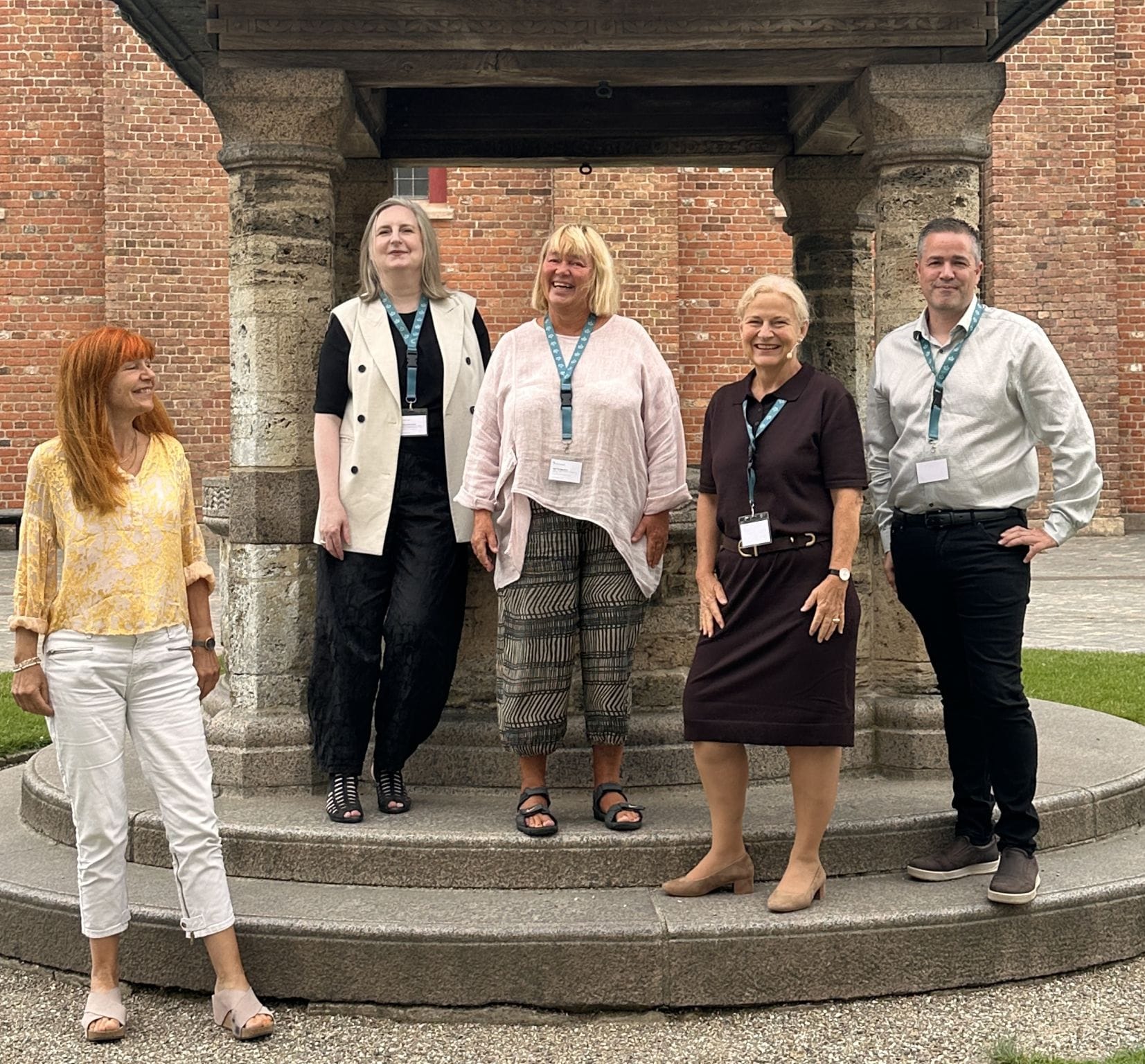
Some members of Ekspertgruppen for ChatGPT (the Expert Group on ChatGPT) in front of Fraterbrønden.
A personal highlight was seeing Ekspertgruppen for ChatGPT again. When the theme is "the next steps", it is worth revisiting the first step. A striking number of the questions raised in Sorø were ones we had already written about in our recommendations from April 2024, including that there should be exams both with and without digital tools. One recommendation is more pressing than ever: a genuine boost to continuing professional development across the sector.
The difficult question of why we run schools, and which values we wish to retain within them, cannot be answered by a quick-fix package or by a ministry alone. It was, however, posed loud and clear in Sorø. Now it must be answered out in the schools, and that work starts in the staffroom, with a clear eye on what is indispensable.