New EVA report: Nine out of ten use AI. Two-thirds have cheated. And we hardly teach them about it.
A new report from the Danish Evaluation Institute presents the most detailed picture to date of high school students' AI use. The numbers are unequivocal, and they should have consequences.
This article has been machine-translated into English. Therefore, there may be nuances or errors in the content. The Danish version is always up-to-date and accurate. Read the original Danish article here.
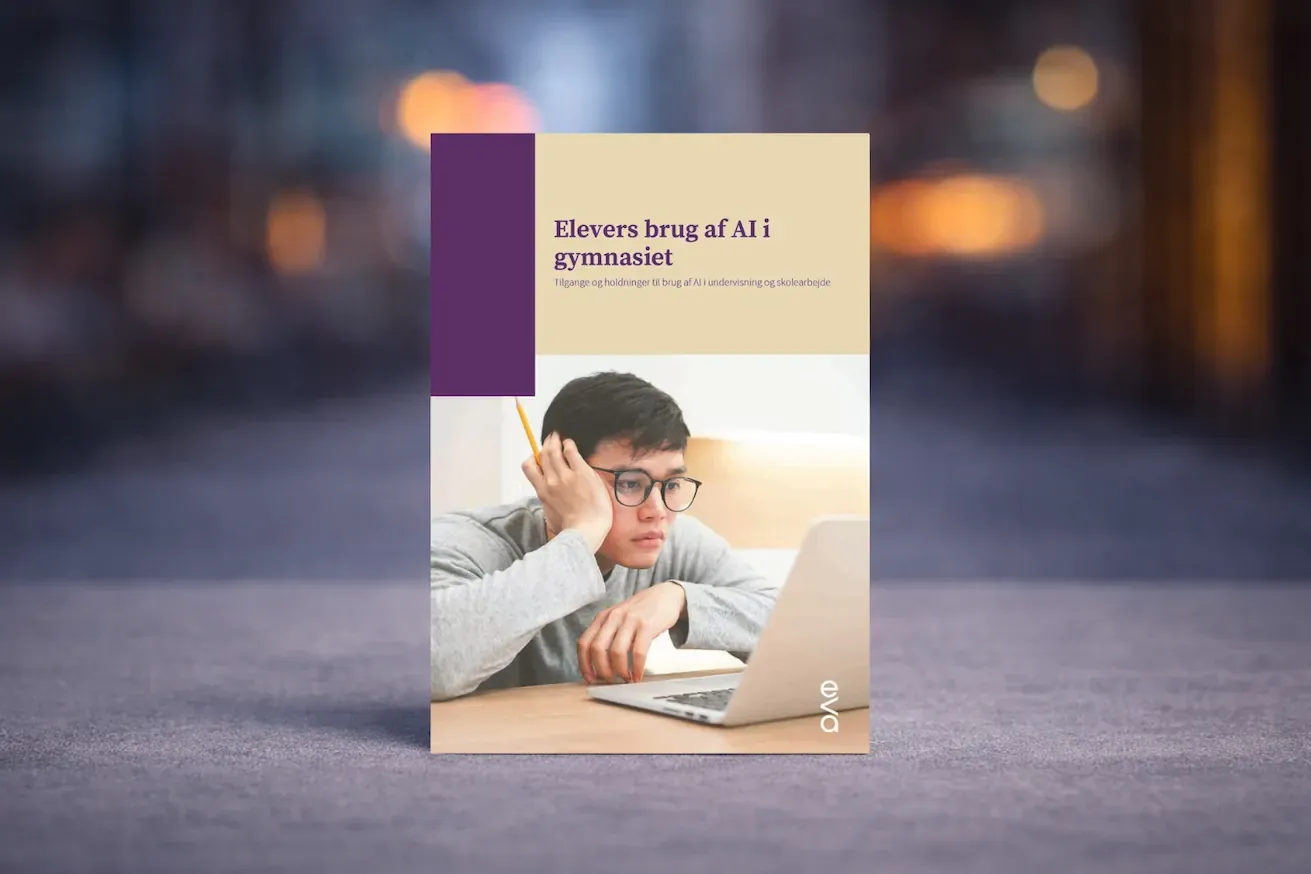
Danmarks Evalueringsinstitut (EVA, the Danish Evaluation Institute) has just published the report Students’ use of AI in upper secondary school (gymnasium), the most comprehensive study to date of how upper secondary students actually use generative AI. It is based on a survey of 1,411 third-year (3.g) students from stx and hhx and covers the first cohort to have had AI available for virtually their entire time at upper secondary school.
The conclusion is unmistakable. The gymnasium is at a “challenging crossroads”: on the one hand, AI has become an integral part of students’ everyday school life, while on the other hand the gymnasium is subject to policy frameworks developed at a time when AI was not yet a factor. EVA calls for action on two fronts: one political and one practical.
In this article, we review the key findings.
AI is everywhere
About nine out of ten students use AI tools in their schoolwork. A third do so daily. Only 7% never use them. Students mainly use them to have concepts and subject content explained, to summarise set texts, and to answer tasks in group work. For submitted assignments, the most common uses are to get ideas for content and structure (55%), to brainstorm themes (48%), and to obtain feedback on a text the student has written themselves (47%). It is also common to let AI write entire paragraphs, which the student then edits.
There is therefore no longer any meaningful discussion about whether students use AI. They do. The relevant discussion concerns how they use AI.
Cheating is widespread
Two thirds of students report that they have used AI to cheat in individual assignments at least once during their time at the gymnasium. 16% have done so ten times or more. For group work during lessons the figure is even higher: just under nine out of ten have cheated in group work.
Students also have a clear sense of when something counts as cheating. On average, they believe you may copy just under a quarter of an assignment from an AI-generated draft before it is considered cheating. At the same time, a little over 60% would accept submitting a task where AI has written parts of it, even though on average they would first change 86% of an AI-generated draft.
The report also uses a so-called list experiment – a method for uncovering sensitive issues where the respondent does not have to admit the behaviour directly. The experiment confirms that students’ self-reported cheating is not exaggerated but rather conservatively stated. In other words, the real figures are probably higher.
Classmates influence each other
One of the report’s most interesting findings concerns a contagion effect. Through a survey experiment, where students were randomly divided into three groups and given different information about classmates’ AI use, the report shows that only 21% of students would to some or a great extent use AI for an assignment if no one else in the class did. The figure rises to 40% when students are told that many of their classmates use AI. That is an increase of 19 percentage points driven solely by perceptions of what others do.
Just under half of students (46%) are to some or a great extent worried that classmates’ AI use makes it harder for them to get good grades. Around two thirds think that more than half of their classmates have cheated with AI. One fifth think that all their classmates have done so. Only 1% think that none of their classmates have cheated.
EVA points out that this may be a false majority perception. Students overestimate the extent of their classmates’ use and therefore feel entitled or compelled to use AI more uncritically themselves. This creates a spiral where the notion that “everyone else is doing it” becomes self-reinforcing.
AI exacerbates inequalities
The report also measures the extent to which students outsource tasks to AI at the expense of their own engagement and learning. It turns out that boys, students from hhx, and students with low grades from compulsory school score significantly higher – even when controlling for background and parents’ education level. Specifically, these groups score between 0.5 and 0.7 points higher on the report’s index.
This finding should give pause for thought. The students who already have the weakest academic foundations are those who most frequently use AI in ways that can be characterised as problematic. As the report puts it, this points to a risk that the technology may amplify existing differences in the preconditions for learning.
Students are well aware
40% of the students who use AI for schoolwork feel that it makes them lazy to some or a great extent. 31% feel they become dependent on the technology. Around a quarter feel they lose creativity (25%) or find it harder to immerse themselves in texts (26%). Girls are generally more concerned about the negative consequences than boys, which may help explain why boys use AI more frequently and in more problematic ways.
Among the 7% of students who do not use AI at all, it is primarily fear that drives the choice. 71% are afraid of being caught cheating, 60% say teachers forbid it, and 60% are worried it will harm their learning. More than half of non-users (57%) are also worried that they would become lazy if they started using AI.
Students are not naive. They can feel that the technology affects their learning. But they lack tools to manage it.
We hardly teach them about AI
80% of students received teaching about AI less than once a month in the 2024/25 school year. Of these, 30% received no teaching about AI at all. Two thirds (65%) have never had a longer unit of work on AI, such as a theme week or a project.
At the same time, two thirds of students want more teaching than they get. 39% want teaching at least once a month, and 19% at least once a week. Only 10% want no teaching about AI at all. The humanities are the subjects where students most often experience that AI is addressed in teaching (41%). The social sciences follow (30%). STEM subjects lag far behind at just 12%.
There is a marked mismatch between students’ use of AI and the guidance they receive.
Guidelines are perceived as unclear
The report also shows that students’ perceptions of the gymnasium’s guidelines on AI are divided. 39% feel to a great extent that the guidelines are clear, while 31% feel the opposite. Just under a third place themselves somewhere in between.
Given that we also know the contagion effect is driven by uncertainty and perceptions of what others do, unclear guidelines are not just an administrative challenge but a direct driver of problematic use.
What does the report call for?
EVA points to the need for action on two tracks.
The political track concerns the need for central guidelines that acknowledge the new reality. The report points to the need to consider how AI can play a role in the purposes of upper secondary education regarding general education, knowledge and competences. The advent of the technology raises questions about subject aims, pedagogies, exam formats and assessment criteria in individual subjects.
The practical track is about gymnasiums developing local guidelines that align students’ and teachers’ understanding of cheating and problematic AI use, counter false majority perceptions, and meet students’ desire for more teaching. EVA specifically notes that the risk of inequality can be addressed by teaching how the technology can be used critically and in ways that support learning in individual subjects.
The ball is in the schools’ court
The political track takes time. The practical track, however, will not wait for Christiansborg (the Danish Parliament). The report’s findings are unequivocal. Students already use AI extensively. Many do so in problematic ways, the most vulnerable are hit hardest, and two thirds of students themselves are asking for more teaching than they get. The figures should also give pause for thought to those who have argued that bans and detection tools are the way forward.
When the primary reason students choose not to use AI is fear of being caught, we have created a culture where students take their AI use underground instead of being equipped to use the technology sensibly.