AI is the area where the most upper secondary teachers want professional development
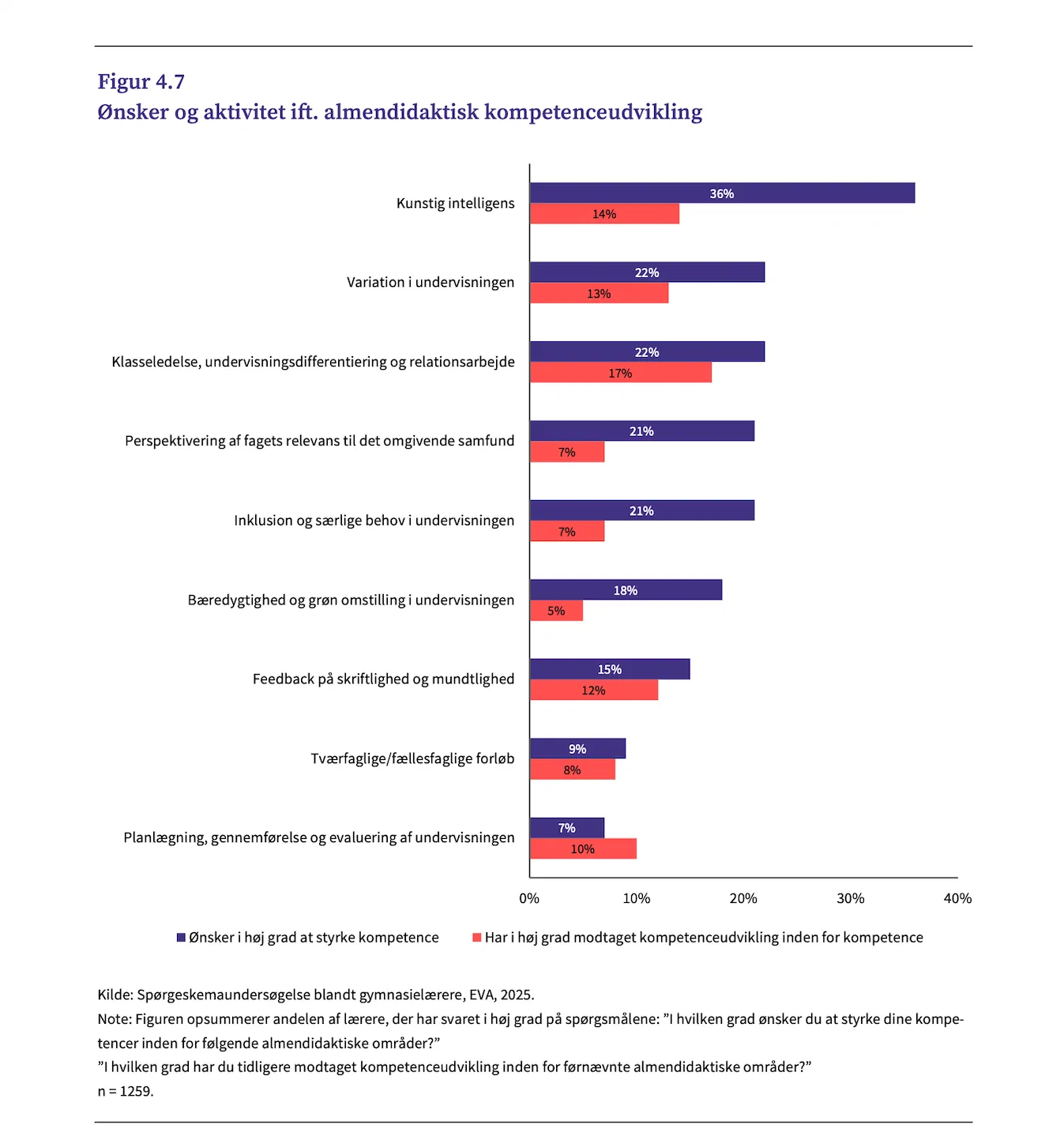
EVA's new report shows that 36 percent of upper secondary teachers strongly want more professional development in AI, making it the most in-demand area within general pedagogy.
This article has been machine-translated into English. Therefore, there may be nuances or errors in the content. The Danish version is always up-to-date and accurate. Read the original Danish article here.
A new report from Danmarks Evalueringsinstitut (the Danish Evaluation Institute) titled Upper secondary school teachers’ continuing professional development in practice shows that AI is the area where the largest number of upper secondary school (gymnasium) teachers want more continuing professional development (CPD). 36 per cent of teachers say they very much want to strengthen their AI competencies, while only 14 per cent have previously received that type of CPD.
This places AI ahead of classroom management, differentiated instruction and variety in teaching, which have traditionally featured prominently in debates about teachers’ competencies. The study is based on responses from 1,259 teachers and 243 school leaders, as well as case visits to a number of upper secondary schools.
The report also shows a clear pattern across levels of seniority. The most experienced teachers are the ones most likely to request AI competencies. 40 per cent of teachers with 20 years’ seniority or more very much want more CPD in AI, compared with 29 per cent among those with under five years’ experience. According to the report, this difference is linked to the fact that younger teachers have themselves received more AI‑related CPD along the way.
By subject area, the need is greatest in the humanities, where 40 per cent want stronger AI competencies, compared with 38 per cent in the social sciences and 30 per cent in the natural sciences. At leadership level, the picture is even clearer. 89 per cent of school leaders have put AI on the agenda in school‑based professional development over the past three years, making it the highest‑priority theme.
In the interviews, teachers and school leaders say that AI is both about dealing with cheating and about harnessing the technology’s potential in teaching. One teacher describes how an entire class submitted assignments written with AI, which differs markedly from earlier, when only a few students copied from one another. The same teacher, however, thinks it would be a shame if the solution were to go back to pen and paper. Others use ChatGPT as a practice partner for argumentation theory or as a learning assistant for calculations.
Across the interviews, the message is that teachers miss concrete guidance and feel that responsibility for AI is placed on the individual without clear guidelines from the ministry. The school leaders confirm this picture and call for a shared strategy, so that the handling of AI is not left to the individual teacher. In the summary, EVA recommends maintaining and strengthening AI as a theme for CPD going forward.