OpenAI's education strategy - what we must not repeat from social media
OpenAI has launched a new framework to measure learning. But behind the pedagogical terminology is a familiar social-media logic that threatens to take over the definition of good education.
This article has been machine-translated into English. Therefore, there may be nuances or errors in the content. The Danish version is always up-to-date and accurate. Read the original Danish article here.
In this article, I delve into the blog post that OpenAI published titled New tools for understanding AI and learning outcomes. The project looks like a robust research initiative in collaboration between Stanford and the University of Tartu in Estonia, aimed at measuring how AI affects learning over time. Here they have developed a framework called the Learning Outcomes Measurement Suite.
It is professionally interesting to me because, in my own master’s thesis in 2017, I built a platform to collect data about students and provide feedback to teachers. I will return later in the post to what I found.
But in relation to OpenAI’s blog post there was something that caught my attention, and something I have not seen others write about.
Nestled in the middle of the text is a sentence that reveals something far larger than the project they describe.
We have been building a structured measurement system to measure AI's impact on learners at scale, and create a mechanism to improve models based on those outcomes.
Read it again. It is two things in one sentence: measuring learning at scale and being able to train the models on those data. That is not a side effect. It is the business model.
The logic of platforms
In the education sector we should be wary of the mechanisms we know from social media, where a platform offers a free service and users flock to it. After a while, as users generate lots of data, the platform uses it to improve the service. That brings new users and even more data. The loop closes and accelerates.
That is exactly what I see in the quotation above. OpenAI is building the same loop—only with learning instead of attention.
ChatGPT is the tutor, study mode is the pedagogical interface, and the Learning Outcomes Measurement Suite collects data from every interaction. The model gets better each time it runs, which makes it more attractive for the next school, the next ministry and the next country.
Right now it is being rolled out at scale in Estonia, where almost 20,000 students aged 16 to 18 have used it for several months. Estonia is not a random choice. The country has a digital-first education culture and actively serves as a proof of concept for the tech industry. That gives a precise picture of the power relation at play. And it is something people in Denmark are already looking at with interest. Among others, the IT union PROSA (the Danish IT professionals’ union) directly urges following the Estonian model.
What is good learning?
The big question is, in fact, quite simple. Who defines what good learning is?
Traditionally the answer has rested with teachers, professional communities, ministries and educational research. It has been imperfect, slow and marked by disagreement, but it has been a democratic process.
In OpenAI’s framework, what constitutes a “good learning interaction” is defined. Classifiers are built to score them, and a model is optimised towards those scores. It is no longer a tool that helps with learning. It is a system that shapes what learning is.
Reading the framework closely, they measure, among other things, autonomous motivation, task persistence and metacognition. That sounds like concepts drawn from learning theory. But in practice it means that an AI model assesses whether a student is sufficiently independent, persistent and reflective, and that the model is then optimised towards those judgements.
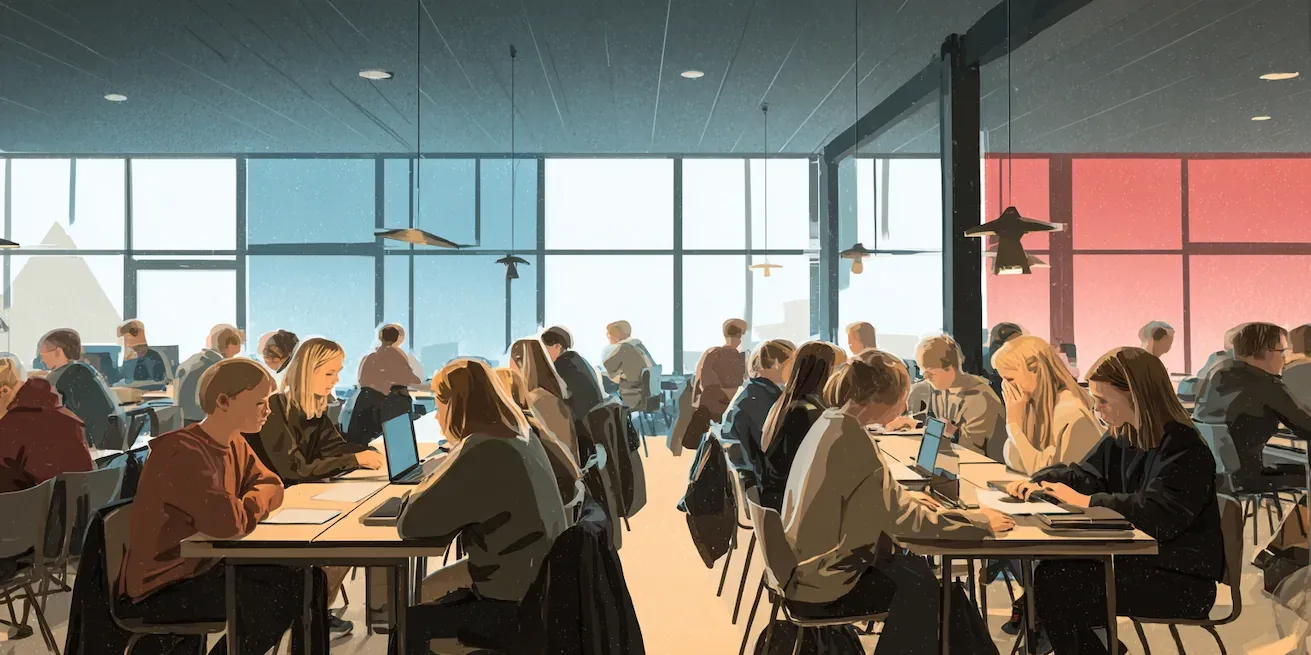
Illustration: OpenAI
OpenAI themselves write that systems and educators should be empowered to manage trade-offs in line with pedagogical best practice. That sounds reassuring. But intentions and infrastructure are two different things. Once the measurement system is built, the classifiers defined and the platform adopted at national scale, it is hard to steer around the categories already laid down.
If OpenAI’s framework becomes the standard for how AI‑based learning is evaluated, we will end up letting a tech company define what good learning is. Not by force, but through infrastructure. When a measurement system is sufficiently widely adopted and integrated into a platform already used by hundreds of millions, it becomes, in practice, hard to define success in other ways.
That is exactly the dynamic we have seen with social media. No one decided that likes should be the yardstick of social recognition. But the platform’s architecture made it the inevitable metric.
Measurement must not become an end in itself
Gert Biesta has written an entire book titled God uddannelse i målingens tidsalder. His point is simple:
When measurement becomes the goal, it stops being a good measure.
The danger is not that OpenAI measures too little. The danger is that we start to confuse what can be measured with what actually matters.
I encountered this problem myself in my thesis in 2017. I experimented with machine learning to analyse formative feedback data and built visualisations such as radar charts and a “learning pulse”. What I learnt was that the visualisations introduced an extra layer between teacher and student and captured surprisingly little of what actually happened in teaching. Not because the technology was poor, but because learning in practice is messy, relational and context‑bound in ways that dashboards cannot capture.
OpenAI’s framework is far more sophisticated than what I built back then, but the fundamental challenge is the same.
Social media taught us what happens when we leave the definition of human interaction to platform logic. Now it concerns something even more fundamental: the way we learn.