This article has been machine-translated into English. Therefore, there may be nuances or errors in the content. The Danish version is always up-to-date and accurate. Read the original Danish article here.
Styrelsen for Undervisning og Kvalitet (the Danish Agency for Education and Quality, STUK) today published new recommendations to guide leaders and teachers in upper secondary schools (gymnasier) and in general subjects in vocational education and training to use generative AI in teaching in a balanced and appropriate way.
Download the recommendations for upper secondary education here.Download the recommendations for general subjects in vocational education and training here.
The recommendations have been developed in close collaboration with teachers, students, external experts and practitioners in the field of education.
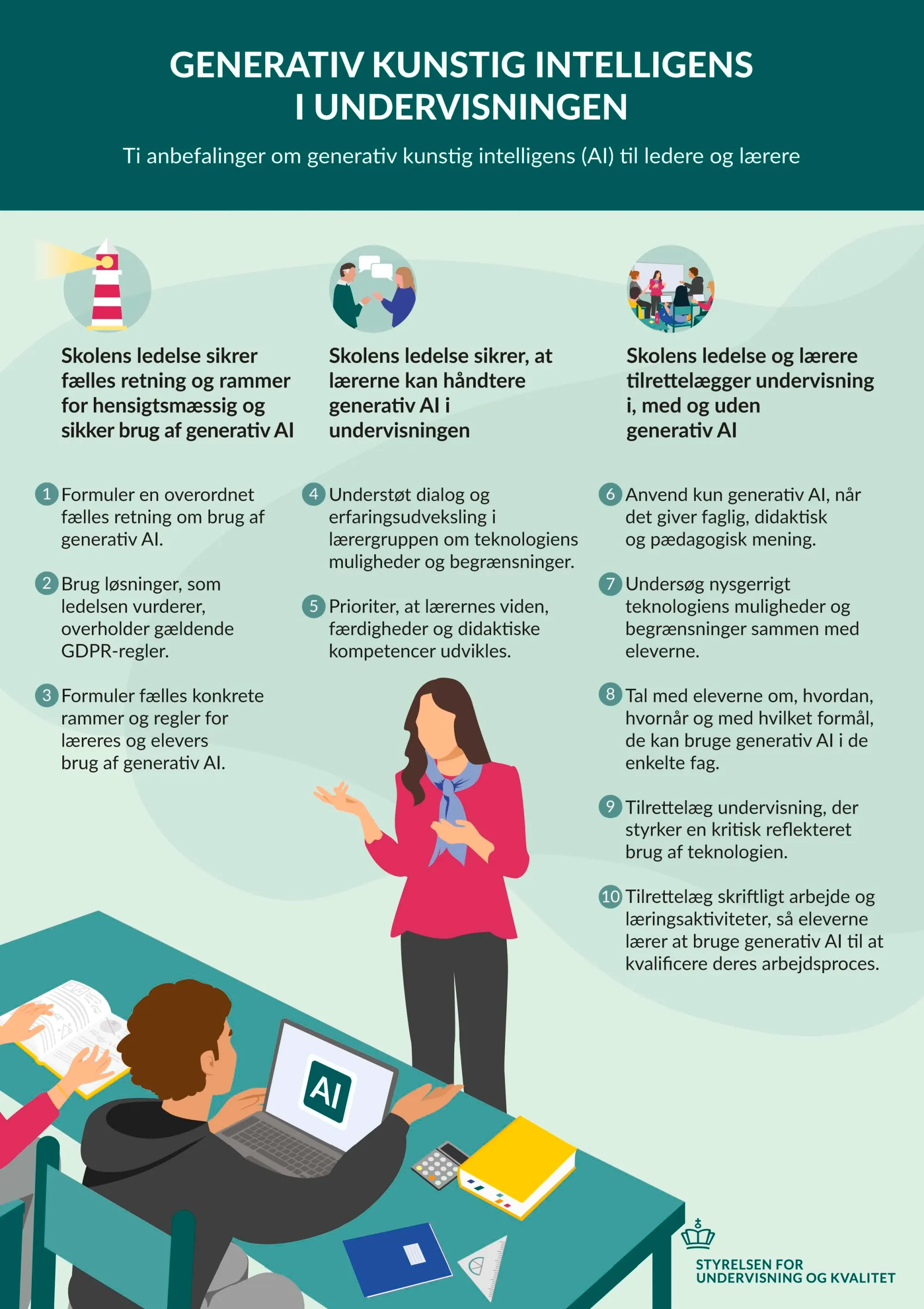
They include concrete guidance within three main themes:
Professional development for teachers For teachers to handle generative AI effectively in teaching, the school leadership should prioritise dialogue, sharing of experience, and the continual updating of teachers’ pedagogical competences. Teachers need to understand both the possibilities and limitations of the technology and be able to guide students in a balanced use of AI that enhances the learning process.
Teaching that develops students’ competent use Generative AI should only be used when it makes sound subject and pedagogical sense. Teaching should strengthen students’ critical judgement of the technology and their understanding of responsible use. Examples include focusing on process rather than product and setting tasks that challenge students to reflect on the role of AI in their work.
Clear framework for the use of generative AI The school leadership is responsible for formulating a shared strategy and clear framework for how generative AI can be used at the school. This involves choosing solutions that comply with GDPR and setting clear rules for teachers’ and students’ use, for example what is considered cheating. Involving teachers and students promotes ownership of the rules.
Overall, the recommendations suggest that schools teach students both about, with and without generative AI. The technology should be seen as a pedagogical tool that can strengthen learning and digital literacy when used thoughtfully. At the same time, it is emphasised that students must be able to navigate a society in which AI plays a central role, and avoid pitfalls such as plagiarism and inappropriate use.
Finally, Styrelsen for It og Læring (the Danish Agency for IT and Learning) is working on guidance on AI and GDPR, which is expected to be published in the first half of 2025.
Page 8 with an overview of all 10 recommendations - Source: STUK