This article has been machine-translated into English. Therefore, there may be nuances or errors in the content. The Danish version is always up-to-date and accurate. Read the original Danish article here.

EVA (the Danish Evaluation Institute) has just published a report that focuses on how to ensure fair and meaningful assessment of students’ subject competence at a time when AI has become an integral part of everyday life for upper secondary school (gymnasium) students.

The report was commissioned by Styrelsen for Undervisning og Kvalitet (STUK, the Danish Agency for Education and Quality) and is based on interviews with teachers and school leaders from 12 upper secondary schools, input from universities, and a thorough literature review.

Four new guiding principles for assessment

EVA points to four approaches that several teachers are already experimenting with to strengthen the validity of their assessments:

  • Focus on students’ core subject competence
    • Basis for assessment: Writing exercises with pen and paper, or tests without aids, and task descriptions deliberately designed so that the task is difficult to answer using generative AI. 
    • Assessment focus: Basic subject competences. 
  • Focus on students’ work process
    • Basis for assessment: Project work and open-ended tasks.
    • Assessment focus: Students’ engagement in a task process, focusing on more advanced subject competences, including meta-competences such as critical thinking, curiosity, and reflection on their own learning. 
  • Focus on oral communication
    • Basis for assessment: Oral presentations and group discussions, or videos and podcasts as a supplement to written products.
    • Assessment focus: Basic subject competences in relation to oral communication, and whether the students’ oral presentation indicates that they have worked independently on their written product. 
  • Focus on students’ interaction with generative AI 
    • Basis for assessment: Appendices in connection with written assignments, where students attach their prompts and, where relevant, their reflection on how they used them to improve their assignment. 
    • Assessment focus: Students’ use of learning-support prompts, including whether the students’ prompts indicate that they have used generative AI as a constructive sounding board in developing their assignment, or as a tool to outsource the production of parts or all of the assignment. 

New challenges and shifts in the teacher’s role

The report emphasises that it is increasingly difficult to determine whether a piece of work has been written by a student or generated by AI.

Some students deliberately insert small errors into their work to avoid suspicion of AI use. That says something about the fundamental doubt the technology has introduced.

This reflects the fundamental uncertainty that the technology has introduced.

It also means that many teachers are intensifying the use of familiar approaches: oral work, process, and tasks without aids – not as a return to earlier practice, but as a route to more nuanced assessment.

What does this mean for future examinations?

EVA’s report suggests working more with forms of examination that combine written and oral elements – or examinations with and without aids.

This also aligns with the expert group’s recommendations from 2023: that examinations should rest on two pillars, so that we assess both students’ basic skills and their ability to navigate a digital landscape.

Read the report here:
Download the report here: https://eva.dk/udgivelser/2025/mar/kortlaegning-af-bedoemmelsespraksis-i-gymnasiet-i-lyset-af-generativ-ai
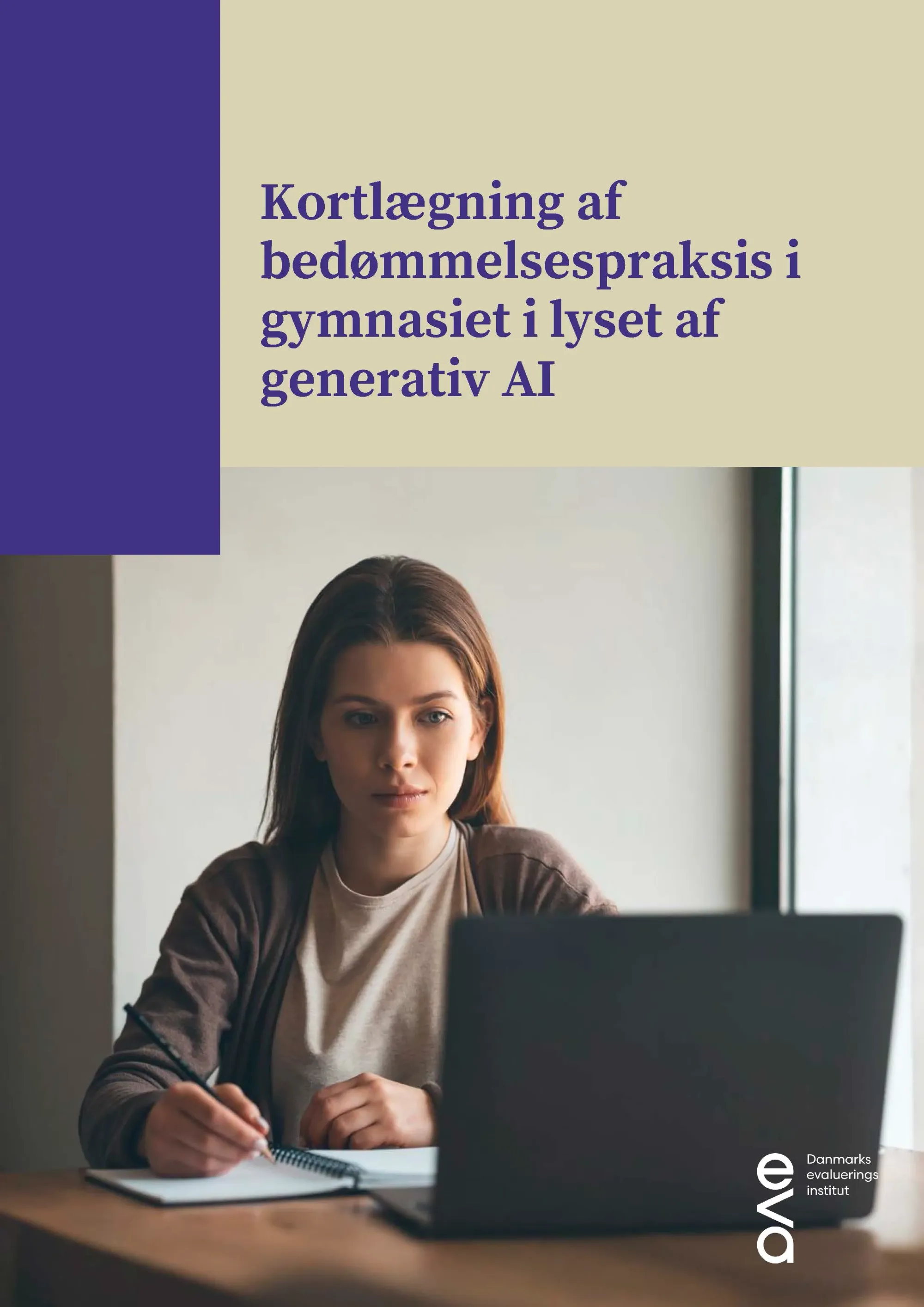
Kortlægning af bedømmelsespraksis i gymnasiet i lyset af generativ AI
This publication provides insight into how upper secondary schools’ assessment practices regarding written composition have changed since the emergence of generative artificial intelligence.

Share this post

Written by

Per Størup Lauridsen
MSc in IT | Co-founder of Viden.AI | Head of IT and Communications at TietgenSkolen