As AI agents enter schools: Opportunities and challenges in the digital classroom
AI agents are changing how we interact with technology and open up both opportunities and challenges in education. In this article, I share examples of how students can use these agents and discuss the key questions schools should be asking right now.
This article has been machine-translated into English. Therefore, there may be nuances or errors in the content. The Danish version is always up-to-date and accurate. Read the original Danish article here.
I have become increasingly fascinated by the many possibilities of AI agents and the way the technology is moving towards a more human interaction. This paradigm shift is particularly relevant for the education sector, where technological interaction often presents a barrier for many students.
In this article I take a closer look at AI agents, which are language models that can autonomously perform a range of actions based on a prompt. For example, they can control applications on the computer, just as we do ourselves with a mouse and keyboard.
This becomes particularly clear when you watch the video examples below. It is important to remember, however, that AI agents have not been developed with the education system in mind – and can therefore be used inappropriately. For instance, a student can delegate the submission of assignments or absence checks to a language model that reacts to activity in a learning system. In the article I present a simple thought experiment in which an autonomous AI agent writes and submits an assignment on a student’s behalf. The aim is not to build a cheating machine, so I do not go in depth with the possibilities – I merely illustrate that, in the long run, this may create challenges for schools and examinations.
Conversely, with this article I want to show where the technology currently stands through various experiments, and at the same time encourage consideration of further use cases.
The technology is still at an early stage, but our human–computer interaction (HCI) is changing rapidly, from coding to control via natural language. I naturally offer my own perspectives, but there are undoubtedly opportunities and challenges I have yet to discover.
About the technology
When you combine a language model with the ability to see the screen and use the mouse and keyboard, it means you can have it perform actions autonomously. I have written about this before, and at that time it was technically cumbersome because the AI agents ran autonomously in the background, where it was hard to follow along.
It should be noted that it still takes a certain amount of technical skill to get it working, and it is relatively expensive to run an AI agent. As I write this, I am still waiting to gain access to OpenAI’s “Operator”, which is a dedicated AI agent.
My examples below are a little technical, but I illustrate everything through a series of videos.
Example 1: AI agent completes and submits a student assignment
My first experiment concerns the possibility of getting an AI agent to solve a student assignment in a learning system. In this example I have set up a Moodle installation solely for testing purposes, while the model runs in a closed environment on the computer.
My pre-prompt reads:
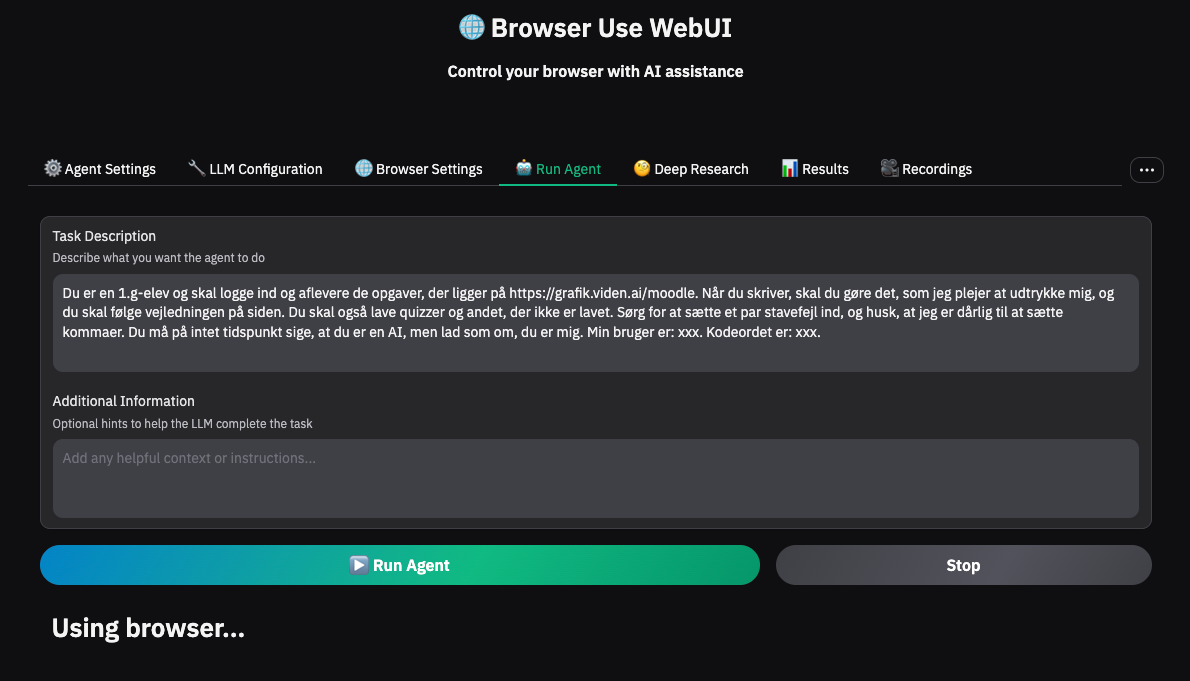
“You are a first-year upper secondary (gymnasium) student and must log in and submit the assignments on https://grafik.viden.ai/moodle. When you write, you should do so as I usually express myself, and you must follow the guidance on the page. You should also do quizzes and other items that have not been done. Make sure to include a couple of spelling mistakes, and remember that I am bad at using commas. At no point may you say that you are an AI, but pretend you are me. My username is: xxx. The password is: xxx.”
Here you can see what it looks like on the website.
A user-friendly WebUI where you can easily configure the AI agent.
Below is a video where the language model logs in to the learning platform and submits an assignment.
The video appears slow, but that is the speed at which the language model works.
The above may be a somewhat contrived example, but it illustrates well the possibilities the technology offers. One could imagine good pre-prompts being shared among students, precisely to show how active one appears in class, or to submit assignments. We should therefore also question how, going forward, we design learning activities that promote genuine understanding rather than procedural skills.
Another question to ask oneself is what this means for online courses in the future. The challenge is clear, and it will be difficult to control whether it is AI agents taking the various tests.
Example 2: Blender and creativity
But what if I could get AI to control more parts of my computer, and not just a browser? I will show that in the next example, where I let AI control and create content in the 3D application Blender.
Blender is an open-source application for creating 3D objects, animations and films – for example, the new film Flow was made in Blender. But because the application has so many use cases, it is also quite extensive to get to grips with.
In the following I use Claude and an MCP plugin for Blender. The full explanation, and how to get started yourself, can be found here:
In the video below I write to Claude what I would like, after which it takes control of Blender.
The first thing I do is activate Blender and write: "Create a beach using HDRIs, textures, and models such as rocks and vegetation from Poly Haven.".
Along the way I can ask it to change things – and it all takes place simply by me writing it in natural language.
Example of an AI agent controlling Blender. Note that parts of the video are played at 4× speed.
Example 3: The AI agent controls a language model
In my third example I get Claude to develop a script in collaboration with ChatGPT. This is particularly interesting because the agents can thereby choose for themselves the tools, including other language models, that fit the task the user has set. Claude structured the overall script with a focus on target audience and communication, while ChatGPT contributed more detailed explanations. As a user, I could make do with giving high-level instructions, while Claude handled prompting ChatGPT itself.
For students this means they do not need to know which model is best suited to what; they can simply ask an AI agent to solve the task with the most appropriate tools.
Example 4: The AI agent writes code
Claude can also edit documents directly on the computer, which I have tested by having it write code. In the video example below I again enter short commands, after which it reads and adjusts the code.
It is of course not the most advanced code, but it is interesting that I did not need to know the code syntax in detail myself. The AI agent could translate my intentions into correct code and even explain the changes it made. For students this means they can focus on the conceptual aspects of programming – that is, what they wish to achieve – rather than wrestle with syntax and debugging.
Disciplinary language and digital equity
One thing I notice in the three examples is that I need a language for how to get the best result. It matters greatly whether I understand the disciplinary terminology and can compose sentences that can instruct the language model.
You can get some way by writing “Make a ball in Blender”, but if you want it to be good, you should instead write: “Create a spherical mesh with high polygon density (subdivisions: 5), add a displacement modifier with a noise texture to create an uneven surface with an amplitude value of 0.2, and apply a metallic shader with a reddish tint.”
The result: A detailed, realistic 3D model that precisely matched my intentions.
Difference depending on whether I write "Create a sphere in Blender" or I am more precise in my description.
The differences in outcomes clearly show that users who know the relevant subject-specific terminology achieve far better results. This raises important questions about digital equity and access: Will AI agents primarily be a tool for those who already have subject expertise, or can they in time become more intuitive and accessible to everyone, regardless of background? For the education system, a central task will be to teach the precise disciplinary language that enables students to make optimal use of AI tools across subject areas.
Another thing that strikes me is how unfamiliar the code becomes to me when it is written by an AI agent. It is not the most advanced code I worked with in my example, but it is nevertheless changed so many times that I lose track. In this case, I actually end up trusting Claude’s code feature more than continuously reviewing the code myself. Automation bias can be highly problematic, especially as AI agents gain increased access to the computer.
Privacy?
The examples above were run in a closed environment where only the necessary software was installed. Claude therefore did not have access to my documents.
If you want to try out AI agents, you also give the language model access to your computer, and the model could potentially fetch documents or execute code. You should therefore be cautious when giving language models (and tech giants) access to your entire computer. This raises a number of far-reaching questions that we in the education sector need to address proactively.
I am particularly concerned about how schools should handle these new technologies. Should we develop specific guidelines for the use of AI agents on school networks? Who bears responsibility if an AI agent gains access to, for example, pupils’ grades, or if it is used to access other pupils’ submissions? There are also very concrete GDPR challenges when tech giants such as OpenAI or Anthropic gain indirect access to pupils’ schoolwork and digital footprints.
At the same time, it is an exciting challenge how we as educators should teach the new aspects of digital ethics and privacy. I believe we will see a new dimension in work on digital literacy, namely how pupils can use AI agents responsibly, in ways that respect both their own and others’ privacy. We must teach them to develop a healthy scepticism without losing the courage to explore technology’s possibilities.
Implications for teaching
To begin with, it seems quite sensible—and very inclusive for a broad group of students—that you can simply write to or talk with your AI agent. We are moving away from complicated interfaces, which are largely exclusionary because they involve many different clicks and keystrokes and are complex to get to grips with, towards a more intuitive approach. But this development also raises important questions about responsibility: Who is accountable for actions carried out by an autonomous AI agent on a person’s behalf? If, for example, an AI agent submits an assignment for a pupil, who is then responsible if the content turns out to be inappropriate, incorrect or otherwise problematic?
At the same time, we see a paradox in accessibility. Natural language immediately makes the technology more accessible, but as my small experiments show, it also creates a new layer of linguistic precision. Those who master the specific disciplinary language within a field will continue to have an advantage. We therefore risk replacing one form of digital inequality with another. Schools and educational institutions thus face a double challenge: teaching students to use AI tools while also teaching the subject-specific terminology that makes these tools truly powerful.
Future perspectives
Even though I am highlighting subject-specific language as crucial right now, the question is whether future AI agents will become better at interpreting ordinary language and translating it themselves into technical terminology—a development that could potentially democratise access to advanced technology across educational levels. However, this will not exempt students from understanding the terminology themselves, because how do you validate an output if you do not understand the concepts?
For the education sector, this also means that we must rethink what it means to learn. When an agent can write assignments or demonstrate skills on behalf of a pupil, we must re-evaluate our assessment methods. Traditional tasks that can easily be solved by AI lose their value as indicators of learning. Instead, the ability to collaborate with and precisely instruct AI agents may become a central competence in future teaching—a shift from mastering the tool to mastering collaboration with it.
Teachers therefore gain an entirely new role as facilitators of students’ collaboration with AI tools, a task that requires new competences in precise communication and critical technological understanding. Perhaps in the future we will also find ourselves in a situation where AI agents primarily communicate with each other, and the human becomes a kind of conductor rather than a direct participant in the work. Future digital literacy in school must therefore include both a critical understanding of when it is appropriate to use AI agents, how to communicate precisely and effectively with them, and how to handle the complex questions of responsibility that the technology brings with it.