New TALIS Report: How Teachers Use Artificial Intelligence
A new TALIS report provides insight into the use of artificial intelligence in primary and lower secondary schools and in upper secondary education, and points to an urgent need for professional development.
This article has been machine-translated into English. Therefore, there may be nuances or errors in the content. The Danish version is always up-to-date and accurate. Read the original Danish article here.
The new TALIS 2024 report has just been published and provides a good insight into how artificial intelligence is used in the primary and lower secondary school and in upper secondary education.
TALIS is an international survey that maps the school environment and teachers’ working conditions. In Denmark, information is collected on both teachers and school leaders across the primary and lower secondary school and upper secondary education.
Below is a summary of the key findings concerning artificial intelligence, with links to the reports at the end of the article.
Artificial intelligence in upper secondary education
The report for upper secondary education shows that 50% of teachers on the upper secondary school (gymnasium) programmes have, in the past year, used AI in teaching or to facilitate learning. Only 35% of teachers in vocational education and training (VET) had done the same. It is especially teachers aged 30–39 who have adopted the technology.
However, usage varies considerably. In VET programmes, artificial intelligence is used to a great extent for teachers’ own preparation, for example for planning teaching sequences. Gymnasium teachers use it less for preparation but, like their colleagues in vocational colleges, have begun to use the technology to create real-world learning situations. In VET, the technology is also more often used to support students with special educational needs.
Source: TALIS 2024 – Upper secondary education
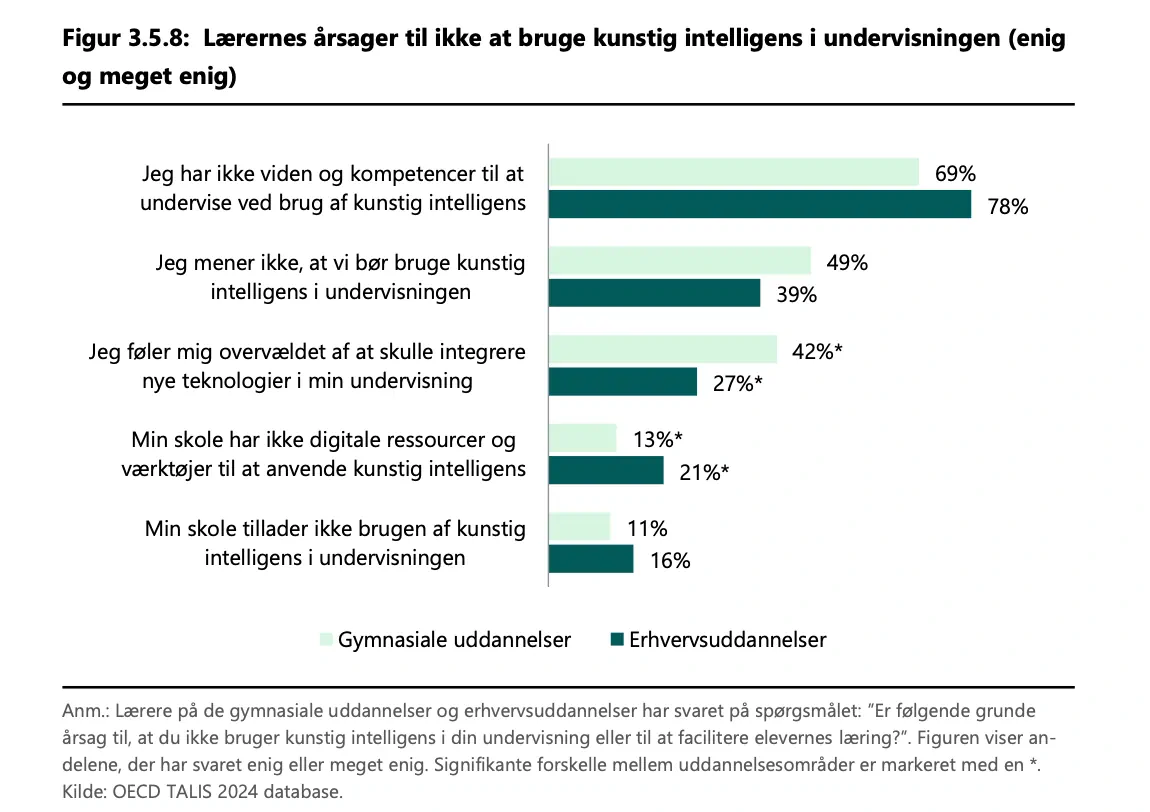
At the same time, the report shows significant barriers. A large proportion of teachers who do not use artificial intelligence cite a lack of knowledge and skills as the reason. This applies to as many as 78% of gymnasium teachers and 69% of VET teachers.
Source: TALIS 2024 – Upper secondary education
In addition, concerns about cheating and incorrect answers are widespread, especially in upper secondary schools where 82% fear plagiarism and 85% doubt whether AI-generated answers are accurate.
The report for upper secondary schools underlines that there is a clear need for continuing professional development (CPD) if AI is to be used pedagogically.
Artificial intelligence in the primary and lower secondary school
The report for the primary and lower secondary school shows that the uptake of artificial intelligence is at a lower level than in upper secondary education. Around one third (36%) of primary and lower secondary teachers had, in spring 2024, used AI in teaching or in their work with pupils. The use is centred primarily on teachers’ own preparation.
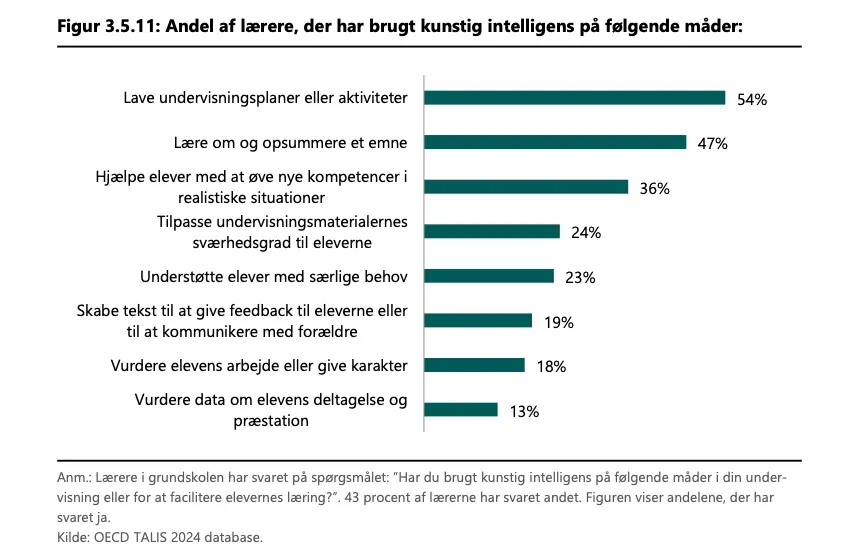
54% of teachers have used artificial intelligence to prepare lesson plans or activities, while 47% have used it to familiarise themselves with new topics. By comparison, only about a third have used the tools to let pupils practise skills in real-world situations, and even fewer use it for feedback or assessment.
Source: TALIS 2024 – Primary and lower secondary school
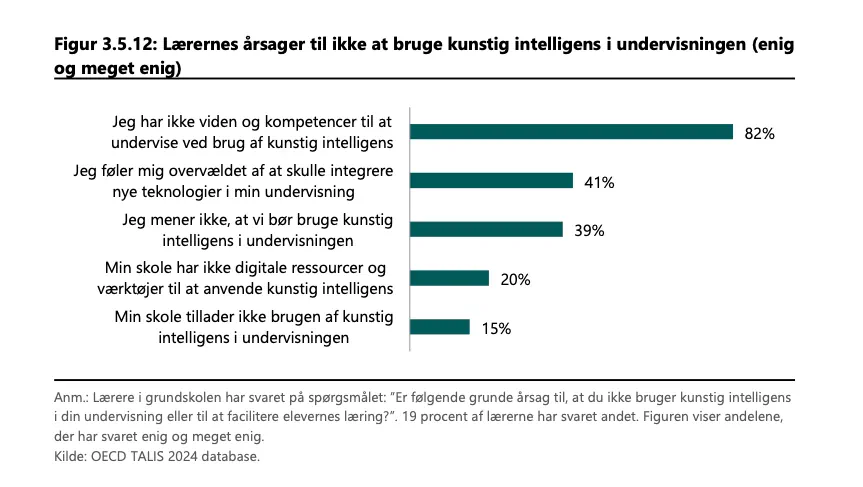
At the same time, the report points to significant barriers for teachers who have not yet adopted the technology. 82% of teachers state that they lack the knowledge and skills to use artificial intelligence in teaching. In addition, 41% feel overwhelmed by the thought of having to integrate new technologies.
Source: TALIS 2024 – Primary and lower secondary school
Uncertainty among primary and lower secondary teachers is widespread. While 41% are concerned that AI gives incorrect answers, and 36% fear cheating, the most striking feature is the high share of “don’t know” responses. For example, 70% answer that they do not know whether AI suggests inappropriate pedagogical approaches.
The report underlines a strong need for professional development and clarification of the role of the technology in the primary and lower secondary school.