Exams after ChatGPT: Part 1 - When cheating becomes too easy
How should we assess students in a digital reality where artificial intelligence has become an integral part of everyday life, including during exams?
This is the first part of a series on an exam system under pressure, and why we should rethink the entire way we test students.
This article has been machine-translated into English. Therefore, there may be nuances or errors in the content. The Danish version is always up-to-date and accurate. Read the original Danish article here.
Exams after ChatGPT is a three-part series in which I explore how artificial intelligence challenges our examination system – and how we can rethink it so that exams continue to make sense and retain their credibility.
Part 1 examines the written examinations and the acute problems of cheating and mistrust.
Part 2 delves into the oral examinations and poses the fundamental question: What is it, exactly, that we want to test?
Part 3 concludes the series with a look at Nordic experiences and possible solutions for the future of Danish examinations.
This first article is about the written examinations, where AI and monitoring software are already putting pressure on both teachers and students.
The debate about AI and exams has truly taken off. In recent months several media outlets have focused on the growing mistrust of the examination system – and with good reason. Behind the headlines lies a real concern: Are we losing confidence that exams actually measure what they are supposed to?
Weekendavisen recently described how teachers feel powerless in the face of AI-enabled cheating, where there is a marked difference between students’ day-to-day performance and their exam results. I believe that what we are facing is a natural development in the way we have digitised schooling for many years, and that we now face challenges because AI today can write very convincingly.
In this article, I delve into an explanation of why upper secondary school (gymnasium) examinations have come under pressure in the encounter with generative AI – in terms of control, academic judgement and the trust between students and teachers.
An examination system that denies reality
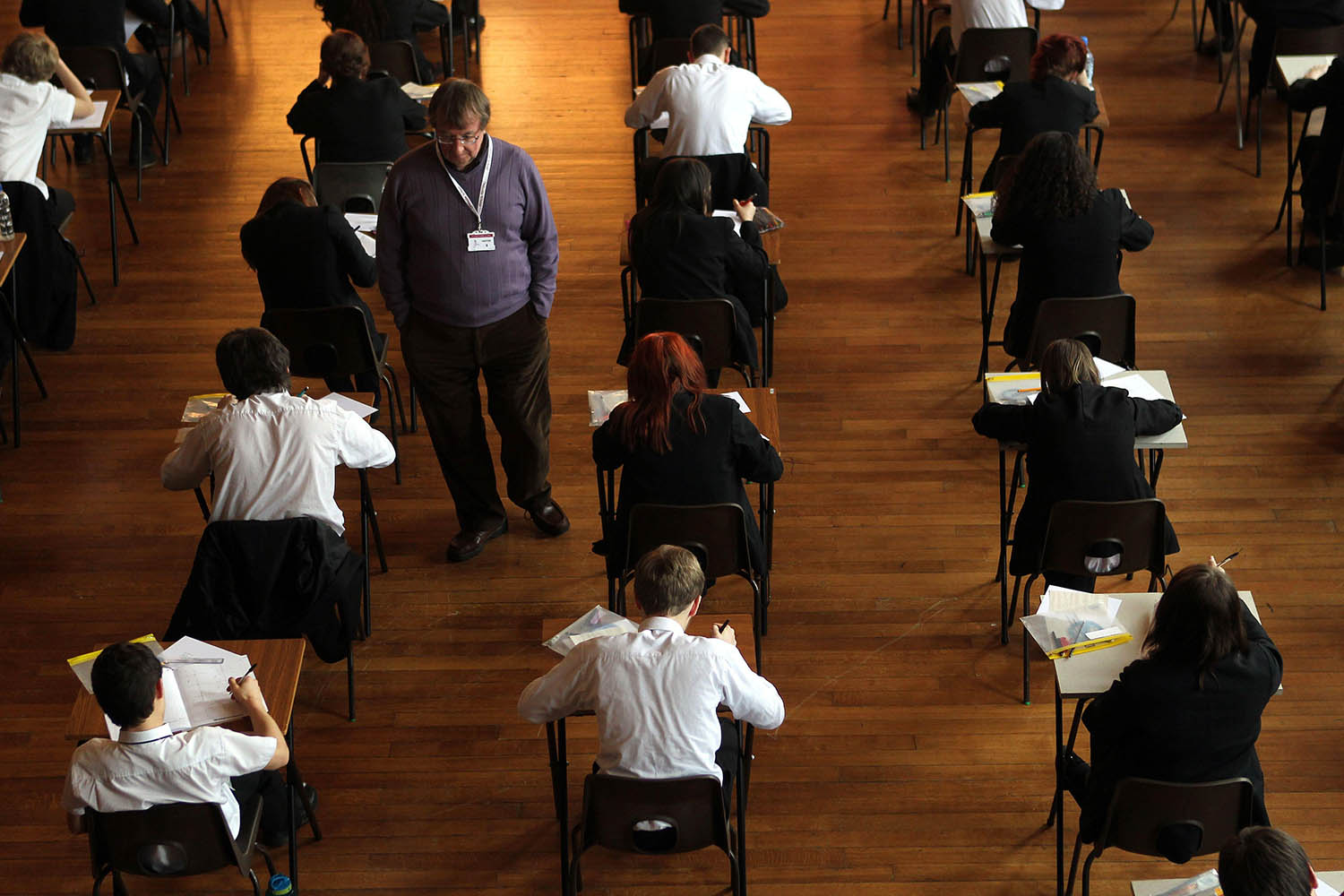
A significant part of the challenge is that students today submit exam scripts that could have been written ten years ago. Not because they lack digital skills, but because our examination system systematically excludes the technology that shapes their education and future working lives.
While teachers struggle with suspicions of AI-enabled cheating and monitoring software that does not always work, the question remains: Are we actually testing the competencies that students will need in a digital future shaped by AI? And can we maintain an examination system that refuses to acknowledge the digital reality students live in?
Our examination system has not kept pace with the times. It is not only about cheating, but about our continued reliance on outdated forms of assessment in a digital reality we no longer control. In the meantime, we see a range of different stopgap fixes applied to the current system.
Why the examination system is falling behind
At many schools we have moved away from using dedicated computer rooms, because they were expensive to maintain, and because all students were already bringing their own laptops to lessons to take notes. This has changed how we use computers, because the computer is no longer optional, but a precondition for taking part in teaching at all.
When we do not have school-owned computers, it is also natural to require students to bring a laptop to the exam. This shift offers possibilities, but to a great extent also day-to-day challenges.
On the one hand many argue that students have become too dependent on screens. The first thing a student does in class is open the laptop and take notes. On the other hand, it also enables adaptive learning systems and the use of interactive learning materials in teaching. We have accepted an everyday reality in which students work digitally with information, collaborate in shared documents, and in which artificial intelligence is increasingly integrated into daily routines.
I will not enter the debate about screens in school, but simply note that it both challenges teaching and expands its possibilities. I see a paradox in the fact that, on the one hand, we worry about screen dependence, while on the other we expect everything to be submitted digitally and marked digitally.
At the same time, schools have streamlined many of the manual tasks associated with exams. For example, students now submit directly in Netprøver, which at the same time scans scripts for plagiarism, and the external examiner marks digitally.
Written examinations
A key challenge is that students use their own computer – a “bring your own device” approach. We are thereby asking them to bring their entire digital private life into the examination setting, even though they are not allowed to access it. Students often do not themselves have an overview of which programs are installed on the computer, or which programs they are allowed to use at all.
For this year’s written exams, I have helped go through the rules with the students. There are by now so many rules, guidelines and instructions that it can feel confusing. Some teachers automatically ban spellcheck or the thesaurus, while others allow them, because they interpret the rules differently. The rules are so complex that even teachers find it hard to interpret them consistently across subjects, leaving both teachers and students confused.
The rules include, among other things, a ban on “ChatGPT and other forms of generative artificial intelligence” in exams. That may make sense if we still think of the computer as a neutral tool. In practice, however, it has become an active player – even in exams. For example, a student using Word can easily receive “help” from tools such as Grammarly or Word Editor. This is not necessarily an attempt to cheat. Many of these tools have become standard for students and can be difficult to disable, both technically and in terms of teaching practice. In some cases, chat functions pop up in unexpected applications, for example in Spotify. Even platforms such as Studienet exist in different versions, both with and without exam functions.
Common to many of these situations is that the student is not necessarily cheating deliberately, but using the tools we employ in and outside teaching. The digital reality in which we place exams has blurred the boundaries between permitted aids and unauthorised support. This makes it difficult to create unambiguous rules that can be enforced consistently. We are holding exams in an environment where the boundaries are constantly shifting.
EVA’s latest report confirms this development: “Generative AI makes it more difficult for teachers, examiners and external examiners to assess students’ independent academic level. It is especially hard to judge written products, since AI can generate all or parts of the answers, making it unclear how much the student has contributed.” (Danmarks Evalueringsinstitut (the Danish Evaluation Institute), 2025)
When we test students, however, we insist on testing them in an artificial, analogue-like situation that in no way reflects the reality they will meet after finishing their education.
Technology rarely has only one effect, and precisely for that reason we should dare to discuss what kind of examination system we want: one that reflects reality, or one that clings to the past – without letting go of the fundamental academic competencies that still play an important role.
ExamCookie as a countermeasure
Many schools have purchased ExamCookie as a safeguard against artificial intelligence. However, a significant challenge is that ExamCookie is not used as standard at all schools.
Proctoring tools can lose their value if the log files are not reviewed after an exam. Some schools merely note that the system is running – without following up. Others place too much trust in the hits the tool generates, without critically assessing whether they actually make sense.
At the same time, we risk trusting that no one is cheating simply because we do not find anything in ExamCookie. That is a false hope, because after some time it turns out that IT-savvy students can circumvent the program relatively easily – even though it carries a risk of being discovered. Although ExamCookie is not a sustainable long-term solution, it may be the best temporary safeguard we have, provided we use it critically and not as a false insurance against cheating. The greatest risk may be that ExamCookie creates a false sense of security, weakening the appetite to think in more sustainable solutions.
Danske Gymnasiers (the Danish Association of Upper Secondary Schools) member survey from February 2025 showed that 57% of principals judge that the current tools to counter cheating are not sufficient. At the same time, principals assess that half of teachers do not have the necessary AI skills to handle these situations competently.
We are also looking towards a future in which computers are increasingly enriched with AI functions. Apple is, for example, in the process of launching its Apple Intelligence, and Microsoft’s next version of Windows will include Copilot+ PC with the new feature Recall. A particularly challenging element of Recall is that the system automatically takes ongoing snapshots of everything displayed on the screen and stores it locally, so the AI can provide context-based suggestions.
At the same time, it does not necessarily require an internet connection to run language models. That makes it difficult to detect whether a student has renamed a program to bypass systems such as ExamCookie. All this raises important questions about privacy, data security and the running of exams. If artificial intelligence is what one is trying to shut down, it will become practically impossible in a future where the computer itself is an AI-powered device.
When suspicion is not enough
I have spoken with several teachers and external examiners who in recent years have shared experiences of well-founded suspicion that an exam script was wholly or partly generated by artificial intelligence. Yet such cases often end without consequences, because it is not possible to document the use of AI in the same way as traditional plagiarism.
This raises a fundamental challenge for the examination system. What are we to do when experienced teachers assess that a script contains AI-generated sections, especially when there is no technical evidence? In some cases, schools choose to close cases quickly, not least because lengthy investigations are resource-intensive, but perhaps also because the economic incentive in the taxameter system does not reward students failing.
Whether that is due to finances, or to the fact that strong evidence is generally required to fail a student, I cannot say. Fundamentally I see a major challenge in the way finances and assumptions are being mixed together in our approach to exams.
What should future examinations look like?
The challenges with written examinations clearly show how our current examination system struggles to keep up with technological development. We are trying to control the uncontrollable with tools such as ExamCookie, while students’ computers increasingly function as pure AI machines.
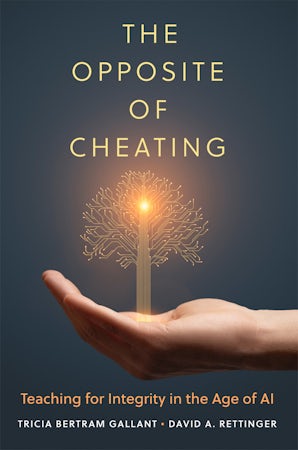
We must ask ourselves what we really want to test with exams: only memory and communication skills – or also the ability to use, critically, the digital tools that will shape students’ future working lives? As Tricia Bertram Gallant and David R. Rettinger point out in the book The Opposite of Cheating, instead of banning AI tools we should redesign our exams so that they engage students authentically with the tools they actually have access to.
The need for action is urgent. As Anders Frikke, chair of Gymnasieskolernes Lærerforening (the Danish Union of Upper Secondary School Teachers), emphasises: “We need to act faster than we normally would like when it comes to an examination reform, but we cannot wait three to four years from now.” The alternative is a so-called “test hell” with increased control, which harms the teacher–student relationship without addressing the underlying problems.
But it does not stop at the written exams. In the next part, I take a closer look at how the oral exams are also facing equally significant challenges. At the same time, we are beginning to see new digital devices that will only make monitoring even more difficult.
However, I see opportunities to future-proof the exams if we still wish to allow students to use their own computers. Whatever direction we choose, there is an urgent need to rethink examinations in light of technological developments.
In the next part, I examine the oral exams, which in many ways face equally significant challenges.
In the third and final part, I look at how our neighbouring countries are already working on possible solutions.