This article has been machine-translated into English. Therefore, there may be nuances or errors in the content. The Danish version is always up-to-date and accurate.
We are writing on December 9th, and the penultimate newsletter of the year is now ready.
Over the past week, there has been significant focus on the government’s new AI strategy, which has a total framework of 62.5 million kroner. The strategy highlights the increasing need for skill development and education and the desire to strengthen the development of the Danish language model.
This call for continuing education seems to have been heard, as the AI Competence Pact was launched shortly afterward. The pact aims to upskill 1 million Danes in AI through strong public-private collaboration and make technological understanding a central part of the education system.
However, AI changes what we learn and how we think and interact. Jeppe Klitgaard Stricker raises the question of whether the education sector is ready for the consequences of this revolution.
Much has also been talked about how AI can make the public sector more efficient and improve it, but are we at risk of repeating the mistakes of previous digitization projects?
In the new year, Christiansborg will hold a conference on implementing digital technological understanding in primary schools.
OpenAI is fanning the hype around generative AI through a 12-day event.
Additionally, we have a range of links, primarily to international articles, focusing on generative AI and the education sector.
Happy reading.
The Danish Government’s New AI Strategy to Make Denmark a Digital Frontrunner and Improve Education
The government has launched a new strategic initiative for artificial intelligence to promote the responsible development and use of the technology in both the public and private sectors. The initiative is also expected to positively impact education by providing new tools for teachers and educators.
A key element of the strategy is establishing a secure platform for developing Danish language models. The project is led by Danish Foundation Models (DFM), an existing collaboration between universities and the Alexandra Institute, focusing on creating tailored solutions for the Danish language and culture through responsible, secure, and transparent methods. The funding will finance an advanced platform for training, fine-tuning, and evaluating AI models for Danish applications. This platform will also include an open sandbox where researchers, developers, and users can collaborate on specific use cases within public administration, healthcare, and education.
The strategy also ensures free access to large volumes of Danish text data in open-source format. These data can be directly used to develop language models that integrate into teaching materials and educational technologies tailored to Danish curricula.
In addition to open language models and free data, the AI strategy includes two more initiatives:
1. The Digital Taskforce for AI establishes a new collaboration across the public sector, including states, municipalities, and regions, to disseminate and scale successful AI solutions in education.
2. A new center for AI in society, advising businesses, authorities, and public institutions on the responsible use of AI. The center can support schools and educational institutions in effectively and ethically implementing AI in education.
The strategy has broad political support and a total budget of 62.5 million Danish kroner through 2027.
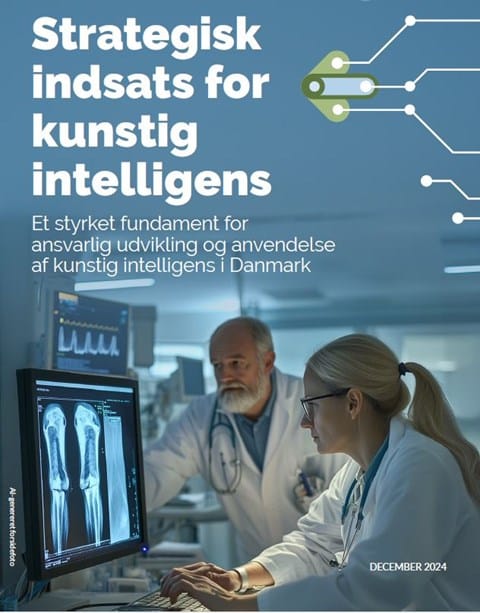
Strategisk indsats for kunstig intelligens
Et styrket fundament for ansvarlig udvikling og anvendelse af kunstig intelligens i Danmark
The Danish AI Competence Pact – Collaboration for Denmark’s Digital Future
The AI Competence Pact is a new public-private partnership aiming to upskill 1 million Danes in AI and digital skills over the next three years. The pact brings together companies, educational institutions, authorities, and organizations to strengthen technological understanding and digital literacy.
The initiative is led by the AI Competence Council, which coordinates strategic efforts and flagship projects and ensures knowledge sharing across sectors. A significant part of the effort focuses on the education sector, involving primary schools, secondary schools, and universities to integrate AI naturally into teaching.
Microsoft contributes with a free online learning environment, giving Danes access to courses and certifications. Additionally, the pact specifically includes women, individuals with disabilities, and citizens with shorter educational backgrounds in the digital upskilling efforts.
The Quiet Revolution: AI’s Impact on Higher Education
AI’s entry into the education sector is changing teaching methods and students' thinking and learning. Jeppe Klitgaard Stricker emphasizes that while debates often focus on academic integrity and assessment methods, deeper cognitive and behavioral transformations are underway.
Students are beginning to adopt AI’s communication patterns, which could influence their ability to process and express ideas. There is also a growing dependency on AI, where brief outages or lack of access can cause genuine anxiety. This “digital dependency disorder” challenges traditional learning and critical thinking, as AI’s quick answers often replace the necessary struggle for understanding that fosters deep learning.
Socially, group-based learning and dynamics are declining, as students prefer AI’s efficient but isolated solutions. This development risks weakening essential social and cognitive skills that traditionally fostered innovation and creativity. At the same time, complex problems may be reduced to optimization tasks rather than requiring human reflection and nuanced understanding.
When students begin viewing reality through the lens of prompting, we risk a fundamental shift in how future generations approach problem-solving.
Jeppe Klitgaard Stricker warns that AI’s authoritative answers could undermine trust in human expertise and create pressure for perfection, stifling creativity and risk-taking. “The real disruption isn’t in how we teach, but in how our students’ minds are reshaped by constant AI interaction.”
What does it mean for the public sector when the government aims to make it a world leader in using artificial intelligence? As part of the government’s new AI strategy, a ‘Digital Taskforce’ contributes to “freeing up labor, reducing administration, and improving quality.”
Integrating AI into the education system and preparing Danes for the digital labor market is a key priority. The strategy includes freeing up to 99,999 full-time equivalent positions through AI solutions by 2030, aiming to reduce administration, release workforce resources, and improve the quality of public services.
The debate surrounding the strategy highlights both potential and challenges. Camilla Gregersen, chair of the academic union DM, emphasizes the importance of targeted skills development to ensure employees can use AI effectively. Martin Aarup, director of Populus Analytics, warns against superficial courses and calls for training tailored to specific needs. Anders Kühnau, chair of Danish Regions, points out that AI should be integrated into education at professional schools and universities, noting that many educational institutions already use AI solutions in teaching.
There is consensus that success with AI requires substantial investments in continuing education and future-proofing educational programs. The goal is to reap technological benefits without leaving groups without digital skills.
P1 Debat > Erstattet af AI?
Hvilke opgaver skal kunstig intelligens varetage? Skal nogen erstattes af kunstig intelligens og bliver kvaliteten af den offentlige sektor bedre?
Medvirkende: Lisbeth Bech, Finansordfører, It-ordfører, (SF), Camilla Gregersen, Forperson Den Akademiske Fagforening DM, Rasmus Lund-Nielsen, Digitaliseringsordfører (M), Martin Ågerup, co-founder af Popoulos Analytics og foredragsholder, fhv. direktør, Cepos, Anders Kühnau, Formand Danske Regioner (S) og
Conference on Digital Technological Understanding in Primary Schools
On January 29th, a conference will be held at Christiansborg focusing on implementing digital technological understanding in primary schools starting in 2027. Experts, teachers, politicians, and students will discuss how this new subject area can enhance Danish students’ digital skills and prepare them for future challenges in the job market and society.
The conference provides current insights into digital technological understanding as a subject and what it takes to elevate students’ skills to a higher level after the primary school agreement and the latest digitization strategy, both introduced in early 2024.
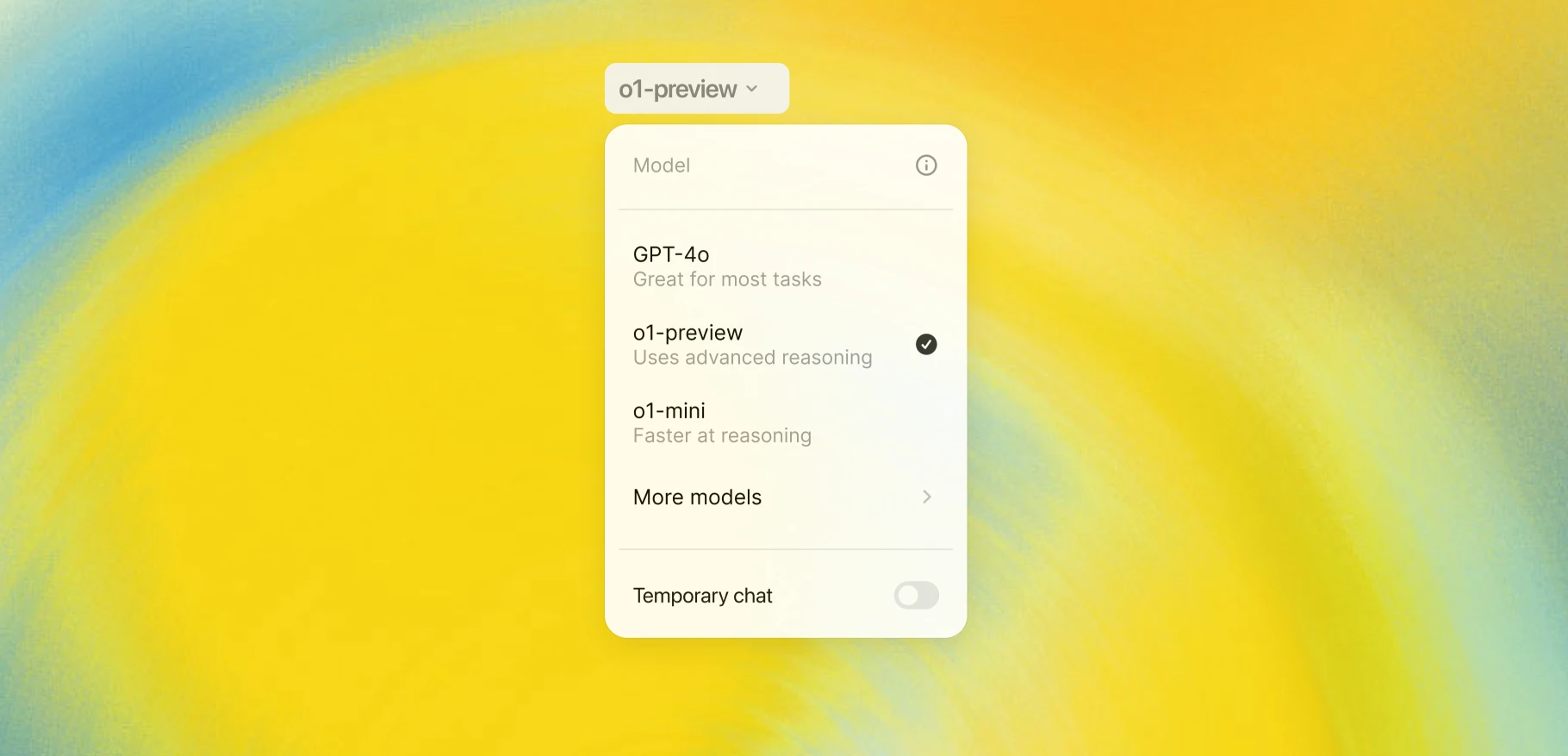
OpenAI has announced a live stream series, “12 Days of OpenAI,” that will span twelve days and showcase new technologies and updates. While rumors about new models like GPT-5 and the “Orion” project circulate, OpenAI has confirmed that no GPT-4 successor will be launched this year.
On the first day, OpenAI introduced a new subscription plan, ChatGPT Pro, priced at $200 per month. This plan provides unlimited access to their latest AI model, o1, and an exclusive ‘o1 Pro Mode.’ This Pro mode utilizes additional computing power to handle complex tasks with greater precision, making it suitable for data analysis, programming, and legal analysis.
On day two, OpenAI announced a new method called Reinforcement Fine-Tuning (RFT), which enables training specialized versions of their o1 models for complex technical tasks with minimal training examples. Unlike traditional fine-tuning, RFT employs a process where the model is evaluated and adjusted through a feedback mechanism that reinforces effective thinking patterns and reduces errors.
There is also speculation about the launch of Sora, OpenAI’s video-generation model, which was introduced earlier this year. Sora has been tested with selected artists, but its development has sparked controversy due to complaints about inadequate compensation for artists.
We will follow up on OpenAI’s upcoming announcements in our next newsletter.