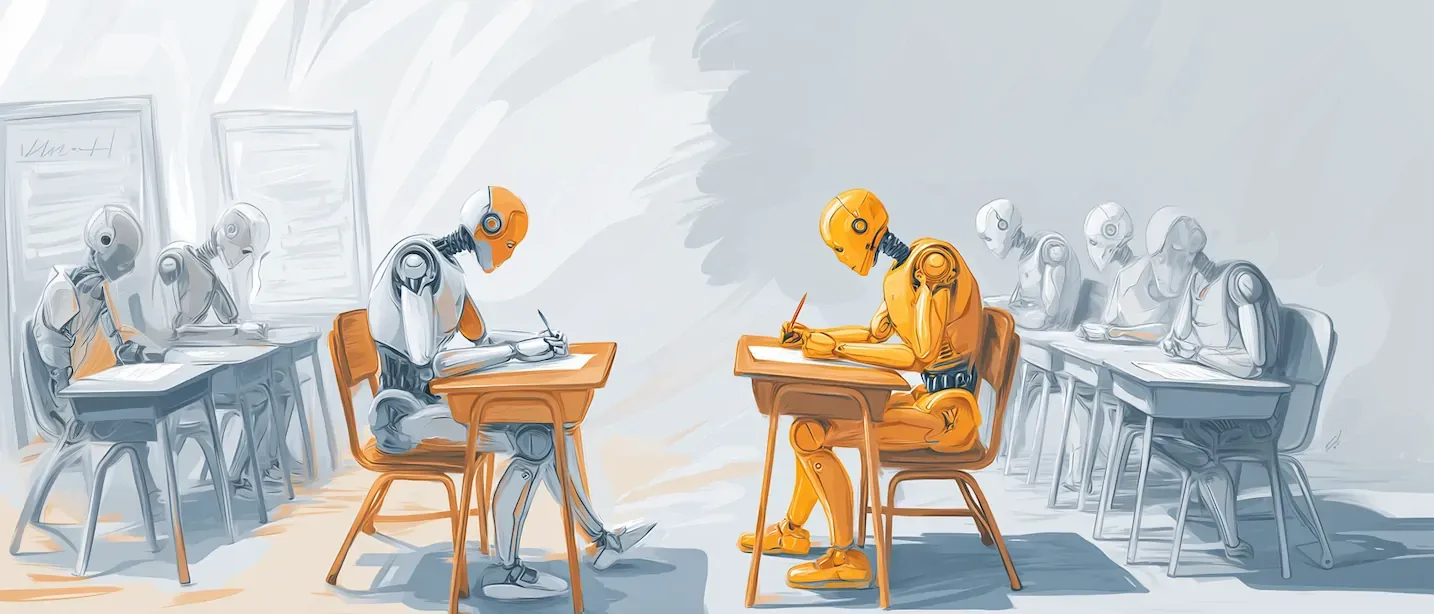
This Week's Newsletter: When AI Steals the Productive Struggle
AI can speed up schoolwork, but what happens to learning when that productive struggle disappears? This week's newsletter brings together new examples from schools and the workplace, where AI both creates opportunities and raises questions about thinking, mastery, and the purpose of education.
This article has been machine-translated into English. Therefore, there may be nuances or errors in the content. The Danish version is always up-to-date and accurate. Read the original Danish article here.
Here is this week's newsletter on artificial intelligence in education.
Every week we read a stream of stories about AI helping us complete tasks faster and more efficiently. For educators there can be a gain, but what happens when the technology no longer just helps, but completely takes over the work?
That’s why we open this week’s newsletter with an article in The Atlantic, which poses a strong and provocative question:
Is schoolwork effectively becoming optional?
The article argues that we are heading towards a fully automated learning pipeline, where AI can write reports, answer online quizzes and take part in online discussions on pupils’ behalf.
When the technology removes the hassle, it also removes the necessary struggle and thus part of the very basis for going to school. As psychologist Astrid Galsgaard wrote last week, we develop not only academic skills but also our identity when we fail, struggle and eventually succeed in understanding a subject. If we are served the answer in a split second, we risk educating a generation of passive pupils who suffer from what the authors of an opinion piece in Finans call cognitive laziness.
The consequences are not only theoretical. A survey of 9,000 teachers in England paints a worrying picture of pupils losing basic skills in critical thinking and writing. At the same time, a US Gallup poll shows that pupils are increasingly becoming sceptical about AI and fear that the technology will make learning harder in the future.
But it is in education that the consequences are greatest. What happens when AI both writes the assignments and marks them? This week’s commentary points to a growing risk that everything appears to be working well while real learning disappears.
Enjoy the newsletter.
The Atlantic warns about AI and automated schoolwork
In The Atlantic, Lila Shroff writes that American education is entering a phase in which AI no longer merely helps pupils with individual tasks, but increasingly takes over large parts of the schoolwork. The article describes, among other things, tools that can take online quizzes, write reports, create presentations and take part in discussion forums. The point is that developments in the United States raise a broader question about what schoolwork and academic participation should be when AI can do so much on pupils’ behalf.
The article also points out that the development is being driven by pupils, educators and technology companies alike. Some students use AI as learning support, while educators are experimenting with AI for organisation and assessment. According to the article, this creates a risk of an almost fully automated learning pipeline, where AI both helps to produce and to evaluate schoolwork.
AI confronts teachers with a responsibility that goes beyond control
Astrid Galsgaard, psychologist and PhD in people’s relationship to artificial intelligence, writes in Skolemonitor that the debate about AI in school and education has focused far too much on plagiarism, control and bans. She believes the most important question is what happens to pupils’ learning and identity development when AI takes over the processes where they would otherwise struggle, fail and learn for themselves. Her point is that mastery not only develops academic skills but also shapes the pupil’s self-understanding.
When pupils are quickly served answers and formulations, they may feel they have mastered the material without actually having worked their way to understanding. At the same time, she warns that pupils may become accustomed to a passive role, where AI is the one that thinks and knows, while they settle for asking questions.
She therefore places a particular responsibility on teachers and lecturers. In her view, the task is not to ban AI, but to design teaching so that pupils still work independently, reflect on their process and encounter appropriate academic challenge.
Anders Heede and Flemming Poulfelt write in Finans that the economic gains from AI already loom large in companies’ plans and on stock markets, while the possible costs get far less attention. According to the authors, the bill may arrive sooner and be larger than many expect, even though AI also holds considerable potential.
They particularly emphasise that AI can also lower quality. Hallucinations in language models, uncritical use of answers from chatbots, and systems’ tendency to confirm the user rather than challenge them can have major consequences in work where precision, judgement and critical sense are crucial. At the same time, they point out that AI is already contributing to a stream of mediocre content, because the tools make it easy to produce texts quickly without sufficient disciplinary depth.
In the longer term, they warn that AI may lead to cognitive laziness if people increasingly hand over thinking and judgement to the technology. They therefore highlight education as a central part of the solution. If AI is to create real value, the authors argue, it requires a high level of knowledge, understanding, creativity and critical sense among students, employees and leaders alike.
Computerworld reports on a new large-scale survey from England suggesting that many teachers find pupils are losing basic skills as AI takes up more space in teaching. The survey is based on responses from 9,000 teachers in primary and secondary education.
About two thirds judge that pupils’ ability to think critically, write, solve problems and hold conversations has been weakened, and several teachers point to AI as a significant cause. The criticism focuses particularly on pupils’ growing dependence on quick answers and therefore less practice of their own academic and language skills.
At the same time, the survey shows that teachers themselves are using AI more than before. Three out of four now use AI in their work, especially for teaching materials, planning and administrative tasks. This paints a two-sided picture in which the technology is seen both as a practical help for teachers and as a possible challenge to pupils’ learning.
The survey also indicates that many schools still do not have clear guidelines for how AI should be used by both staff and pupils.
Gallup: Generation Z is becoming more sceptical about AI
A new US study from Gallup, the Walton Family Foundation and GSV Ventures shows that Generation Z has become more negative towards AI over the past year. More young people now say that AI makes them angry, while fewer associate the technology with excitement. At the same time, a large majority of both school pupils and young adults believe that AI, which is designed to complete tasks more quickly, could make learning harder in the future.
The study also shows that young people’s use of AI is still growing, but more slowly than before. Many young people still see AI as something they will need in education and working life, but fewer than last year think that AI helps them learn faster. Part of the scepticism also appears to be linked to concerns about how AI will affect job opportunities, trust and professional skills.
Upper secondary school (gymnasium) replaces homework with in-school tests
Svendborg Erhvervsskole og Gymnasier (Svendborg Vocational School and Upper Secondary Schools) has decided to convert part of the homework into in-school tests, where students complete the tasks at school under exam-like conditions.
According to the leadership, the change is due to growing frustration among teachers, because homework is increasingly shaped by AI and has therefore become harder to use as a basis for assessment. At the same time, the school finds that students have generally welcomed the model, partly because tasks are now completed during school hours and provide practice in a form of testing that resembles the exam.
AI is already part of teaching, and the leadership notes that expectations for students’ skills are changing. Precisely for that reason, they believe new forms of assessment are needed, along with swifter action from the ministry. The school’s experience is that teaching can no longer be based on old exam formats if AI is simultaneously changing the way students work.
In an opinion piece in Skolemonitor (a Danish education news site), headteacher Jonas Fisker argues that AI should be used constructively in school rather than met with bans and a return to pen and paper. He points out that pupils have always tried to make tasks easier for themselves, so the challenge is not new. The key, he says, is to find ways of working where AI supports learning instead of tempting cheating in traditional written assignments.
He particularly highlights that AI can strengthen differentiation. In language subjects, for example, pupils can have conversations with an AI tool that adapts the level and topic to the individual pupil.
Pupils should not use AI to cheat, and teachers should be clear about when AI is part of teaching or feedback.
New DR project aims to strengthen pupils’ technological understanding
The new project Ultra Bytes builds on Ultra Bit, which in recent years has taught many pupils to code with Microbit. This time the goal is broader. DR (Danish Broadcasting Corporation), CFU (Centres for Learning Materials), Aarhus Universitet (Aarhus University) and Life Fonden (the LIFE Foundation) want to strengthen pupils’ technological understanding and digital literacy, so that children become better at relating to technology in everyday life and not only at using it.
The project runs until 2029, and schools can already sign up to be considered for 3,600 resource kits and learning materials, which will be ready for the 2027/2028 school year.
An important point is that the effort should not only take place in school, but also support conversations between children, teachers and parents. According to DR, a new survey shows that 73 percent of children aged 9 to 14 use generative AI, while conversations with parents often focus on warnings, bans and cheating.
The project should therefore also give adults better tools to talk with children about technology in a more open and informed way.
Carina Marie G. Korsgaard tells Børsen (the Danish financial daily) that EY is significantly scaling up on AI and training, while at the same time taking a strict line on which tools employees may use. According to her, AI is already so critical for the sector that all employees are expected to use the technology in their daily work without compromising data security and quality.
EY therefore deliberately chooses not to adopt all open and freely available AI tools, because errors and data leaks can have major consequences.
At the same time, she describes AI as a cultural and leadership shift that requires new competencies across the organisation. Classical professional disciplines need to be tied more closely to technological insight, and therefore EY has put training high on the agenda, including through internal programmes for partners and leaders.
Her main message is that the development of AI cannot be put on pause, and that companies must therefore continually invest in technology, competencies and change management to remain relevant.
Professor calls for clearer leadership to realise the gains from AI
Professor of digitalisation Jan Damsgaard points out that many workplaces are not yet getting sufficient benefit from AI, even though the technology is already saving time across a wide range of tasks.
He uses his own work as a professor as an example that AI can make tasks such as course development, lesson preparation and the marking of written assignments faster. His point is that the gains will not be realised if management leaves the use of AI to each individual member of staff.
At the same time, he highlights middle managers as a key bottleneck, because it is often at this level that AI has to be translated into new workflows. From an education perspective, it is therefore not just about access to AI, but also about leadership, prioritisation and organisation.
This week's commentary: Machines that talk to machines
In 2022 I met a headteacher who joked about it. The student uses ChatGPT to write the assignment, and the teacher uses ChatGPT to mark it. We laughed because it seemed absurd. Now it’s 2026, and it’s no longer a joke.
The Atlantic wrote last week about AI agents that can answer quizzes, write reports and take part in online discussions on students’ behalf. At the same time, educators are using AI to mark those very same tasks. Both sides of the table are being automated. This is not down to bad intent, but to the fact that the technology makes it rational.
The problem isn’t that anyone is cheating. The problem is that we’re building a system where no one learns anything, and no one notices because the numbers look fine.
Assignments are handed in. Feedback is given. Everything runs. But there’s nobody home.
You can see it as a form of cognitive debt. Every time a student submits something they haven’t thought through themselves, and every time the feedback confirms it without picking it up, the debt grows. It is invisible because the system doesn’t register it. Grades look reasonable, submissions arrive on time, and no one sounds the alarm. But the debt doesn’t disappear. It grows quietly until it becomes visible at the oral exam, on placement, or the day the student has to use their subject knowledge for something that can’t be automated.
Perhaps that is exactly what students are already sensing. In the US Gallup survey, young people have become markedly more negative towards AI over the past year. Three out of four school pupils fear that the technology will make learning harder. This is not technophobia. As Astrid Galsgaard points out, it is in the struggle with the material that we find ourselves. If we remove the struggle, students are left with a sense of having everything under control without actually having understood anything.
The question is not whether AI should enter teaching. It already has. The question is whether we notice when the circle closes, and when it is no longer people learning, but machines talking to machines.
It is our task to keep the circle open. Not with bans, but by insisting that there is still a person somewhere in the chain who is grappling with the material. Because that is where learning lives.