This week's newsletter: Learning is not a technical problem
This week's newsletter rounds up a set of stories that revolve around the same question: What do we actually expect AI to solve in schools?

•
10 min read



This week's newsletter rounds up a set of stories that revolve around the same question: What do we actually expect AI to solve in schools?
Here is this week’s newsletter on artificial intelligence in education. At Viden.AI we took a slightly extended Easter break, and we are now on our way back again.
This week we are focusing on a question that several of the week’s news items revolve around:
What do we actually expect AI to solve in school?
It is a big question, because AI affects teaching whether we like it or not, and the technology is taking over more and more of the areas where we need to train the brain.
If you put the question to Google’s Head of Learning, Ben Gomes, the answer is fairly clear, because AI can organise, tailor and save time in everyday work. But the major challenge is that AI cannot solve students’ lack of motivation. He therefore believes that the teacher is still absolutely central to ensuring students learn.
Københavns Universitet (University of Copenhagen) has just launched a new research project called AIPLA to investigate the use of AI in physics teaching. Here, too, AI is envisaged to take over the dull routines, freeing time for human experience, sensing and professional judgement. Vestre Skole is also testing AI as a support tool for teachers to better accommodate highly able students.
It is interesting that the above is very much about giving teachers the right tools so they can plan teaching in new ways.
We also see the downside if we remain passive. As upper secondary school (gymnasium) teacher Morten Rudfeld Henriksen points out, we are already educating young people who are world champions at delivering well‑worded answers without necessarily understanding them.
The same concern is shared by efterskole (residential continuation school) headteacher Rasmus Bro Henriksen, who warns against handing the actual writing over to the machines, because language and thinking risk becoming poorer. If the school does not take the lead, we risk, as Professor Thomas Bolander warns in Berlingske, creating greater inequality and technological passivity.
But what does it look like when the school actually takes the lead?
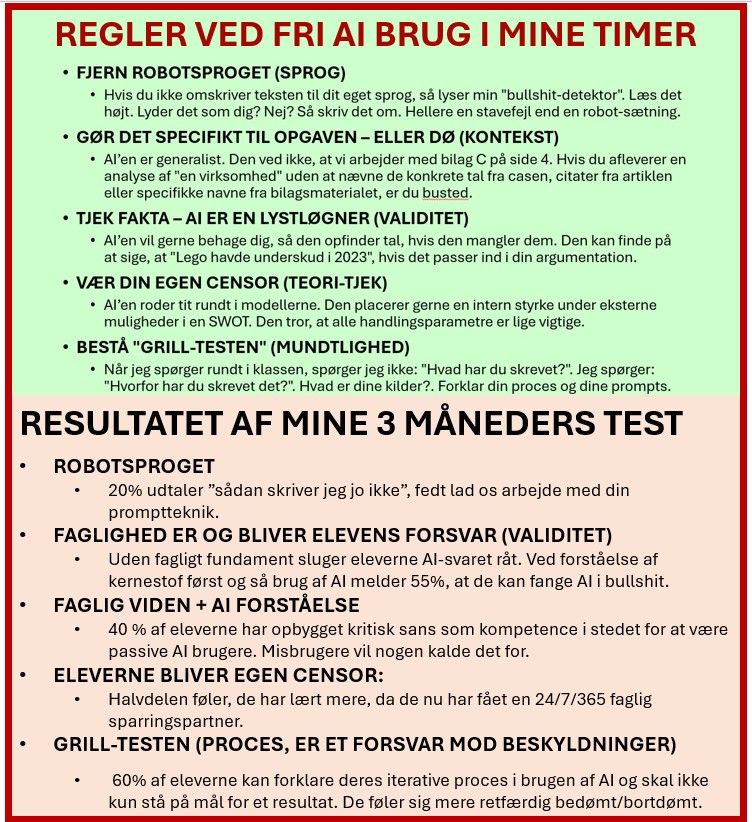
A really good and concrete example comes from AI coordinator Niels Lundberg Thingvad from Køge Handelsskole (Køge Business College). He has conducted the trial ‘fri AI under ansvar’ and now finds that students are increasingly able to sense when AI takes over, and that they have begun to take ownership of their own academic voice. In other words, the solution was not to ban the technology, but to create conditions in which students dared to be curious and honest. It is an excellent, practice‑grounded example that I encourage everyone to read.
All this leads to this week’s commentary, where I argue that we need to bring pedagogy along before we surrender to the technology.
Happy reading.
In Forbes, Dan Fitzpatrick writes that Google’s Head of Learning, Ben Gomes, sees motivation as the school’s biggest challenge and as something AI cannot solve on its own. According to Gomes, AI can improve the way students learn and free up teachers’ time, but it cannot replace the human relationship that makes students feel seen and gives them the desire to learn.
A central message in the article is that AI is particularly strong when it comes to supporting the learning process itself by explaining, adapting, organising and saving time. But the desire to learn does not arise in the technology. It emerges in encounters with other people, and here Gomes points especially to the teacher as the decisive figure. It is the teacher who can create safety, direction and a sense that the student matters.
The article also suggests that AI may influence what the school should prioritise in future. As more practical tasks are automated, it becomes more important for students to develop understanding, overview and the ability to think across domains. At the same time, Gomes emphasises that the technology only makes a real difference if it is used in strong professional communities where teachers help each other and translate the tools into concrete teaching.
Finally, the article raises an important question about the teacher’s role. If AI can ease workload, it may help reduce stress and make it easier for teachers to spend their time on what matters most: the relationship with students.
The AIPLA research project will investigate how generative AI can be used meaningfully in physics teaching in the gymnasium. The project starts from the premise that AI can already solve many classic physics problems, but that there are still aspects of the subject that require human experience, sensing and professional judgement. The aim is therefore not to let AI take over the teaching, but to identify where the technology actually strengthens students’ learning.
We can let students use AI for the boring bits to free up time and energy so they can focus on what matters. Jesper Bruun
The project is carried out in collaboration with teachers from four gymnasiums, who will help develop and trial new solutions in practice. The goal is both to generate new knowledge and to develop materials, guidance and tasks that can later be used widely in physics teaching and possibly also in other science subjects.
Read more here:


At Vestre Skole in Grindsted, teachers and school leadership are trialling a new AI tool designed to help tailor teaching for highly able students. The aim is to provide students with more meaningful challenges while also helping teachers in a busy working day. According to teacher Hanne Holm, it is not enough simply to give them harder tasks. Instead, they need tasks that demand more reflection and a different way of thinking.
Headteacher Birgitte Edens also points out that highly able students can often be hard to spot, and that their behaviour is sometimes misunderstood. The AI tool is intended to help teachers with ideas for teaching and suggestions for how they can adapt tasks for this group of students.
Psychologist Dea Franck judges that the idea behind the tool makes sense, because highly able students need more complex tasks. However, she also stresses that AI cannot replace the teacher’s professional judgement and knowledge of their students. The article therefore presents AI as a potential support tool in teaching, but not as a stand‑alone solution.

In the opinion piece, upper secondary school (gymnasium) teacher and member of GL’s hovedbestyrelse (the executive committee of GL, the Danish Association of Upper Secondary School Teachers) Morten Rudfeld Henriksen writes that in just a few years AI has become a real challenge in the gymnasium.
He refers to a study by Danmarks Evalueringsinstitut (the Danish Evaluation Institute), where two thirds of gymnasium students report that they have used chatbots to cheat. At the same time, some students say they are afraid to stop because they fear their grades will fall. According to the opinion piece, this points to AI already having a problematic role in the gymnasium.
The core of the critique is that students may end up submitting well‑formulated answers without themselves building the necessary understanding. Teaching thus risks educating young people who are good at delivering answers that appear correct, but who find it harder to explain, evaluate and think academically for themselves.
The opinion piece acknowledges that trials have been launched with new ways of using chatbots in teaching, but at the same time criticises the pace of the political response. The message is that a lack of action is not only a current school problem, but may also affect the quality of the future academic workforce.
 Morten Rudfeld Henriksen
In the opinion piece, Rasmus Bro Henriksen describes how AI is already experienced as something entirely normal in the gymnasium among both students and teachers.
This worries him, not because he rejects the technology, but because he believes it can easily become a shortcut that displaces the work involved in writing, formulating oneself and thinking. His main point is that understanding is not simply ready‑made in the head, but often arises in the writing process itself.
Therefore, he warns against schools embracing AI too quickly without considering what students may lose along the way. In his view, both language and thinking risk becoming poorer if students get used to letting AI formulate their texts. For teaching, the point is that writing is not only a tool for showing what you know, but also a way to develop understanding.


Thomas Bolander says in Berlingske that AI will rapidly change society, and that politicians are still not taking the development seriously enough. He warns that the technology can create greater inequality and put pressure on jobs, especially in text, analysis and coding. At the same time, he emphasises that AI can also deliver major gains, including higher productivity and better solutions in a pressured healthcare system.
In education, his most important point is that AI should be part of teaching, and that children should learn early to understand and use the technology. He believes that society needs students not only to encounter AI as a tool, but also to learn to take a critical stance towards how the technology affects the way they think, work and learn.
 Marie-Louise Tønder
AI coordinator Niels Lundberg Thingvad finds that more students can tell when an AI text does not sound like something they would have written themselves. He sees this as an important sign that they are developing critical judgement and becoming more aware of their own academic voice.
At Køge Handelsskole (Køge Business College) he has, since January, been working on the pilot "free AI under responsibility". Here, students must make the language more concrete, check facts and be able to explain their choices. The experience is that AI in itself is neither the problem nor the solution. What matters is whether the teacher creates conditions that strengthen students’ academic ownership.
Read his full post on LinkedIn, and feel free to dive into the comments thread.
 Niels Lundberg Thingvad
In this week’s newsletter I have focused on the statement from Ben Gomes, Google’s head of learning, who says that AI cannot solve the school’s biggest problem – namely creating motivation among students.
At Viden.AI we have previously written about analyses and political ideas that 6,900 full-time equivalents in education can be cut because the technology is allegedly able to solve the school’s challenges. Students’ learning is not something that can be solved with AI or the next new technology, because learning is a human process.
Good learning arises when a teacher sees a student, and when they struggle together with the subject matter. It is in this struggle, in the academic friction, that learning happens. If we remove the friction, we also remove the learning.
That is precisely why the pilot at Køge Handelsskole is worth noting. Here, Niels Lundberg Thingvad has not banned AI. He has set boundaries for the technology, and the students have not only learned to use it. They have learned to sense when the technology takes over too much. They have begun to say: "Niels, I used AI for this because I was stuck." That is not a confession. It is a sign that they have understood what it means to take ownership of their own learning process.
The solution did not lie in prohibition. It lay in creating conditions in which students dared to be curious and honest, and where the teacher was present to receive that.
We can use technology to remove routines and free up time. The question is simply who and what are present when that time is freed.





