This week's newsletter covers, among other topics, SkoleGPT facing criticism for problematic answers, the fact that only a third of Danish school students receive AI instruction, warnings about gender differences in technology use, and how AI is challenging traditional assessment methods in the…
This article has been machine-translated into English. Therefore, there may be nuances or errors in the content. The Danish version is always up-to-date and accurate. Read the original Danish article here.
Here is this week’s newsletter on artificial intelligence in education.
At the same time, a new survey from DR Ultra Nyt shows that only a third of Danish school pupils have been taught about AI. For that reason, Sine Zambach, among others, believes that technology understanding should be a compulsory subject in school rather than just an elective that boys tend to choose. A new Norwegian study is also relevant here, as it shows that pupils’ grades may suffer if they do not learn to use the technology effectively.
We have also followed the news about SkoleGPT after DR’s article, where they got the chatbot to write about self-harm. This is of course problematic when it concerns such serious topics, and it is a difficult balancing act. On the one hand, we must protect pupils from harmful information, but on the other hand, the tool must not be so restricted that it loses its pedagogical value.
Please also dive into our references in this week’s other news. There are many genuinely interesting articles, and they very much deserve to be read.
Enjoy this week’s newsletter!
Google executive warns about gender imbalance in AI
In an interview with Berlingske, Bianca Bruhn, Managing Director of Google Denmark, warns of a serious gender imbalance in AI development. Women use and develop AI significantly less than men, which could have major consequences for the future of technology, the labour market and the distribution of power.
Bruhn compares the AI revolution to industrialisation and fears that women risk being left behind. Studies show that women use AI 16–20 percentage points less than men – even when they have the same job or education. Globally, women make up under 25% of the AI workforce, and men are offered AI training twice as often.
If women do not engage, it can lead to bias in AI models, as the technology is shaped by those who develop and use it. Bruhn believes that both businesses and women themselves have a responsibility to change the situation. She urges women to take the initiative and acquire AI skills now in order not to lose influence in the future.
In Information, journalist and author Ida Ebbensgaard explains how AI’s development has a gendered downside. In the interview, she says she originally thought AI’s biggest problem would be political disinformation, but she now sees a far more overlooked challenge: deepfake pornography has exploded, and almost all the victims are women.
International studies show that up to 98% of all deepfakes are sexual in nature and primarily target women. In Denmark, Johanne Schmidt-Nielsen came forward in 2023 as a victim of fake nude images, while internationally, celebrities such as Taylor Swift have been targeted by similar digital abuse. The problem has sparked major demonstrations, including in South Korea, where legislation now criminalises possession of sexual deepfakes.
Ida Ebbensgaard also points to another consequence of AI’s development: women are falling behind in the use of the technology. While many men are actively acquiring AI skills, fewer women are taking part. This could create a future imbalance in both job opportunities and digital influence. She urges women to engage with AI to ensure the technology reflects a broader spectrum of perspectives and values.
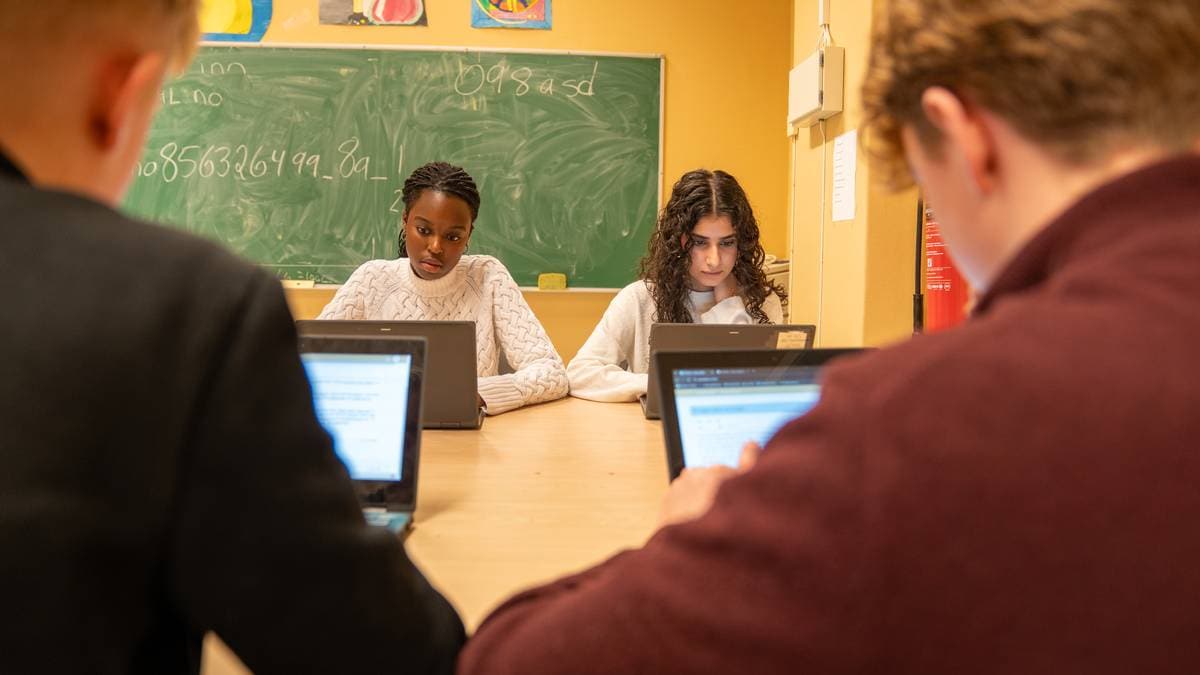
A new survey by Epinion for DR Ultra Nyt shows that only a third of Danish school pupils have been taught about AI. 56% of 9–14-year-olds say they have not received any teaching in AI, while 12% are unsure.
According to AI researcher Sine Zambach, this is problematic, as it can create an A team and a B team, where some pupils learn to use AI actively and critically, while others only acquire basic skills or misuse the technology without real learning. She supports the idea that technology understanding (teknologiforståelse) should be a compulsory subject in school rather than just an elective, which the government plans to introduce in 2027/2028.
The Minister for Children and Education, Mattias Tesfaye, agrees that too few children are taught about AI, and indicates that AI will in future be included across more subjects throughout the school.
At Lindevangskolen in Copenhagen, pupils have already worked with SkoleGPT and report that they have gained a better understanding of AI – both as a useful tool and as a technology that requires critical judgment.
A new study from Norway shows that pupils who do not use AI in their schoolwork risk getting lower grades than those who use the technology actively. According to teachers and experts, AI has become an important tool in teaching, and pupils who do not learn to use it effectively risk falling behind.
Many schools have not yet developed clear guidelines for the use of AI, which creates uncertainty among both pupils and teachers. Experts urge schools to integrate AI into teaching in ways that promote learning without compromising pupils’ independent work.
SkoleGPT in the spotlight after controversial responses
The Danish chatbot SkoleGPT has received considerable media attention over the past week. After DR’s test of the chatbot, it emerged that it gave detailed descriptions of self-harm and suicide when asked for help with school assignments on these topics. This shocked experts, who pointed out the potential dangers of such easy access to this type of information for children and young people.
The developers behind SkoleGPT, Center for Undervisningsmidler (CFU) ved Københavns Professionshøjskole (the Centre for Teaching Materials at Copenhagen University College), have responded quickly to the criticism and changed the chatbot’s responses so that it no longer gives descriptions of self-harm and suicide. “Stop words” and safety mechanisms have been introduced to prevent this.
Experts believe the chatbot should have had these safeguards from the start, but at the same time praise the developers’ rapid response. There is, however, an ongoing debate about whether censorship can go too far and limit topics that are relevant to teaching.
💡
If you are in crisis or having suicidal thoughts, you can contact Livslinien (the Danish national suicide prevention hotline) on 70 201 201 every day between 11:00 and 05:00. You can also chat with Livslinien at livslinien.dk.
AI challenges the foundations of academic learning
Anthropologist and associate professor Maja Hojer Bruun explains in Forskerforum how AI is changing the fundamental premises of higher education. Traditionally, written assignments have been regarded as an expression of learning, but when AI can generate texts, it becomes necessary to rethink how we assess whether students have actually acquired new knowledge.
Maja Hojer Bruun and her colleagues have reviewed research on AI’s impact on higher education and conducted fieldwork among students who use AI chatbots. They see a tendency for many to use AI primarily to save time, which can reduce academic engagement. If the text and the learning process are separated, we risk educating graduates who do not possess the knowledge and understanding we think they do.
She points out that AI is built for efficiency, whereas university programmes are based on a reflective learning process. If AI is used uncritically, it can eliminate the necessary immersion that is crucial for academic thinking. Universities should therefore not simply adapt to business demands for speed, but rather maintain a focus on critical thinking and deep learning.
The solution is not to ban AI, but to adapt teaching and assessment so that oral work and didactic reflection play a greater role. She argues that students should be more involved in discussions about the purpose of teaching and how AI can be used constructively in their discipline. In addition, teachers should be better equipped to understand how AI affects learning.
The article underlines the importance of AI literacy – not just as a technical skill, but as a critical understanding of how AI affects academic processes.