This week's news: When the chatbot lies to your students
New reports reveal that schoolchildren as young as 6 have unrestricted access to AI that hallucinates, while Norwegian teachers warn that the exam system is collapsing. Read about the consequences and the educational solutions here.
This article has been machine-translated into English. Therefore, there may be nuances or errors in the content. The Danish version is always up-to-date and accurate. Read the original Danish article here.
Here is this week’s newsletter on artificial intelligence in teaching. This week, the focus is on language models that hallucinate.
In Norway, lecturer Jørgen Ulvan Moe writes in an opinion piece about how language models are designed to sound convincing rather than to tell the truth. It is therefore important that we integrate AI as part of teaching. Otherwise, pupils are left to their own devices.
Another new initiative is AI Arenaen, which is a collaboration between Danish Foundation Models, Digitaliseringsstyrelsen (the Danish Agency for Digital Government) and the French Ministry of Culture. Here, pupils can pit models against one another, investigate the language models and, at the same time, discuss the environmental impact.
In this week’s commentary I write about why we should learn to treat every answer from AI as a hypothesis to be falsified, and why an answer that is 95% correct may be more dangerous than one that is completely wrong.
Here are this week’s three key points
Errors are a feature, not a bug We must stop waiting for “flawless” AI. Hallucinations are a built-in part of the technology, so teaching should prioritise critical judgement over blind trust.
Uncontrolled roll-out raises concerns DataEthics sounds the alarm that very young school pupils have access to chatbots without age verification.
Solutions are emerging from the ground up New books and tools such as AI Arenaen show how to work critically with AI in teaching.
Happy reading.
AI hallucinations are here to stay, and that is a challenge for teaching
Jørgen Ulvan Moe, a lecturer in Vestfold Fylkeskommune, writes in the Norwegian Utdanningsnytt about a fundamental problem with AI in education. Hallucinations are not a temporary glitch but a permanent part of the technology. The real problem is not the incorrect answers in themselves, but that far too few pupils and teachers understand how systematic the issue is.
Large language models such as ChatGPT are trained to produce likely text, not truthful information. They generate answers that look like facts, without any real understanding of whether the content is actually correct.
Therefore, Jørgen Ulvan Moe believes that pupils should never be left alone with AI as an information source. Instead, we should treat AI output as a possible starting point for further inquiry, never as definitive knowledge.
Several researchers support the need for critical AI literacy. While meta-analyses show small to moderate learning effects from chatbot use, expectations are often unrealistically high. We should focus less on efficiency and more on critical and responsible use.
Anne Grønlie, a senior teacher at Drammen upper secondary school, strongly criticises the Norwegian authorities’ lack of action on AI and examinations. For three years, teachers have warned, yet there are still no solutions that can prevent pupils from cheating with AI – in either written or oral exams.
The problem is simple: pupils bring their own computers to the exam, and invigilators cannot detect whether they are using AI. Pupils can therefore easily have AI prepare answers at home and bring them into the exam.
The situation pressures pupils to use AI just to keep up grades-wise. Grønlie describes how the school has been completely overwhelmed by the technology. When the government was confronted with the criticism, State Secretary Sindre Lysø gave a vague response and pointed to irrelevant measures such as mobile phone bans in lessons.
The Directorate for Education and Training (Udir) also faces strong criticism. This concerns earlier failed exam tasks, for example where pupils were asked to analyse poems written by staff in the directorate, and, more generally, being invisible and paralysed in the face of AI.
DataEthics warns: AI chatbots in the folkeskole have been introduced without oversight
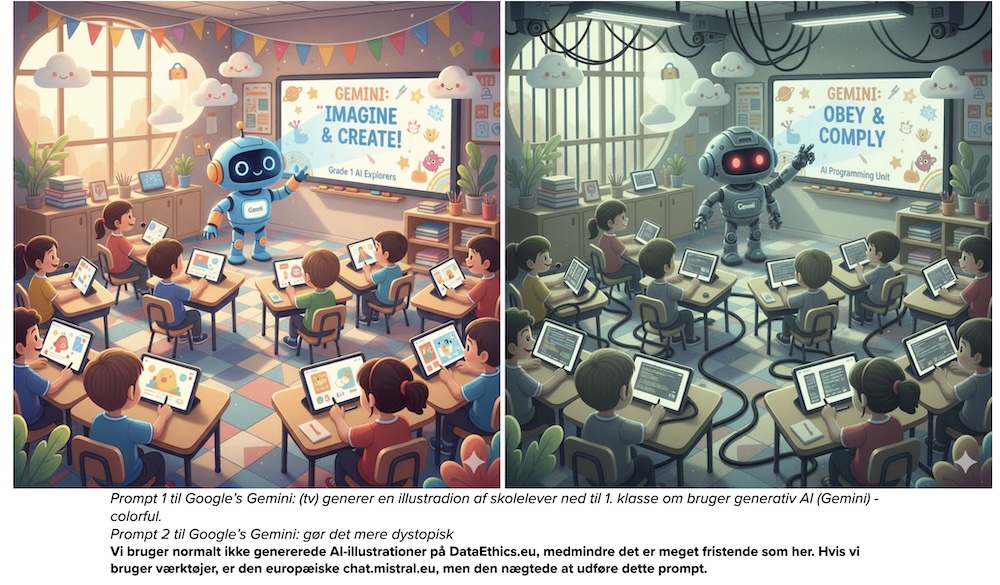
At the think tank DataEthics, Mie Oehlenschlager and Pernille Tranberg write about how Google Gemini is now available to children as young as six via schools’ Chromebooks. According to DataEthics, this roll-out has happened without public debate, pedagogical consideration or political regulation.
The authors raise particular concern about how AI is taking over central parts of pupils’ learning, such as idea generation, feedback and text production, which may weaken pupils’ motivation and their ability to develop independent writing and thinking skills.
Mie Oehlenschlager and Pernille Tranberg also criticise the fact that while Denmark is working to introduce age verification on social media, AI chatbots such as Gemini are not covered by similar protections – despite their potentially equally far-reaching influence.
The authors stress that this is not about being against technology, but about ensuring that children are not used as test subjects in a pedagogical and technological development whose consequences we do not yet understand.
Denmark risks losing its position as a knowledge nation
In an opinion piece in Politiken, Kaare Nielsen criticises current Danish education policy for being driven by short-term ideology and a lack of understanding of future needs. He emphasises that Denmark, as a knowledge-based society, should invest massively in education, research and new technologies such as artificial intelligence to secure welfare, prosperity and independence in a globalised world.
Kaare Nielsen points out that other countries, particularly China, are strategically investing in innovation and advanced technology, including artificial intelligence, which gives them a significant head start. In Denmark, by contrast, we see reduced university intakes, fewer specialists and shortened degree programmes, which, he argues, run counter to the needs of both the present and the future.
Instead, he calls for a new national vision for education that combines strong academic environments with broad and inclusive educational opportunities, while also taking technological changes such as artificial intelligence seriously.
Upper secondary school (gymnasium) teacher Lars Due Arnov and folkeskole teacher Esben Bækkelund Jensen have published the book AI i historie – Praksis og øvelser, which gives history teachers concrete tools to integrate AI into teaching. The book is their response to teachers’ demand for practical guidance and didactic support.
AI is already part of many pupils’ everyday lives, but use is often unconscious and uncritical. History teaching should therefore both explore AI as a learning tool and as an object of critical analysis. This is a natural connection in a subject where source criticism plays a central role.
Lars Due Arnov emphasises that pupils need to understand how AI generates its answers, and they should learn to examine and challenge chatbot outputs in a critical way.
The first chapter of the book and four exercises are freely available on the book’s website. Requires a free login.
AI Arenaen aims to strengthen pupils’ critical eye on AI
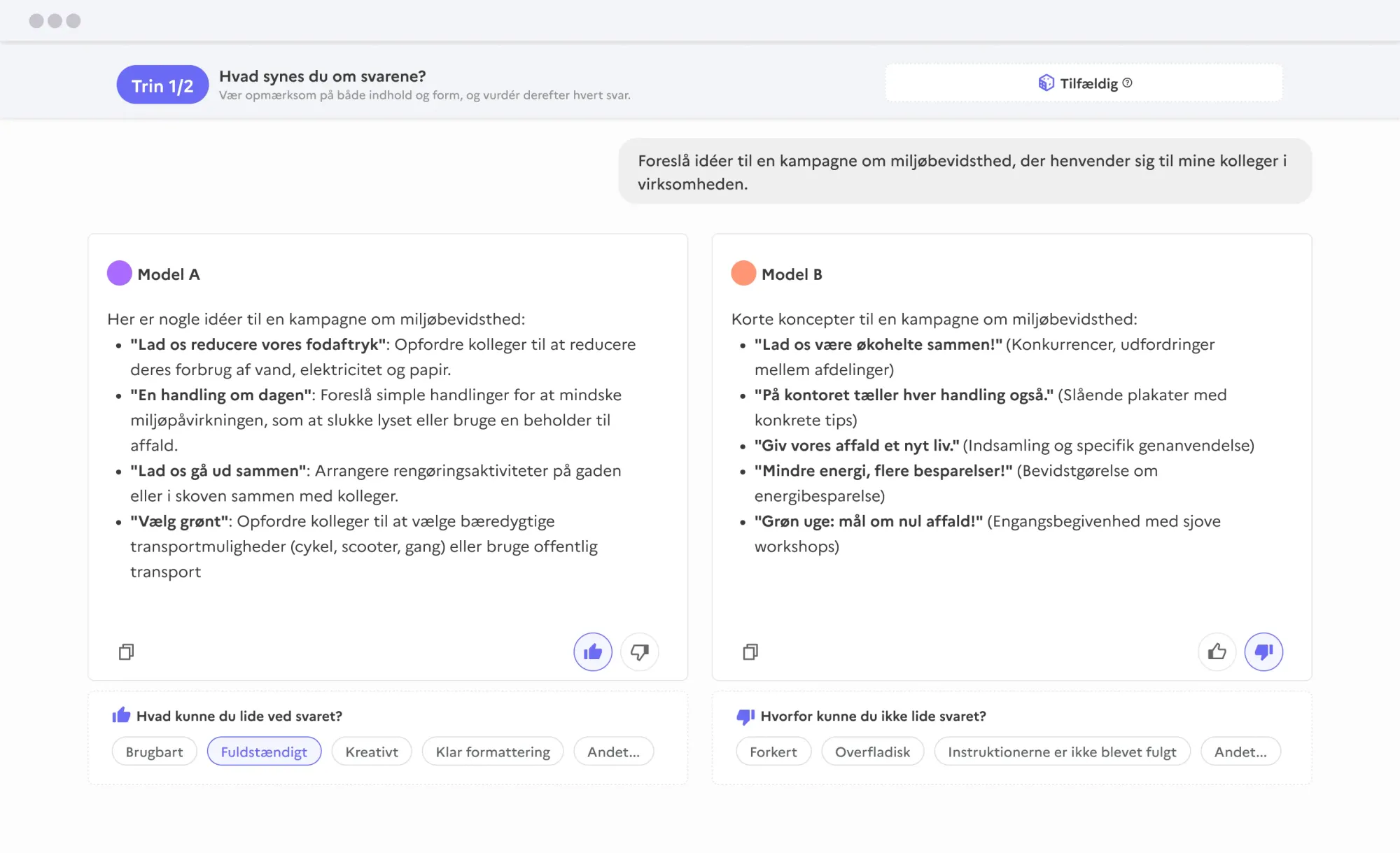
AI Arenaen is a free tool, developed in collaboration between Danish Foundation Models, Digitaliseringsstyrelsen (the Danish Agency for Digital Government) and the French Ministry of Culture.
The aim is to enable users to test and compare answers from different AI models without knowing which models are responding. In this way, users can practise their critical thinking, identify differences in quality and relevance, and learn how different AI models handle the same questions.
Arenaen also functions as a learning environment, where users gain insight into the environmental impact of their queries and become aware of generative AI in practice.
The platform can be used as a pedagogical tool in teaching, enabling teachers to introduce pupils and students to how AI works and how to assess and compare different answers.
This week’s commentary: An AI answer is a hypothesis, not a definitive answer
Last week’s news cycle was paradoxical.
On the one hand, we have language models with built-in hallucinations. They do not lie deliberately, but they make false statements with such confidence that even experts can be left in doubt. On the other hand, we could read that children as young as 6 have access to these “hallucinating machines” via their school computers, without our having had a debate about it.
When we give talks about AI, we often discuss how to ensure that an answer from AI is actually a good answer. That requires both deep subject knowledge and rigorous source evaluation to judge the quality.
As Claus often says, we should learn to see every answer, no matter how authoritative it seems, as a hypothesis to be tested and, if possible, falsified, rather than an established truth.
If we approach the technology in that way, we turn its greatest weakness, hallucinations, into a pedagogical strength. The task is no longer to get the answer from the AI, but to use one’s subject expertise to test it. That is where the real learning lies.
But there is another danger here. As the linguist Emily Bender writes, a system that is right 95% of the time may be more dangerous than one that only hits the mark 50% of the time.
When the technology is that accurate, we trust the output blindly and forget to check the remaining 5% where the errors hide. And even if the chatbot’s answer is correct, we lose something essential along the way: the opportunity to build the information literacy that arises when you search for, evaluate and compare knowledge yourself.
This is precisely the challenge Claus has examined in more detail in an article about the new AI search engines, which you can read here: