This Week's News: When Students Miss Their Own Voice
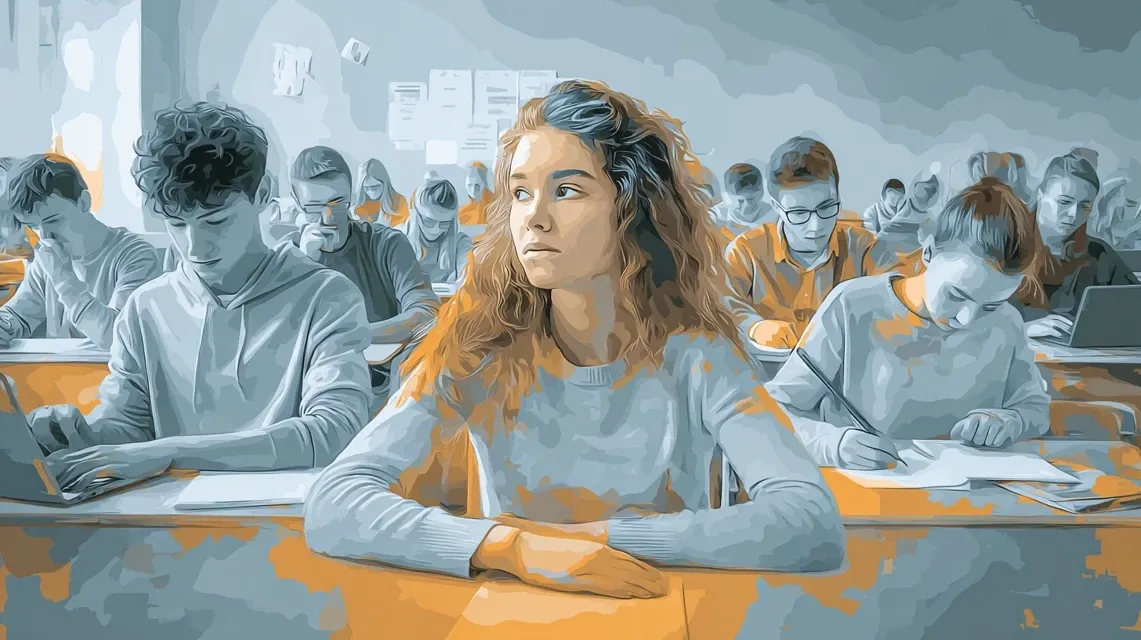
Teachers and experts are calling for new exam formats and a rethink of pedagogy. But behind those demands lies something else the students themselves have articulated: they miss their own voice when AI has polished the text.
This article has been machine-translated into English. Therefore, there may be nuances or errors in the content. The Danish version is always up-to-date and accurate. Read the original Danish article here.
Here is this week’s newsletter on AI in education, where we bring together the past two weeks’ news. I have selected the most interesting items, and you can see the full list with all news directly on our news page.
In the just over four years we have been writing about AI in education, the same questions have recurred again and again. Is it cheating to use AI? Should we ban the technology in schools? Will AI take our jobs? Do pupils become less able by using AI? But the stories in this newsletter are more concrete and contain clearer demands.
Gymnasielærernes Hovedbestyrelse (the executive committee of upper secondary school teachers) demands new exam formats in Politiken. They write that major written assignments should be combined with an oral defence, that oral examinations should be rethought, and that certain subjects should be examined without a computer.
But it is not only exams that are at stake. AI is also changing written language in everyday life, and we came across an interesting article by PhD student Nurul Hassan Mohammad. Over two years he has interviewed STEM students in Toronto, and several of them can no longer hear their own voice in their writing.
Researcher Marie Falkesgaard Slot warns against switching off the screens, because it will disadvantage precisely those pupils who do not have digital competence from home.
There is no consensus. There is no single answer. But beneath the calls for new exam formats lies something else, which the students themselves have put into words. In this week’s commentary I write about the young people who are losing their voice to AI.
Happy reading.
Upper secondary school teachers call for political frameworks for AI in teaching
In an opinion piece in Politiken, Gymnasielærernes Hovedbestyrelse warns that AI can no longer be treated as an ordinary digital tool. The authors believe the technology changes the very conditions for learning, because pupils can quickly obtain answers, analyses and finished assignments without going through the academic process themselves. In their view, this creates a real risk that the capacity for independent thinking and academic immersion will be weakened.
The executive committee particularly highlights exams and assessment as areas requiring swift changes. They propose, among other things, that major written assignments should always be combined with an oral defence, and that oral examinations should be rethought with tests without preparation or without a computer in selected subjects. At the same time, they call for transparency, data security, equal access to tools, and a national language model tailored to education. They highlight Estonia as a possible role model.
The point of the piece is that AI does not change the purpose of the upper secondary school (gymnasium), but challenges the way that purpose should be met. Therefore, teachers need time, competences and professional frameworks to decide when AI belongs in teaching.
Norwegian AI committee: AI requires new examinations and new study skills
The chair of a Norwegian AI committee, Anders Malthe-Sørenssen, believes AI challenges the integrity of educational institutions. The committee is investigating how higher education in Norway should handle AI, because the technology can increasingly solve tasks at a level comparable to students. This makes it harder to assess whether students actually have the necessary subject understanding, and whether their submissions are the result of independent work. The committee therefore recommends, among other things, more controlled forms of examination, for example in-person and oral exams, and that take-home assignments are combined with a controlled component. The committee also advises against the use of AI detectors, because the technology is developing so quickly that it is not possible to determine with certainty whether a text was written with AI.
However, the committee also points out that AI is not only a challenge. The technology can strengthen learning and serve as a kind of superpower for students, but it can also short-circuit learning processes if it is used to skip thinking, practice and academic immersion.
Anders Malthe-Sørenssen therefore judges that all students will in future need AI skills, including knowledge of how language models work, the legal and ethical frameworks that apply, and how AI affects learning and thinking.
Trine Hemmer-Hansen, teacher and Folkeskolen’s Danish and PE adviser, argues for keeping Exam format B in oral Danish, even though AI has made it easier for pupils to get help with preparation.
She believes the format is particularly important for pupils who are academically challenged, because they are able to start the exam with something familiar and prepared. Here, teachers and examiners can still assess whether the pupil genuinely owns the presentation, because the subsequent conversation can reveal whether the pupil understands the text and can think, speak and answer independently. She therefore sees Exam format B as a form that can both include more pupils and still put AI in its place.
When AI‑polished text no longer sounds like the student
In The Conversation, PhD student Nurul Hassan Mohammad from the Ontario Institute for Studies in Education at the University of Toronto writes that the debate on AI in education is missing an important perspective. While institutions focus on cheating and detection, a deeper shift is taking place that concerns identity.
He describes how writing is not just a technical skill, but also a way in which students position themselves as future professionals. A recurring concern among the students is that AI-generated drafts are technically strong, but “don’t sound like me”.
It’s better writing, yeah, it sounds good and helps get a better grade. But it’s kinda generic. Like anyone could’ve written it, not just me.
Nurul Hassan Mohammad warns that if AI-generated writing becomes the implicit standard of good work, students risk locating the expertise in the tool rather than in themselves.
He suggests that educators shift focus from product to process, for example by asking students to compare an AI-generated paragraph with their own and explain what changes in tone, clarity and reasoning.
Mikkel Aslak warns against both uncritical use of AI and bans in school
On LinkedIn, teacher and author Mikkel Aslak writes that AI can harm learning if the technology is used without clear boundaries in school.
His point is that both uncritical use and outright bans risk doing harm. When pupils let chatbots take over writing and thinking, what he calls cognitive outsourcing occurs, where important learning processes are skipped. Conversely, a blanket ban leaves pupils without the tools they need to navigate critically and responsibly in a world with AI.
Mikkel Aslak particularly highlights the social downside, where some groups of pupils will learn to switch the technology on and off appropriately, while others risk falling through the cracks. His solution is neither uncritical enthusiasm nor prohibition, but clear frameworks and pedagogy that retain the friction and independent thinking.
Generative AI is changing the conditions for learning and assessment in upper secondary school (gymnasium)
In an opinion piece in Jyllands-Posten, Jesper Tække, associate professor and PhD in media studies at Aarhus Universitet (Aarhus University), writes that the debate about AI in upper secondary school (gymnasium) is trapped in too narrow a frame of cheating and control. The traditional link between assignment production, learning and assessment is being destabilised, because generative AI shifts the uncertainty from the act of writing itself to the evaluation of whether the text is academically sound.
The education system cannot regulate itself back to a previous state, but must instead work experimentally with Bildung as the focal point. Students must both learn to manage AI in academically sound ways and to take the community into account.
Merete Riisager: AI requires a fundamental rethinking of project-based pedagogy
Merete Riisager writes in Uddannelsesmonitor that AI has changed the premises for teaching and education. She believes that project-based pedagogy is under pressure because, with AI, students can quickly have answers produced without necessarily engaging with the subject matter themselves.
She points out that project work requires maturity, motivation and concentration. That is already difficult for many students, and AI makes it easier to skip the cognitive work. She therefore believes that traditional homework, group work and projects must be rethought so that students actually develop insight, understanding and independent thinking.
Merete Riisager proposes more analogue teaching, with computers put away and students working with the material through dialogue, reading, drawing, presentations or embodied forms of expression. The aim is to ensure that students acquire new knowledge, store it in long-term memory and use it actively.
Stop educating children for a world that no longer exists
Psychotherapist Puk Elmsdal argues in Information that both the pensions debate and the school’s self-understanding rest on an outdated picture of the future. She points out that AI is already changing the way people learn, work, write, calculate and think, and that it is therefore problematic if the school continues to educate children on the basis of fixed notions of knowledge, working life and competences. When large parts of both knowledge work and production can be created with a prompt, she argues, it becomes less important merely to reproduce standardised knowledge. Instead, creativity, curiosity, the capacity to create and the desire to keep learning become decisive.
Puk Elmsdal emphasises that AI can process existing knowledge but not necessarily create new ways of understanding the world. The school should therefore give children knowledge and skills as tools for inquiry and creative processes rather than shaping them according to rigid goals.
The commentary culminates in a broader question about the purpose of schooling in an AI‑infused future, where students should not only be prepared to fit into an existing labour market but also be equipped to create solutions to problems we do not yet know.
Researcher warns against switching off screens in school
In an opinion piece in Weekendavisen, Marie Falkesgaard Slot, docent (associate professor) at the Department of Teacher Education at Københavns Professionshøjskole (University College Copenhagen), writes that the current screen debate is too one-sided. Through 20 years of fieldwork at 25 schools in Denmark, Norway and Sweden, she has seen both the digital distraction hegemony of the 2010s and what she calls the post-digital classroom, where teachers effortlessly switch between analogue board, marker pens and digital learning resources. Her point is that the problem did not start in school but at home, and that removing computers from teaching will create inequality.
She argues that AI makes the question even more urgent. If the technology is not part of everyday life in the classroom, students can neither develop algorithmic understanding nor learn to work with it critically and creatively. For some students, she says, school is the only chance to become digitally competent.
Comment of the week: When the student can no longer hear themselves
It’s better writing, yeah, it sounds good and helps get a better grade. But it’s kinda generic. Like anyone could’ve written it, not just me.
I am sure many reflective and capable students around Danish upper secondary schools are saying the sentence above to themselves. AI is involved in their texts. Grades are rising, and the texts are getting better, but students are missing their own academic voice.
We have spent a long time discussing cheating, the challenges around exams, and how to ensure students don’t use AI where we don’t want it.
But the quote from the Canadian student says something about what we have not talked enough about. It tells us that AI not only changes what students hand in. It also changes who they are when they hand it in.
Mikkel Aslak calls this process cognitive outsourcing. It is a good term, but it does not quite capture what the students in Toronto describe. They have not just outsourced a task. They have outsourced a voice.
This is about something irreplaceable. The academic voice emerges when the student fights their way through the material. If the struggle disappears, the voice disappears. And students have begun to feel it. Now they are saying it out loud.