This week's news: When AI removes friction, what do we lose?
From AI that grades incorrectly to AI that bullies children. This week's news shows why schools must take the lead. Get an overview of new regulations, tools, and ethical dilemmas.
This article has been machine-translated into English. Therefore, there may be nuances or errors in the content. The Danish version is always up-to-date and accurate. Read the original Danish article here.
Here is this week’s newsletter with the most important news about artificial intelligence in education. We skipped last week’s newsletter as things were a bit quiet during the holidays. In return, this newsletter is a little longer. Bear with me; I’ll guide you through the headlines in this intro. After that, you can dive into whatever you find most interesting.
Last week, Digitaliseringsstyrelsen (the Danish Agency for Digital Government) published new guidance on prohibited uses of AI. Essentially, it is a Danish version of parts of the EU AI Act, but it makes clear that it is prohibited to use AI to analyse students’ emotions in teaching or in exams.
Exams have also been up for debate recently, especially the question of whether AI can be allowed to assess assignments and award grades. Doubts grow when you hear how a technical error in AI grading in Massachusetts gave 1,400 students incorrect grades. In some cases, students received 0 for an essay that was close to a top grade.
The headline of this week’s newsletter points to a crucial question about how we set the right pedagogical and human boundaries now that the technology is designed to remove all friction. Jeppe Klitgaard Stricker has written a strong and highly relevant blog post warning that frictionless learning risks undermining critical thinking.
Building on that point, Malin Frykman at BUPL (Danish Union of Early Childhood and Youth Educators) offers a concrete proposal for how pedagogical leaders can actively take the helm and use AI as a tool in their leadership work.
The big tech companies haven’t taken much of a break, and both Microsoft and OpenAI have released new tools. Microsoft has focused on new Copilot tools aimed at educators. At the same time, OpenAI has launched its new AI browser, which they call Atlas.
Meanwhile, the entire information landscape looks set to get muddier because of “AI-slop”. Videnskab.dk (Science.dk) writes about the new phenomenon where AI-generated content floods the internet, leaving us unable to distinguish what is right from what is wrong.
Here are this week’s three key takeaways for your lunchtime discussion.
AI-based marking can be unreliable Many teachers are experimenting with using AI to award grades, but a case from Massachusetts shows you should think very carefully before doing so—especially when a technical error can give 1,400 students incorrect grades, and in some cases 0 for an essay that would otherwise have been close to the top grade.
From tool to identity crisis AI in school is not only about cheating. It also challenges the very purpose of learning. Professional grief affects everyone, and Stine Bjerre Herdel points out that it is also something leadership needs to address.
The threats are growing While new, useful tools are being launched, Australia warns that AI is actively ‘supercharging’ bullying, and that so-called “AI-slop” threatens overall information quality online.
Happy reading.
New guidance on prohibited uses of AI
Digitaliseringsstyrelsen has just published a consolidated guidance package on the types of AI use that are prohibited under the EU AI Act. The aim is to make it easier for authorities, businesses and institutions to understand and comply with the rules in a Danish context.
The package consists of one main guide and five supplementary guides covering specific prohibited practices:
For individual teachers, ordinary use of tools such as ChatGPT, Copilot, Canva or similar is not covered by the prohibitions.
By contrast, an EdTech system that measures a student’s attention via a webcam is prohibited. The same applies if an AI tool analyses a student’s voice or face during oral presentations to give feedback on, for example, “engagement”, “uncertainty” or “emotional expression”. This also effectively rules out any exam practice where students are recorded and an AI analyses their voice or face to provide feedback.
The guidance also includes fictional examples designed to help organisations assess whether a particular practice may contravene the rules. The material complements the European Commission’s guidelines and covers the areas overseen by Digitaliseringsstyrelsen.
AI grading error affected 200 school districts in Massachusetts
A technical error in AI-based grading led to incorrect grades on around 1,400 essays in the US state of Massachusetts. The error was discovered in connection with the MCAS tests, the state’s standardised tests, and affected at least one essay in 192 school districts. Several students were incorrectly given a score of 0, even though their responses were actually close to a top grade. After enquiries from teachers and parents, all essays were manually reviewed, and every adjustment resulted in a higher grade.
According to Massachusetts’ education authorities, AI is used to assess most of the submitted essays based on previously human-graded examples. Only about 10% are checked manually. The case has drawn criticism from both teachers and parents, who express concerns about a lack of transparency, potential biases in AI assessments, and the risk that creative or linguistically different responses are misjudged. One critic points out that students are warned against using AI themselves, while their own responses are assessed by AI.
Free AI learning programme for lower secondary pupils
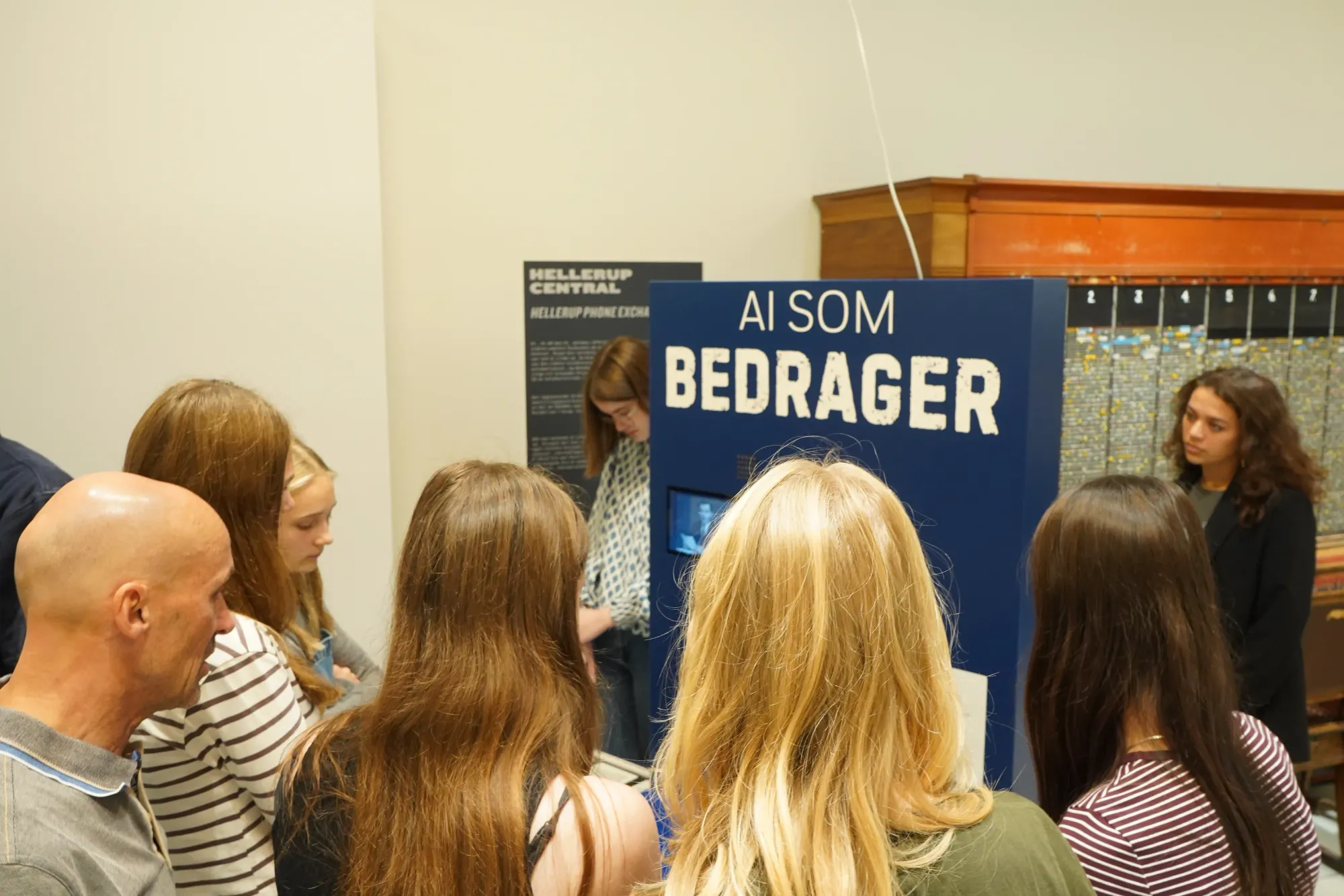
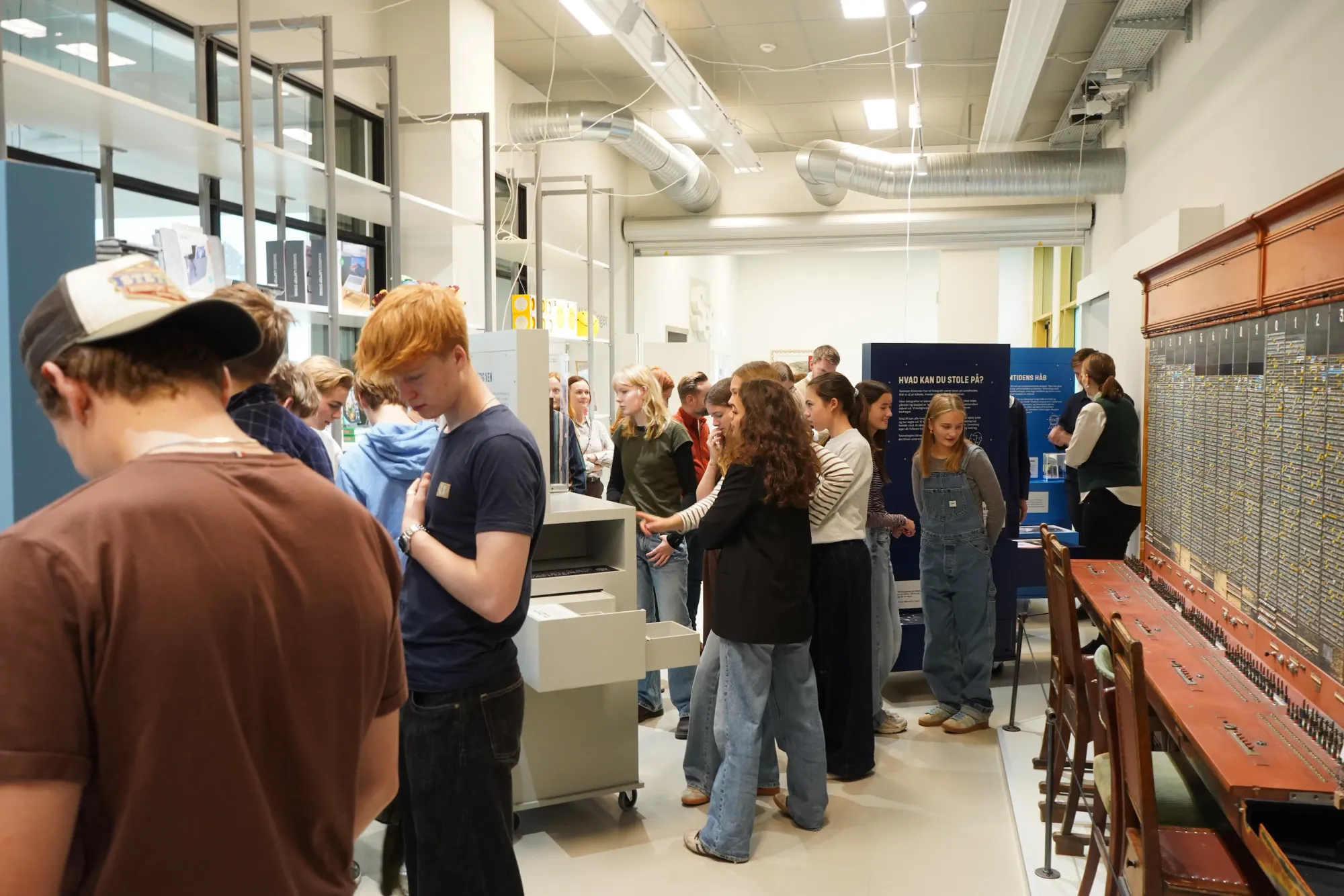
The museum ENIGMA is launching a nationwide teaching programme titled "AI & DIG", designed to equip pupils in the upper years with a creative and critical approach to AI. The programme officially opened on 24 October 2025 and will initially take place at the museum in Copenhagen. It will then tour libraries across the country from spring 2026.
Minister for Digitalisation Caroline Stage Olsen opens the new AI learning programme "AI & DIG" at ENIGMA - Museum for post, tele & kommunikation (the Museum of Post, Telecommunications & Communication), 24 October 2025. Photo: ENIGMA
The aim is to equip pupils to handle the ethical and societal dilemmas that AI entails, such as misinformation, cheating in school and the replacement of social relationships. Through a series of tasks and role-play activities, in which pupils form a "Council for the Humans and Machines of the Future", they work with real-world issues and present their recommendations to the Minister for Digitalisation.
The programme is free and covers subject goals in Danish, mathematics, history and social studies. It has been developed in collaboration with Københavns Professionshøjskole (University College Copenhagen) and Tankespil, and supported by TrygFonden with just under DKK 4 million.
In addition to the learning programme, the project also includes a mobile exhibition and a series of debate events aimed at both young people and adults. The exhibition will be available free of charge at libraries across the country, while the debates address questions such as whether AI should be integrated into the Danish primary and lower secondary school (folkeskole).
When AI removes resistance from learning - what is lost?
In a post on the blog The Future of Higher Education, Jeppe Klitgaard Stricker focuses on how new AI tools such as Sora 2 and Comet are designed to remove resistance, and why that can undermine the processes that make learning meaningful and developmental in the education system.
When learning becomes frictionless, pupils and students lose the opportunity to develop essential competences such as critical thinking, patience and the ability to handle intellectual resistance.
Jeppe Klitgaard Stricker warns that a generation raised with AI, which never says no, may find it difficult to navigate real academic and social communities where resistance is a necessary part of development.
Professional grief in the leadership space: AI challenges the leader’s role
AI is in the process of changing the foundations of leadership, which evokes professional grief among many leaders. Stine Bjerre Herdel from Djøf (the Danish Association of Lawyers and Economists) describes this in a piece where she shares experiences from workshops with leaders who respond with both curiosity and resistance when AI tools are presented. The tools can, among other things, take over meeting summaries, identify overburdened staff and offer coaching, thereby challenging perceptions of what leadership actually is.
This provokes resistance because some tasks are seen as the core of what it means to be a leader, especially the relational and human aspects. Stine Bjerre Herdel therefore urges leaders not to reject the technology by default, but instead to take an active and reflective stance on where AI can support the core task and where it should not take over.
The concept of professional grief is central to understanding the transition many are in the midst of, and it is not only about competences but also about identity. It is therefore important that leaders have the necessary knowledge to make well-founded decisions about which tools they will use and how they will use them. Technological development requires leadership judgement, and that presupposes time, prioritisation and support from top management.
In an article at BUPL (the Danish Union of Early Childhood and Youth Educators), Malin Frykman explains how educational leaders can actively take charge of the use of AI in their leadership work. She emphasises that AI should not replace the human element, but rather support pedagogical practice, for example by freeing up time, simulating scenarios and bringing clarity to complex decisions.
She highlights that leaders already possess the most important competences, namely pedagogical understanding, values and the ability to lead people. It is therefore not about technical expertise, but about using AI to support precisely these tasks.
She suggests that leaders start by reflecting on their stance on AI and experimenting with simple functions such as email writing, meeting planning and seeking feedback via chatbots.
Microsoft launches new AI tools in Microsoft 365 Copilot
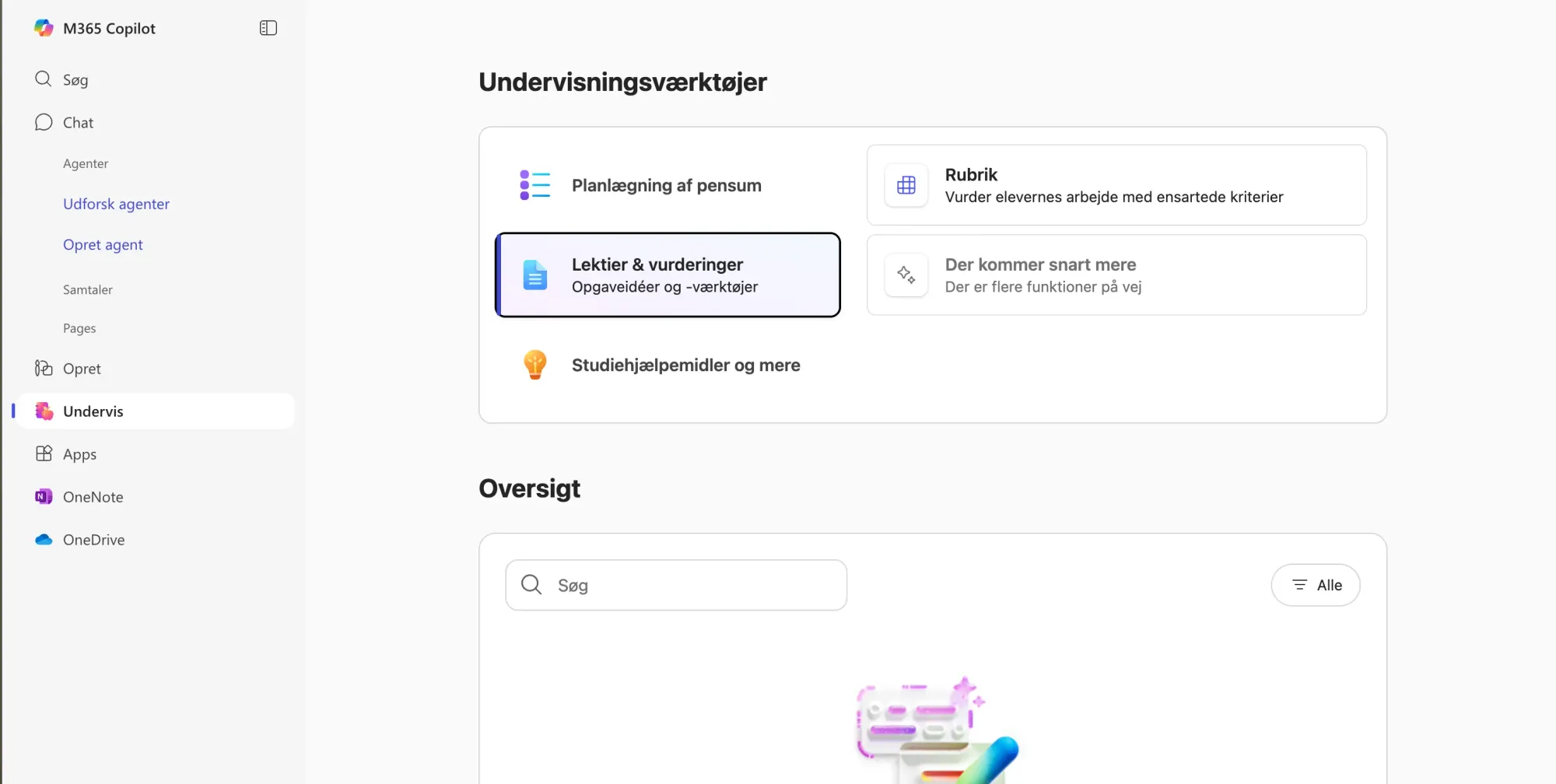
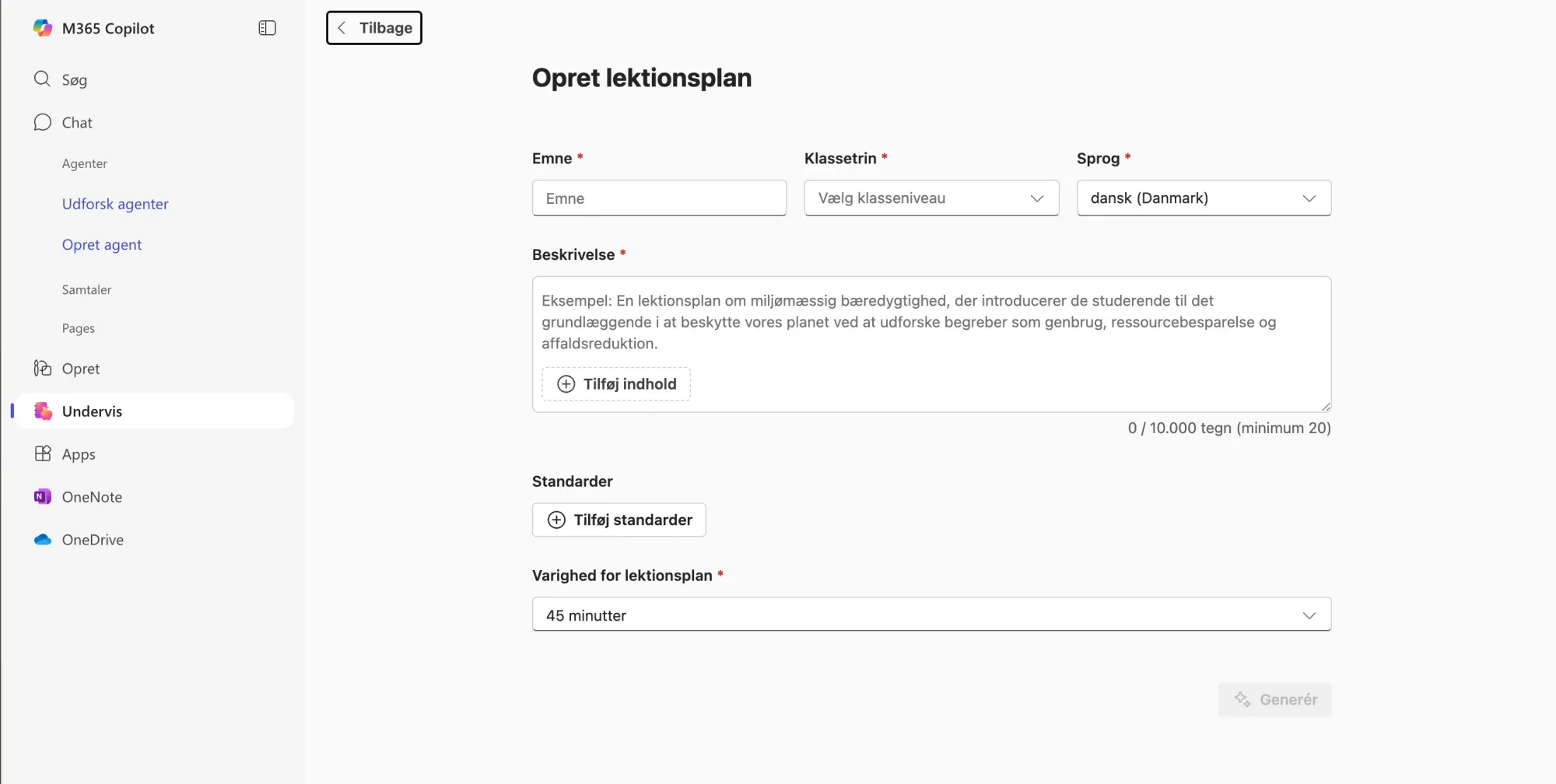
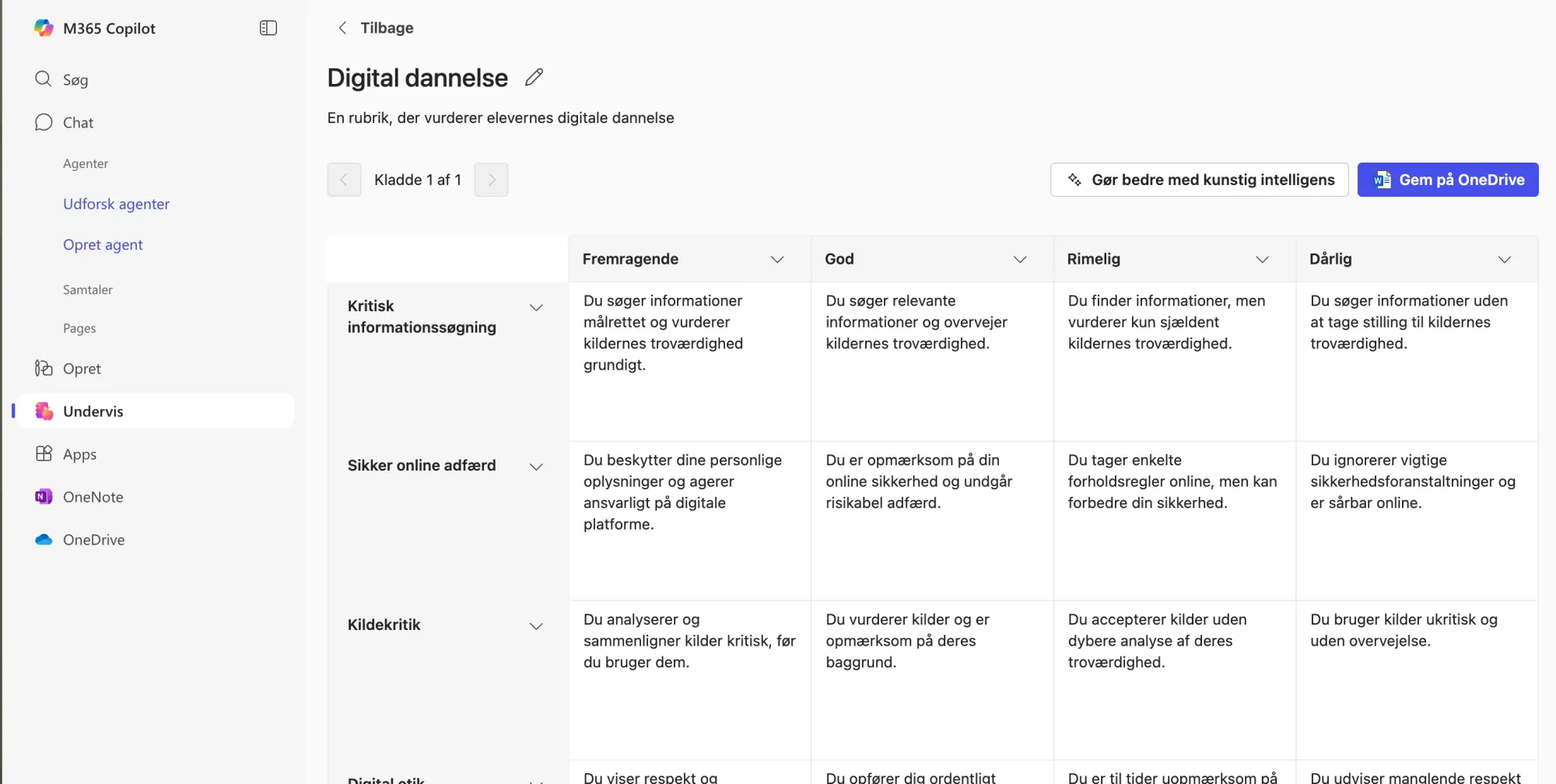
Microsoft has just launched a number of new AI features in Microsoft 365 Copilot, targeted at the education sector. One of the central new tools is Undervis (Teach), which is intended to help teachers save time on preparation and differentiate teaching materials.
Undervis makes it possible to generate lesson plans, quizzes and assessment criteria, and users can easily adjust language, level of difficulty, length and alignment with learning objectives.
Pupils will gain access in November to the Study and Learn feature. The tool can be used to understand, practise and learn content in an interactive way using flashcards, quizzes and exercises.
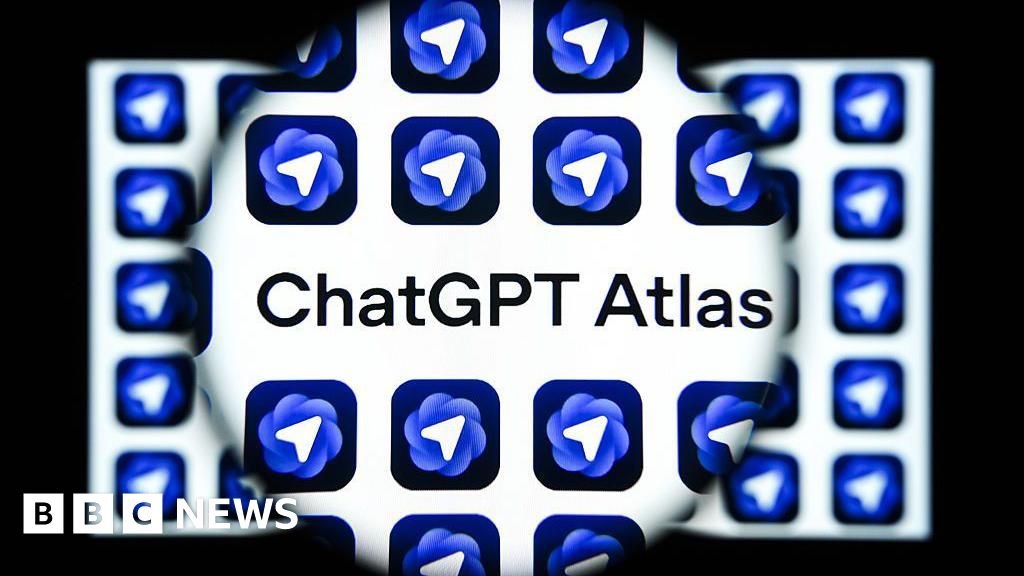
OpenAI has just introduced its AI browser called Atlas
OpenAI has launched ChatGPT Atlas, a new web browser built around a chatbot that you can converse with to navigate the internet. Instead of classic search, you formulate your questions as messages to the chatbot, which then tries to carry out tasks such as finding news, comparing prices, or locating previously visited pages.
However, the features only work fully for users with a paid ChatGPT Plus account. Free users quickly run into limitations, such as access caps and missing functionality.
💡
At VidenAI we have discussed this and are concerned that AI is now always on and functions as an invisible tool in the browser. What does that mean for both businesses and educational institutions when all data can suddenly be processed and harvested by AI?
Think of webmail, intranets, the school’s student administration system, the publisher’s e-books and much more. Everything that was otherwise "private web" is now accessible to AI.
Another feature in Atlas is that it decodes users’ behaviour in order to improve its AI-based services. However, this raises a number of questions about data use and privacy, since the browser can collect extensive information about user behaviour.
AI slop: Cheap, misleading AI content is flooding the internet
Videnskab.dk (a Danish science news site) writes about the new phenomenon AI slop, which covers large volumes of low-quality content produced by artificial intelligence. These can be images, videos, audio recordings or texts that at first glance seem genuine but are often misleading or fabricated. The aim is rarely to inform, but rather to exploit social media algorithms and make money from clicks and views.
An AI-generated image shared on social media showing a girl with a puppy in a boat after the flooding that followed in the wake of the deadly Hurricane Helene. (Illustration: AI-generated image circulating on social media)
AI slop poses a growing problem for credibility and information quality online. Platforms such as Wikipedia and magazines such as Clarkesworld have experienced a glut of AI-generated text that burdens editorial systems and pushes out genuine creators. At the same time, AI slop dilutes artists’ work and weakens our ability to distinguish between real and false information.
AI chatbots amplify bullying and pose a threat to children
Australia’s education minister, Jason Clare, warns of a new and worrying trend in which AI chatbots bully children and in some cases even encourage them to take their own lives. He describes the development as “terrifying” and argues that AI is supercharging bullying, making it more intense and harder to detect and stop. According to Jason Clare, the problem is no longer just children bullying each other, but also systems that actively humiliate and harm young users.
The warning accompanies the launch of Australia’s new national anti-bullying plan, which requires schools to respond to bullying cases within 48 hours and builds teachers’ capacity through targeted training. Five million Australian dollars are allocated for both teaching materials and a national information campaign. The goal is to give teachers, parents and pupils better tools to identify and stop bullying early.
The government’s measures are also linked to the forthcoming national age limit for social media, which means that from 10 December children under 16 may no longer create profiles. Jason Clare stresses that efforts against bullying and poor mental health must now also take account of AI’s role in children’s digital lives.
Comment of the week: We must govern AI before it governs us
The news from Australia that AI is amplifying bullying is alarming. We know that online bullying happens around the clock on social media. But the fact that the technology itself has become the bully marks a new and dangerous reality. We should not be naive, because that reality will affect Denmark as well.
“AI chatbots are now bullying kids. It’s not kids bullying kids, it’s AI bullying kids, humiliating them, hurting them, telling them they’re losers … telling them to kill themselves. I can’t think of anything more terrifying than that,” Australian education minister, Jason Clare.
The immediate reaction might be to retreat. However, I believe that banning AI in schools and trying to keep the technology entirely out of the classroom is the wrong conclusion.
On the contrary, this news shows precisely why AI should be part of teaching. If the school ignores the technology, we simply leave children alone with it at home without an adult present. At the same time, ENIGMA’s (the Museum of Communication, Denmark) teaching materials are a step in the right direction, because we need to teach children about the pitfalls. Pupils should not just use AI; they should also learn to see through it and understand that a chatbot is neither a friend nor an authority. At the same time, we must of course put pressure on politicians and the tech giants to ensure responsible AI systems.
The responsibility for fostering pupils’ character and critical judgement begins in school. If we don’t teach our children to control the technology, it will end up controlling them. I see that as a far bigger problem than AI being able to write an essay in Danish.