This Week's News: UNESCO Defines AI Competencies for Educators

•
10 min read



In this week’s newsletter, we delve into a number of new, interesting articles about generative AI and its significance for the education sector. Each has been hand-picked to give you the best insight.
Happy reading!
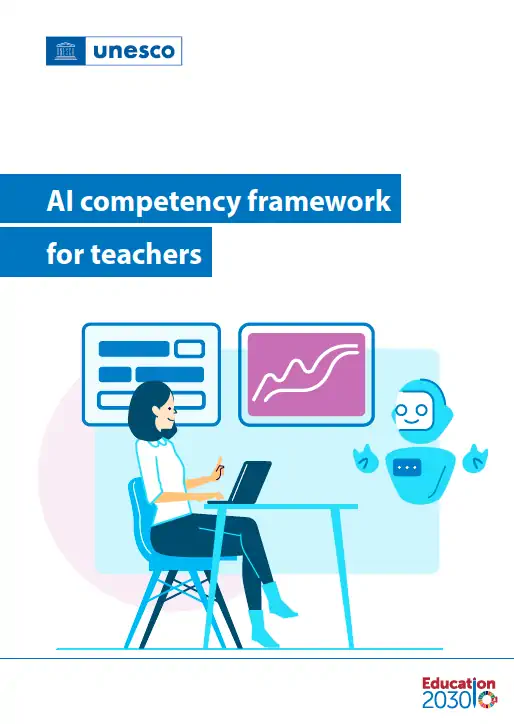
UNESCO has just published a comprehensive guide to the competences teachers need to master to integrate generative AI into teaching. The report, AI Competency Framework for Teachers, presents 15 specific competences divided into five main areas: human-centred thinking, AI ethics, AI fundamentals and applications, AI pedagogy, and AI for professional development. Each of these areas is also divided into three levels of progression: acquisition, deepening, and creation. The aim is to give teachers around the world a structured approach to understanding and using generative AI in their teaching.
Read the full report here:
Jeppe Klitgaard Stricker has also taken a closer look at the report, and we recommend reading his excellent review, where he also writes about the Artificial Intelligence Assessment Scale (AIAS).
 Jeppe Klitgaard Stricker

Many teachers fear that AI, such as ChatGPT, makes things too easy for students and thus hinders their learning. In an article on Videnskab.dk, Sine Zambach, assistant professor at CBS (Copenhagen Business School), explores the question and concludes that AI can serve as a valuable learning tool—if used correctly. AI can help students understand complex material and act as a tutor that makes difficult topics more accessible.
But Zambach also highlights the concern that students may be tempted to use AI as a shortcut, which can lead to superficial learning without depth. It is therefore important that teachers adapt their teaching so that AI is used as a tool to promote deep learning. Students must still be challenged to understand processes and develop their own understanding, even when they use AI to solve tasks.
Sine Zambach’s article on Videnskab.dk builds on her book AI i gymnasiet, where she discusses how AI can be integrated into teaching, and which pedagogical approaches can ensure that students develop both cognitive and creative skills.
 See Sine’s profile

A private school in London, David Game College, has launched the UK’s first AI-taught class as part of its new Sabrewing programme. Twenty students preparing for their GCSE examinations will take part in the experiment, being taught by an AI system and using virtual reality headsets instead of human teachers.
The Sabrewing AI model is designed to tailor instruction to each student by assessing their strengths and weaknesses and adapting lesson plans accordingly. However, students will not be entirely without human contact, as there will be three “learning coaches” to monitor behaviour and support the lesson plans.
Although AI offers new opportunities to personalise teaching, it also raises questions about students’ social development, as they lack the human contact and role models that teachers usually provide.
 Eric Hal Schwartz
 Emma Stokes

Elisabeth Muth Andersen, associate professor of Danish language and communication at SDU (University of Southern Denmark), has developed the site “AI i teori og praksis” as a learning resource, primarily aimed at her students as well as others with an interest in AI. The site focuses on explaining how AI technologies work, and how they can be used for both practical purposes and in research. The content is divided into three main areas: an introduction to AI, how to use AI wisely, and how AI can be used in qualitative research.
The site also offers a range of practical advice on how to try out and evaluate different AI tools, along with references to relevant research and literature on AI and ethics.
Read more on the site: AI i teori og praksis - https://www.aiipraksis.dk


According to Dr. Wolfgang König, technical knowledge alone is no longer sufficient to master the use of AI chatbots such as ChatGPT or Microsoft Copilot. The focus is instead on developing a new kind of capability, called “chatbot literacy”, which is best acquired through hands-on experience. Chatbot literacy is about using AI tools as a natural part of everyday work, much as you would use a calculator. What matters most is understanding how to instruct chatbots effectively and to evaluate their responses critically, not necessarily knowing everything about the underlying technology. Just as you need to judge whether a calculator’s result is plausible, it is crucial to assess whether a chatbot is providing meaningful and accurate answers.
Chatbot literacy will become an essential part of education and vocational training as the use of AI becomes ever more widespread. It is not just a tool, but a core skill for the future, one that will be as important as writing emails or creating presentations.
 Maximilian Schreiner
The course is offered by Aalborg Universitet (Aalborg University) and comprises a collection of teaching videos that explore different aspects of generative AI in teaching. Alongside a series of videos, you will find reflection exercises, quizzes to test your understanding, and practical methods for integrating generative AI into your teaching. There will also be a shared space for discussions, reflections and knowledge-sharing. The micro-course is divided into 6 modules, designed so they can be completed individually at your own pace or together with a group of colleagues.
The course is in English, is open to everyone, and is aimed at teachers in upper secondary schools (gymnasier) and above.
Below you will find more information about the course and how to register.


A study (not peer-reviewed) shows that the use of generative AI can significantly increase productivity among software developers. The study involved almost 5,000 developers from Microsoft, Accenture and an anonymous company, and found that those who used GitHub Copilot saw an average productivity increase of 26%. Less experienced developers benefited in particular, while senior developers did not experience the same level of improvement.
The study suggests that AI assistants can narrow gaps in experience and skills, as newer developers markedly increased their productivity. The article also emphasises that the use of AI technology depends on individual preferences and the working environment, even though the technology is easy to integrate into workflows.
Read about the study here:

 Michael Spencer

 Pia Lauritzen

 Jane Rosenzweig




 Peter Engels Ryming

 Nilay Patel, editor-in-chief of the Verge, host of the Decoder podcast, and co-host of The Vergecast.