The Sorø meeting was supposed to be about early childhood provision. Now it's about AI. A new government wants a national AI strategy, and the question is whether it will focus on detecting cheating or on helping students learn.
This article has been machine-translated into English. Therefore, there may be nuances or errors in the content. The Danish version is always up-to-date and accurate. Read the original Danish article here.
Here is this week’s newsletter focusing on artificial intelligence in the education system.
This week’s newsletter opens with the news that the annual Sorø Meeting will this year focus on AI in education. The meeting is a prelude to the government’s announced AI strategy. It takes place on 6–7 August, and it will be interesting to see which direction it takes.
Norway has just adopted a national strategy and introduced an almost complete ban on 6- to 13-year-olds using AI. In the final years of compulsory schooling, the technology is used only when it can be supervised by the teacher. The opposite extreme can be found in the US. In The Conversation, W. Ian O’Byrne warns against a growing type of AI school, where adaptive software takes over large parts of the school day.
At the Sorø Meeting they will likely also discuss the major challenges our education system is facing—especially as generative AI takes over many of the assignments students submit. Over the past week there have been many examples of this:
Reading these articles, one cannot help but feel sad about the learning loss taking place. At the same time, the above is probably only what we see on the surface.
However, there are a number of voices pointing in a different direction.
In addition to the above, we found it interesting that DMJX (the Danish School of Media and Journalism), RUC (Roskilde University) and SDU (University of Southern Denmark) report more students explicitly noting in their assignments that they have not used AI because they want to do the work themselves. They are the same tools Hugo uses. But the choice is the opposite.
– Leadership, strategy and direction with artificial intelligence
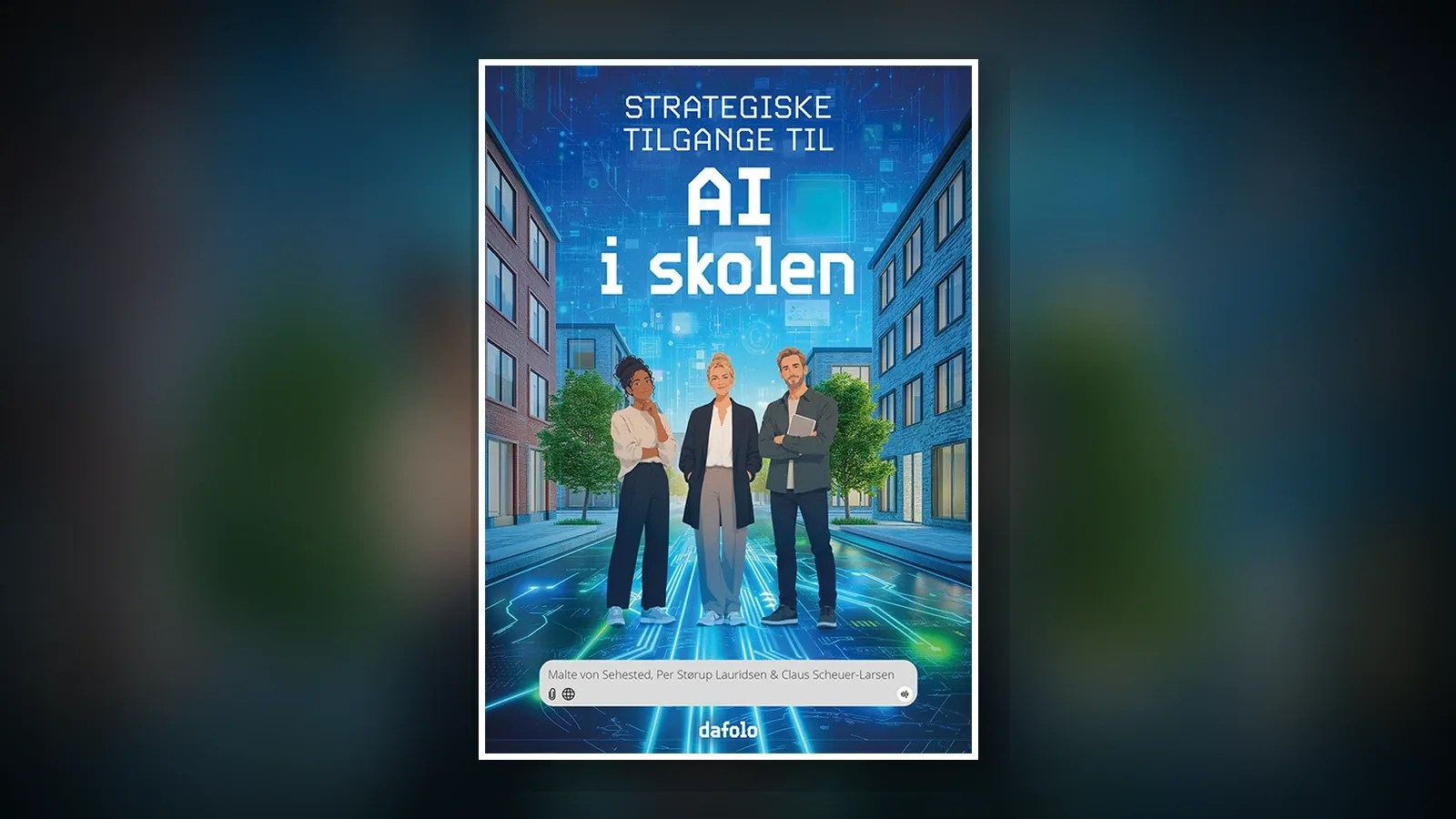
Malte’s, Claus’s and my book has just been published by Dafolo. The book is aimed at school leadership and is about how schools, leadership teams and municipalities can move from ad hoc use and uncertainty to a more deliberate and responsible practice with AI.
The book includes:
Case stories from schools and municipalities working strategically with AI.
A shared language and overview to talk about governance, shadow AI, professional expertise, assessment and responsibility.
Reflection questions, ideas for workshops and concrete process tools that can be used directly in leadership teams, subject teams and pedagogical development programmes.
Free webinar: Strategic approaches to AI in school
Learn how AI can be handled as a shared pedagogical and leadership matter – not just another digital tool.
On 30 June, 13:00–14:00, we are hosting a free webinar and offering a taster of some of the book’s central points and practice examples. The book Strategiske tilgange til AI i skolen looks more closely at leadership, strategy, governance, teaching and concrete workshops that can be used in AI work at school.
The webinar is relevant for school leaders, pedagogical leaders, teachers, guidance counsellors, consultants and others working to set direction for AI in school. It is particularly relevant if you want a more collective, responsible and practice-oriented starting point for work with AI in teaching, preparation and school development.
AI will be the main theme at this year’s Sorø Meeting
This year’s Sorø Meeting, held on 6–7 August, will focus on AI in the school and education sector. The original theme was the early childhood (daycare) sector, but it has been changed after a new four-party coalition government signalled a national AI strategy in its government platform.
Norway introduces near-total ban on AI in the youngest year groups
Reuters reports that from the coming school year the Norwegian government is introducing an almost complete ban on pupils in the youngest classes using generative AI.
The ban applies to pupils aged 6 to 13 (grades 1–7), while pupils aged 14 to 16 may only use the tools cautiously and under teachers’ supervision. Only in the oldest year groups are pupils to learn to use AI appropriately so they are prepared for further education and working life.
Prime Minister Jonas Gahr Støre justifies the decision by saying that AI increases the risk that the youngest children skip important steps in their learning. According to him, the most important thing in school is that children learn to read, write and do arithmetic.
At the same time, Norway is allocating funds for more books, thus reversing the trend away from tablets.
USA: AI schools remove the friction children learn from
In The Conversation, W. Ian O’Byrne, associate professor of literacy at the College of Charleston, warns against a growing type of AI school in the US, where adaptive software takes over large parts of the school day. At schools such as Alpha School, pupils learn core subjects using AI tools for one to two hours a day, while the rest of the time is spent on workshops led by adult guides, who are rarely qualified teachers.
The model promises personalised learning, where each student gets the right material at the right time. But W. Ian O’Byrne points out that children learn through struggle, mistakes and conflict, and that AI schools risk removing precisely that friction.
Upper secondary school (gymnasium) student received a 12 for an assignment he hadn’t written himself
Jyllands-Posten reports on the 18-year-old Hugo (a fictitious name), who in some subjects lets AI do about 90 percent of his assignments. In English and Danish he leaves almost everything to ChatGPT and NotebookLM, and when a piece becomes too perfect, he deletes commas or asks the model to imitate his own uneven writing style so it looks like his own work.
His Danish teacher suspects him every time, but cannot prove anything. At an oral exam in social studies, where he wrote the synopsis with AI, he received a 12.
Future teachers must learn to navigate AI themselves
In Weekendavisen, Lasse Vrist writes about student teachers who use AI to take the path of least resistance throughout their studies. One of them is Alma (a fictitious name), who is 24 and a prospective Danish teacher. She has not submitted a single assignment without artificial intelligence.
She does not feel she is cheating, but when Weekendavisen calls Københavns Professionshøjskole (University College Copenhagen), it turns out, to her own surprise, that she actually is.
At the same time, after last year’s exams the chief external examiners for the teacher education programmes noted that the students had become suspiciously good.
Eight out of ten students at Aalborg Universitet (Aalborg University) use AI
Uddannelsesmonitor (a Danish education news site) reports on a new survey from Aalborg Universitet, in which 84 per cent of students say they use generative AI daily or weekly in their study work. Eight out of ten judge that the technology can enhance their learning, and three quarters believe they are good at using it critically and responsibly.
Behind the figures, however, lies a widespread uncertainty: 54 per cent of the students are worried about being accused of cheating, and it looms large in their study practices.
More than 4,200 students and 766 members of teaching staff responded to the survey.
A warning against leaving AI teaching to social media
In an opinion piece in Uddannelsesmonitor, professors Lene Tanggaard and Ole Sejer Iversen, together with Allan Kortnum, chair of Danske Erhvervsskoler og -Gymnasier (the association of Danish vocational and upper secondary schools), argue that the announced national AI strategy cannot wait.
The authors warn against the strategy becoming bogged down in questions of cheating, control and examinations.
If the education system does not take the lead, algorithms and technology companies will shape not only young people’s understanding of AI, but also the very way they learn.
Head of learning calls for better teaching rather than AI bans
In Skolemonitor, Jette Andersen Nedergaard, head of learning at Kata Fonden (the Kata Foundation), writes that the real challenge with AI in the Danish primary and lower secondary school (folkeskole) is not the technology but the methods used in teaching. AI particularly challenges teaching in which pupils are to reproduce knowledge or find a single correct answer, because that type of task can be solved quickly by a chatbot.
When pupils instead work inquisitively with open problems, AI becomes a tool that requires understanding and judgement to use well.
The teacher’s role thus becomes more important. Not as a supplier of ready-made answers, but as a guide who asks questions and challenges pupils’ assumptions.
Chief consultant calls for more pedagogical imagination
Søren Pjengaard, chief consultant at VIA University College, writes in Uddannelsesmonitor that the education system is often organised as if people learn in the same way, at the same pace and through the same forms of teaching.
We speak warmly of diversity and inclusion, but in practice we adapt people to the logics of the system. His point is that teaching is not only method, but a meeting between people, subject and world, which requires presence and professional judgement towards the individual pupil.
Professor warns against AI in the upper secondary school (gymnasium)
In Gymnasieskolen, Mikkel Flyverbom, professor at Copenhagen Business School and an expert in digital transformations, warns that students are increasingly using chatbots as outsourcing tools that do their work for them. A large part of learning, he argues, comes from carrying out time-consuming and difficult tasks, and it is often the very process and friction that create learning.
He therefore calls for more bounded and subject-anchored technologies, parts of teaching entirely without AI and more resources for human contact, so that AI becomes one tool among many.
Professor calls for focus on teachers’ professional expertise in the encounter with AI
In an opinion piece in Altinget, Jan Alexis Nielsen, head of department and professor at Institut for Naturfagenes Didaktik (the Department of Science Education) at Københavns Universitet (University of Copenhagen), writes that the special knowledge required to teach a subject is given too low a priority in Denmark. His point is that teachers’ subject-didactic judgement becomes crucial now that AI is changing what it means to write, calculate and work inquisitively, and where the EPX is simultaneously to be developed. He urges the government to use the forthcoming natural science strategy to take teachers’ professional expertise just as seriously as pupils’ results.
Journalism programmes are seeing responsible AI use
Writing in Journalisten, Minna Skau reports that the three Danish journalism programmes at DMJX (Danish School of Media and Journalism), RUC (Roskilde University) and SDU (University of Southern Denmark) are encountering great curiosity and a strong sense of responsibility among students in their engagement with AI. Head of Department Henrik P. Berggren from DMJX says that problems with cheating are smaller than one might fear, while Head of Studies Louise Kjærgaard from SDU finds that more students state explicitly in their assignments that they have not used AI because they want to do the work themselves.
This week’s commentary: The questions that come after
Hugo’s Danish teacher suspects him every time there’s a written assignment, but she can’t prove anything. He deletes a couple of commas and asks ChatGPT to imitate his uneven style so the submission slips through more easily. She asks the question everyone asks first: How do I detect it? That question has no answer. Detection is a battle the teacher loses before it begins.
I see it every time we go out to give talks. Roughly speaking, you can divide the room into ‘before’ and ‘after’ questions. The ‘before’ questions are about the technology. Does it work? Can students cheat? These are questions of control, and they are necessary to ask.
The ‘after’ questions only arrive once you have worked with AI long enough. Then they turn inwards. Away from the technology. Towards the subject. What should the subject develop in the student that must not be lost? Where is the productive friction I do not want to automate away? They are no longer questions about AI. They are questions about the teaching itself, asked through AI.
But finding the core also means seeing what is not.
Cutting back your subject hurts. You let go of material you have taught and loved. It is a professional grief. But the teacher cannot do the cutting alone. It is not she who determines the content of the subject. The curricula do that, and they were written for a time before AI.
If we are to make room for the core, the curricula must be opened up and rethought. A teacher who has to cover everything never gets to ask what is worth covering.
The question is not whether we can catch Hugo. It is what the subject should be able to cultivate in him that no machine can.