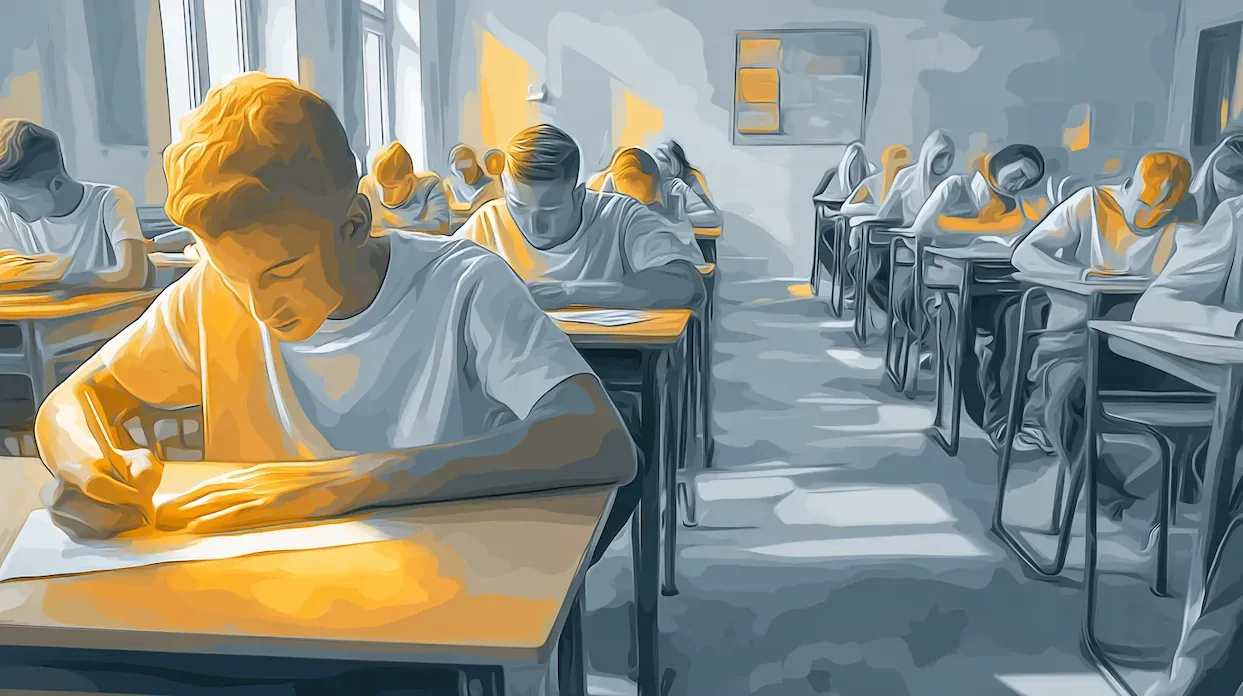
Examiners declare the written assignment dead, and a Berlingske editorial warns that honest students are losing the race for grades. This week's newsletter focuses on exams as the arena where the AI debate is now truly heating up.
This article has been machine-translated into English. Therefore, there may be nuances or errors in the content. The Danish version is always up-to-date and accurate. Read the original Danish article here.
Here is this week’s newsletter on artificial intelligence in education.
We are in the middle of the written and oral exams and, as is customary at this time of year, there is once again a focus on AI and assessment. For what happens when a chatbot can solve the task the student is meant to be assessed on?
Several university external examiners believe the answer is clear. René la Cour Sell, chair of De Erhvervsøkonomiske Censorkorps (the Business Economics External Examiner Corps), declares the stand-alone written assignment dead as an examination format. At four of the five universities with a history programme, an oral defence of the thesis has already been introduced.
At home, Søren Jacobsen Damm paints a particularly uncomfortable picture in a Berlingske leader. The biggest problem is not the student who cheats. It is the honest student who refrains from unregulated AI help and therefore risks losing the race for grades to classmates with top marks for AI‑assisted assignments.
While we in Denmark are discussing what happens with AI in exams and teaching, the EU’s Ministerråd (the Council of the European Union) has for the first time treated AI and education as a distinct education policy topic. It places the teacher at the centre as a guide and critical thinker regarding how AI should be integrated into teaching.
Both thus point to the same thing. AI is not something we can simply legislate our way out of. It is something people must learn to live with.
Happy reading.
External examiners call for exams and learning objectives that fit AI
Uddannelsesmonitor reports that several university external examiners believe that AI makes it necessary to rethink both examination formats and learning objectives. René la Cour Sell, chair of De Erhvervsøkonomiske Censorkorps (the Business Economics External Examiner Corps), declares the stand‑alone written assignment dead as an examination format. He compares AI to a new “shadow‑uncle” who helps students more effectively than earlier forms of informal assistance.
The problem is not only the form of examination, but also the learning objectives. La Cour Sell calls for objectives that test reflection, perspective and the ability to select and deselect theory and method, because only then can examiners assess more than the written product itself.
Hans Henrik Appel from the history external examiner corps says that a good account is no longer enough, because AI can produce it itself. At four of the five universities with a history programme, an oral defence of the thesis has already been introduced.
The examiners also emphasise that AI offers an opportunity to raise standards, if programmes adapt assessment to the new reality.
In an opinion piece in Weekendavisen, former Minister of Education Merete Riisager writes that AI risks making students academically weaker, and that the answer is a rethinking of both teaching and assessment formats. She compares AI to the search engine, which was invented before schools had taken a position on it, and warns against repeating that misstep.
Her main point is that teaching and forms of assessment are inextricably linked: If the project assignment and take‑home task can be solved by a chatbot, they cease to function as documentation of what the student can do.
We are becoming less intelligent – and it is happening disturbingly fast
Merete Riisager argues that teachers should set more on‑site tests, oral exams and tasks completed by hand under supervision, so that students are once again compelled to think for themselves. She acknowledges that AI has its advantages, but insists that the major gains from the technology must not replace the fundamental work of learning to read, write and think. The piece also criticises the political level for acting too slowly and for spending more energy telling a positive story about the school than on giving teachers clear frameworks.
RUC associate professors reject the claim that project‑based pedagogy is especially vulnerable to AI
In Uddannelsesmonitor, Hans Ulrik Rosengaard and Louise Yung Nielsen respond to Merete Riisager’s criticism of project‑based pedagogy. They agree with much of what she says, but reject her claim that project work in particular is especially exposed to AI. In their view, the take‑home essay and the mock exam are at least as affected.
When students choose their own topic and method, that freedom must be matched by a strong responsibility for the product. That responsibility is demonstrated in an oral examination where the student, unaided, can account for processes, formulations and calculations. The way forward is not to abolish project‑based pedagogy, but to raise the level of ambition and maintain that AI‑free zones can only be established in regulated examination settings.
Students’ use of AI calls for adult guidance rather than bans
Associate Professor Anja Lea Olsen writes on her blog that the debate about AI and teaching often stalls because participants talk past each other when discussing AI and learning.
She takes her starting point in Merete Riisager’s op‑ed in Weekendavisen, where AI is described as a serious threat to education. Anja Lea Olsen acknowledges that AI has created a kind of homework apocalypse. Written take‑home assignments have lost much of their value as a reliable yardstick of a student’s academic ability. This is not only because a chatbot may have written the assignment, but also because it is often unclear how the assignment came into being.
At the same time, she stresses that the problem with take‑home tasks is not new. Schools have never been able to be entirely certain that a home‑produced assignment solely reflected the student’s own academic performance. Students have previously been able to get help from parents and friends or use aids that were not part of the task.
AI has therefore not created the problem from scratch, but has made it bigger, clearer and harder to ignore. This means that the discussion should not only be about cheating, but also about how teaching and assessment need to be adapted to a new reality.
Mikkel Aslak warns against both uncritical use of AI and bans in schools
On LinkedIn, teacher and author Mikkel Aslak writes that AI can harm learning if the technology is used without clear parameters in schools.
His point is that both uncritical use and outright bans risk doing harm. When pupils let chatbots take over writing and thinking, it leads to what he calls cognitive outsourcing, where important learning processes are skipped. Conversely, a blanket ban leaves pupils without the tools they need to navigate critically and responsibly in a world with AI.
Mikkel Aslak particularly highlights the social downside, where some groups of pupils will learn when to opt in and out of using the technology, while others risk falling through the cracks. His solution is neither uncritical enthusiasm nor bans, but clear frameworks and pedagogy that preserve productive friction and independent thinking.
Honest upper secondary school (gymnasium) students are losing the grade race to AI
In an editorial in Berlingske, food editor and commentator Søren Jacobsen Damm writes that AI has not only made it easier to cheat in the gymnasium. The biggest problem, he argues, is another: the honest students who refrain from unregulated AI assistance risk being overtaken by classmates who receive top marks for AI-assisted assignments and thereby gain access to the most sought-after degree programmes. He compares the situation to an arms race, where it becomes hard for the individual student not to be tempted.
His solution is not to remove AI from teaching, but to separate the technology from examinations. Year marks should count for less, while exams without digital aids should carry more weight. He calls for national, political decisions now, not in five years, so that misuse of AI does not erode the value of the country’s education programmes.
The EU Council of Ministers puts the teacher at the centre of AI in education
A press release from Rådet for Den Europæiske Union (the Council of the European Union) states that the Council of Ministers has adopted a set of conclusions on AI in the field of education. It is the first time the relationship between AI and teaching has been treated as a standalone education policy topic in the Council.
Teachers are not only users of AI – they are guides, mentors and critical thinkers who help pupils navigate an increasingly complex digital world. It is crucial to support them with the right training, the right tools and the right safeguards to make AI a success in education.
Dr Athena Michaelidou, Minister for Education, Sport and Youth, Republic of Cyprus
The conclusions call for an ethical, safe and human-centred approach and keep the teacher at the heart of the learning process. The Council recognises both the benefits, including more inclusive teaching and less administration, and the risks, including diminished autonomy, over‑reliance on the technology, and pressure on pupils’ concentration.
Yoshua Bengio warns against AI that imitates humans and weakens our learning
In Berlingske, Mikkel Fyhn Christensen interviews the Canadian professor Yoshua Bengio, who is often called the godfather of AI because he helped develop the foundations of the technology.
Over the past six months, Yoshua Bengio has visited 12 capitals to warn that development is heading in the wrong direction, but that there is still a way forward. His main complaint is that AI is being developed to imitate humans, and that commercial language models work best when they act as social companions. That creates services that promote laziness and dependency instead of learning.
For educators, Bengio’s point about human agency is particularly relevant. He describes how children experience agency when they learn: they meet resistance, learn from it, and develop an appetite for more. That resistance, for Yoshua Bengio, is central to being human, and he sees a danger in AI taking over more and more tasks without humans taking on new ones.
At the same time, he warns against power being concentrated in a few tech companies, because the enormous sums behind AI concentrate control in few hands. Bengio says he does not know how much time there is, but estimates that there are at least two and hopefully five years to change course.
Five questions and five answers to add nuance to the political AI debate
In a LinkedIn post, Professor Ole Sejer Iversen sets out an FAQ with five questions and answers about AI, because, in his view, the political debate is drowning in platitudes and imprecise analogies. His concern is that an imprecise knowledge base leads to poorer political decisions.
Among other things, he rejects the comparison between social media and smoking, because smoking is demonstrably deadly, whereas the harms of social media concern well‑being and democratic participation. He also rejects the idea that AI can be reduced to “social media on steroids”, as AI is not a single product but a technology already used in research, healthcare, teaching and public administration.
The core of the post is the argument that education must be part of AI policy. Regulation alone is not enough, Ole Sejer Iversen argues, because technology is also about competences, values and society’s capacity to act for itself. If we do not teach the next generation to develop AI that supports freedom of thought, equality and democracy, we leave the creative power to regimes that do not share those values.
In that context, technological literacy is not about more screen time, but about understanding, analysing and taking a critical stance towards digital technologies – often with pen and paper, long before a computer is switched on.
Five questions and five answers about Artificial Intelligence It’s great that AI is being addressed politically by competent national politicians and placed within an international framework through the EU 👏 👏 👏. But the AI debate is in danger of drowning in platitudes and imprecise analogies. This risks creating an evidence base that leads to worse policy decisions. Here’s a short FAQ for the Ascension Day holiday: Question: Are social media worse for children than smoking? Answer: No. Social media can negatively affect wellbeing, concentration and democratic participation, especially among children and young people. This should be taken seriously. But smoking is a well-documented physical health hazard with directly fatal consequences. If we want to pursue responsible digital policy, it must be based on evidence, proportionality and nuance, not moral panic or exaggerated comparisons. Question: Is AI “social media on steroids”? Answer: No! AI is not a single platform or a single product. AI is already used in research, healthcare, education, energy, public administration and social media. The problems with social media are primarily about business models and the algorithmic attention economy, which can and should be regulated. Question: Is AI a threat to society? Answer: Yes and no! AI can be misused, just like any other powerful technology. Therefore, high-risk applications should be regulated nationally, by the EU, and ideally globally. But if we reduce the entire field of AI to fear and threats, we weaken our own ability to shape development democratically – for Denmark and for Europe. Question: Why should education be part of AI policy? Answer: Because technology is never only about regulation. It is also about competences, values and society’s capacity to act. It is about both individual and societal resilience. We achieve this through regulation and education working together. If we do not teach the new generation to develop AI technologies that uphold freedom of thought, equality and democracy, we cede creative power to regimes that do not necessarily share our values or our view of how AI should be used. AI policy without education is not responsible policy. It is the dismantling of our ability to be informed citizens in a digitalised society. Question: Is technology understanding about more screens in school? Answer: No. Technology understanding is not about more screen time or digitalisation for its own sake. It is about understanding, analysing, creating and critically engaging with digital technologies and AI. It often takes place with pen, paper, dialogue and practical experiments long before a computer is switched on. The subject is built on 11 content areas: • Data and information • Algorithms • Programming • Computer systems • Networks and communication • Human–computer interaction • Design and development • Digital creativity • Modelling and simulation • Privacy and security • Responsibility and empowerment | 18 comments on LinkedIn