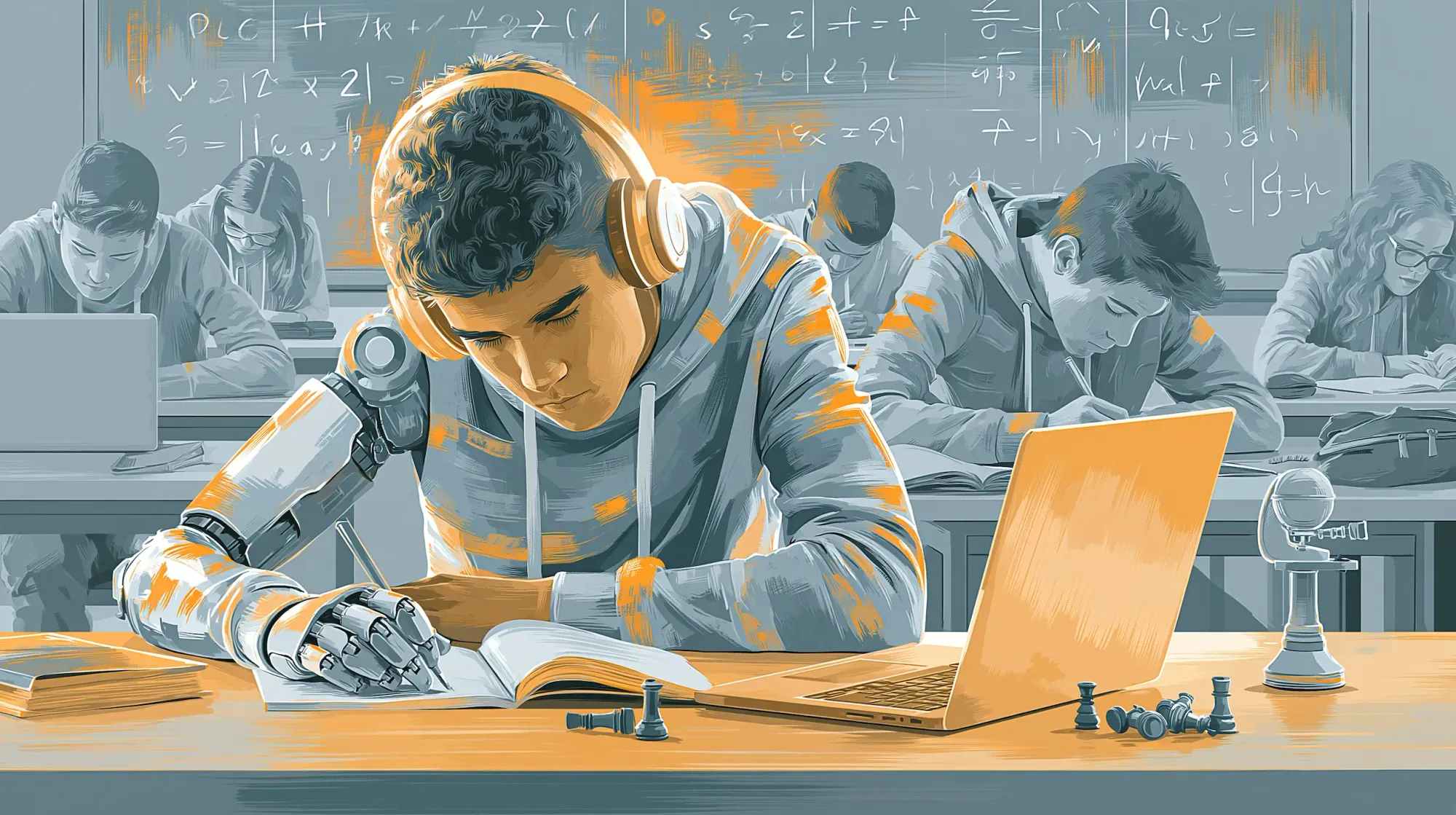
The first cohort that had AI throughout high school has graduated. 25 teachers agree: Students can do less than their grades suggest. This week's newsletter is about what we do now.
This article has been machine-translated into English. Therefore, there may be nuances or errors in the content. The Danish version is always up-to-date and accurate. Read the original Danish article here.
Here is the final newsletter of the school year before we head off for the summer break. Here on the blog we have followed developments since 2022, when ChatGPT appeared. Much has happened since, and the end of this school year has been strongly marked by the fact that it is the first AI cohort to graduate. This means that the students who have had access to the technology throughout their time in upper secondary school (gymnasium) have now completed their education.
And in Berlingske (a Danish daily newspaper), 25 teachers from across the country come forward and say, that students can do less than their year grades suggest. A Danish teacher states that written homework is effectively dead.
So what are the education programmes doing about it? The answer is mostly about exams:
AU associate professor Carsten Bergenholtz says that today’s best chatbots deliver responses at a grade-12 (top mark) level from a single prompt, and he now advises against traditional take-home exams.
Astrid Galsgaard and Anders Buch write that the debate has long been stuck between cheating and efficiency and overlooks the real question: What is education for?
In China they are tightening their grip and now require checks of all glasses at an entrance examination with over ten million participants, after AI glasses have become a tool for cheating.
Three countries, three completely different responses.
We will of course be back in August, but also if something major happens during July. I myself have a short article in mind about bias in the different language models, and about how the models reflect not only technology, but also the values, languages, countries and populations whose texts they are trained on.
Happy reading, and have a great summer.
Upper secondary teachers believe AI has weakened this year’s graduates
In Berlingske, 25 anonymous upper secondary teachers from across the country say that this year’s graduates have been harmed by AI. It is the first cohort that has been able to use language models such as ChatGPT and Claude freely throughout their time in gymnasium, and the teachers are unanimous: Students can do less than their year grades suggest.
Written homework is effectively dead, a Danish teacher observes. Assignments can no longer be used to assess anything at all.
Many believed that AI could level the playing field and give students from disadvantaged homes the same help that the better-off have always had access to at home. That has not happened. The strongest students use the technology with care. The weakest let it take over the work and leave gymnasium with almost nothing in their toolkit.
AU associate professor advises against traditional take-home exams
In Omnibus, AU associate professor Carsten Bergenholtz says that the chatbots failed his exam questions in March 2022. A few months later, the picture changed. Today, the best chatbots can produce answers at grade-10 and grade-12 level from a single prompt, and able students can write a thesis in a day.
Therefore, Carsten Bergenholtz and his colleagues at Aarhus BSS have largely dropped longer take-home exams. The way forward is not pen and paper, but short on-site tests, project assignments closely tied to the teaching, and longer oral defences where students must show that they understand what they have submitted.
Principal links new forms of assessment to boys’ academic underachievement
In an opinion piece in Uddannelsesmonitor (a Danish education news site), Jesper Hasager Jensen, principal at Svendborg Gymnasium, argues that students’ increasing unlawful use of AI requires rapid changes to exam formats and written homework.
He does, however, see the changes as a response to more than cheating. Exams without preparation time and portfolio assessments with AI permitted test both subject competencies and students’ ability to reflect on their own use of AI.
According to him, the combination of extrinsic and intrinsic motivation will particularly benefit boys, who are academically behind the girls.
Gymnasieskolen (the Danish upper secondary teachers’ magazine) writes that AI has changed the way students appeal grades. During the oral exams in June, principal Brian Juul from Slotshaven Gymnasium began to notice appeals that resembled legal documents.
They were longer and more formal and referred to ministerial orders and administrative law at a level he barely mastered himself. The number rose from seven or eight appeals last year to almost 20 this year. At Greve Gymnasium, principal Claus Ellekær Sommer-Madsen recognises the picture and estimates that only a single one of this year’s roughly 25 appeals was written without significant help from AI.
For Brian Juul, the concern lies in what the technology does to the student’s own understanding of the case. A chatbot does not take a view on whether the appeal is reasonable, but can write the student further into the conviction that the grade is too low. In that way, an initial dissatisfaction can grow into a legal case, where the distance between school and student becomes greater.
In Gymnasieskolen, it is described how several schools and organisations are working to make AI a support for learning rather than a shortcut that takes it over.
Claus Scheuer-Larsen, teacher and IT lead at Odense Tekniske Gymnasium (upper secondary school, gymnasium), says that the work should not start with the technology but with the subjects, and that we must determine what is so central to a subject that it must not be outsourced to a chatbot. The school has purchased computers without internet access to build friction into assignments.
Henning Romme Lund, AI adviser at Roskilde Gymnasium, says that students should use AI to think with, not to think for them, and that the school distinguishes between uses that promote learning and those that hinder it. His colleague Torben Geilman, Head of Education at the same institution, says that the focus on cheating has almost brought everything to a standstill and is creating mistrust.
Thomas Hüche Dragsbæk, teacher at Silkeborg Gymnasium, says that the work has shifted from debates about principles to the practical question of what works, including through an 'IT menu' of short modules.
Higher education should follow the upper secondary schools' lead
In an opinion piece, clinical psychologist Astrid Galsgaard and associate professor Anders Buch write that the debate about AI in education has for too long been stuck between cheating and efficiency. According to the authors, both positions miss the real question: What is education for? They praise Danske Gymnasier (the Association of Danish Upper Secondary Schools) for its new AI proposal because it dares to recognise that AI has become a basic condition requiring entirely new forms of assessment, not just more control. They argue that universities and university colleges (professionshøjskoler) should follow the upper secondary schools' example. If they do not, an untenable mismatch will arise between levels of education.
Dansk Industri (the Confederation of Danish Industry) wants to open up further to AI despite teachers’ concerns
In Berlingske, Emil Bo Rask reports that 25 upper secondary school teachers recently described how three years with AI have weakened students’ critical thinking and spelling and made them lazier. At Dansk Industri, the conclusion is the exact opposite. The teachers’ experiences are not an argument for hitting the brakes but rather fuel on the fire in the debate about opening the classroom to the technology. So says Anne Fløe, Head of Vocational and Labour‑Market Education at DI. DI’s aim is to equip young people for a labour market where AI will be ubiquitous. But that assumption does not necessarily hold. Economists Jesper Rangvid and Michael Svarer have pointed out that productivity gains are far from materialising at the pace many predicted.
AI tutors do not solve students’ lack of motivation
In The Atlantic, Jenny Anderson and Mike Goldstein write that the grand American promises of AI as a personal tutor for every single student on the planet have never been fulfilled. The challenge is that AI cannot solve what lies at the heart of all teaching. A chatbot can easily set a task that hits the student’s level precisely. But it cannot make the student sit down and do it.
The article calls it a 5 per cent problem, since only five per cent of students use the technology as intended. They are usually already motivated and come from well-resourced homes. Thus AI risks increasing inequality rather than reducing it.
Canada is giving all students free AI training and access to their own AI agents
Canada’s government has published its national AI strategy, titled AI for All, which makes education and skills one of six core pillars. The strategy promises free, basic AI training for all citizens and sets concrete targets: AI teaching should reach one million students in higher education, and over 3,000 educators should be trained using ready-made classroom learning packages. A key pledge is that all higher education students will have access to reliable AI agents so that they enter the labour market with practical experience.
AI glasses open a new front in the fight against exam cheating
On CNN, John Liu describes how AI glasses are becoming a tool for exam cheating, and that the pressure is greatest in East Asia, where a single exam can determine a young person’s future. Twice in a month, people in South Korea were caught using smart glasses for an English test. In Taiwan, an applicant to a coveted medical degree was exposed when invigilators were puzzled by his gaze and discovered that the spectacle frame was emitting heat.
Several countries are tightening up. China required inspection of all glasses at the country’s annual entrance examination, in which over ten million young people take part.