Here’s this week’s news, focusing on an exam system in crisis, while also delving into concrete solutions, Sweden’s AI reform, and a new study that questions AI’s ability to reason.
This article has been machine-translated into English. Therefore, there may be nuances or errors in the content. The Danish version is always up-to-date and accurate. Read the original Danish article here.
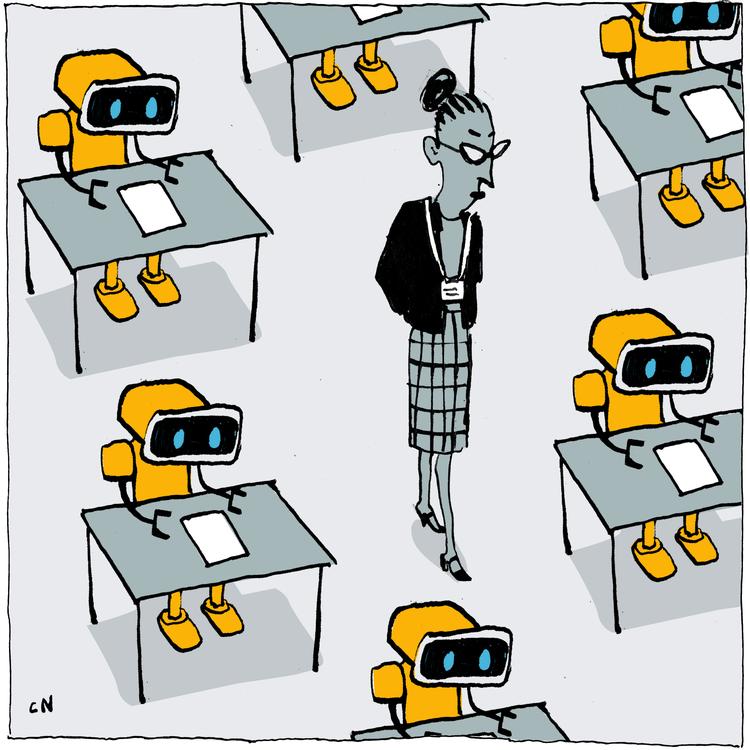
We have gathered a range of news and articles about AI in education, and this week we focus on the examination system. There have been quite a number of contributions from many different quarters, but what they have in common is that there are major challenges in continuing with an examination system that is not equipped to handle AI.
In Politiken, Anders Frikke and student chair Joachim Ekstrand Federspiel go a step further with a proposal to divide teaching into modules with and without AI. But isn’t it teachers who should be responsible for shaping the pedagogy of teaching? And don’t we need better tools and continuing professional development (CPD)?
In teaching there are also challenges in how to assess homework when the student, outside the teacher’s control, can simply use AI for the tasks.
At NEXT Uddannelse København (NEXT Education Copenhagen), director Ole Heinager and Head of AI Peter Bruus propose a radical solution: moving grading away from homework and into the classroom. This gives teachers the opportunity to assess students’ real level under controlled conditions.
More broadly, AI is a technology that has affected the entire education sector.
Fredrik Werenberg Poulsen reflects in Gymnasieskolen on his two decades as a teacher and points out how technology has gradually changed the classroom. Often this has happened without the education system keeping up.
We also look to the Nordic countries, where Sweden has an interesting approach to making the technology accessible to everyone – could we do the same in Denmark?
In Sweden they have adopted an ambitious national AI reform, giving 2.3 million citizens free access to advanced AI tools. The initiative is inspired by the 1990s home PC reform and aims both to democratise access to AI and strengthen the country’s competitiveness.
Irina Engeness, professor of digital learning, warns in a Norwegian article against meeting AI with fear and control. She points out that the technology can both free up resources and support students with special needs, but can also undermine critical thinking if used unreflectively.
An interesting debate last week concerned whether AI can reason.
On Friday a study from Apple was released, which questions AI models’ ability to reason. Even the most advanced models break down on complex logic tasks, which may indicate that they simply imitate patterns of thought without genuine understanding. This underlines the need for students not only to learn to use AI, but also to see through its limitations.
At Viden.AI, last week we published the first part of a three-part article series examining the challenges that have arisen in the wake of ChatGPT. If you have not read it, you can find it here:
An exam reform is urgent if we are to safeguard students’ writing skills
Last week, the chair of Gymnasieskolernes Lærerforening (GL), Anders Frikke, criticised Børne- og Undervisningsministeriet for not doing enough to secure exams, and said that the initiatives launched are inadequate in relation to the challenges the sector faces.
He points out that ChatGPT and similar tools threaten students’ deep thinking, which otherwise arises when you write longer, coherent texts yourself. At the same time, he highlights that written homework in particular has become meaningless, because the teacher has no way of assessing whether the student wrote the assignment themselves. He is also sceptical about returning to paper and pencil, as is happening in the language subjects. (Read more in last week’s newsletter: https://viden.ai/nyhedsbreve/ugens-nyheder-mellem-ai-begejstring-og-behov-for-kritisk-forstaelse/#eksamen)
Like many others, he therefore calls for a new form of examination that takes account of the use of AI without allowing the technology to determine the content.
Upper secondary schools (gymnasier) must adapt to AI
In Politiken, Anders Frikke, together with Joachim Ekstrand Federspiel, chair of Danske Gymnasieelevers Sammenslutning (the Danish Upper Secondary School Students’ Association), argued that teaching itself should be divided into modules with and without AI. There is a need for clear guidelines so that both teachers and students know how AI may be used.
Like many other educational institutions, NEXT Uddannelse København is also experiencing a growing challenge with students using AI in connection with submissions. In Berlingske, Ole Heinager, director at NEXT, and Peter Bruus, Head of AI, explain how teachers find it difficult to assess students’ actual academic level.
They therefore propose moving the entire basis for awarding grades away from homework and instead using the classroom as the primary assessment setting. This means the teacher can better follow how the student works, both orally and in writing, under controlled conditions.
After two decades as an upper secondary school teacher, Fredrik Werenberg Poulsen reflects in Gymnasieskolen on the impact of digital developments on teaching and highlights the need to update the education system in light of AI. He points out how the arrival of technology, from PCs and tablets to smartphones and AI, has gradually changed the classroom reality, often without the education system keeping up. This has led students to log out of the physical space and into digital worlds, challenging both learning and presence.
New AI posters from Mikkel Aslak for teaching and the classroom
On the blog AI i skolen, Mikkel Aslak has updated his popular overview poster of AI tools for teaching.
The new classroom edition focuses exclusively on approved tools for students, while the updated teacher poster includes new tools from TA Padlet, which are considered particularly interesting.
All three posters are available in full resolution and can be edited in Canva, allowing for local adaptation.
New book gives teachers 40 practical activities for using AI in teaching
Ove Christensen has written a review of the book 40 AI-aktiviteter til din undervisning: Generativ kunstig intelligens i efter- og videregående uddannelse.
Sweden has launched an ambitious national AI reform that will provide free access to advanced AI tools for 2.3 million citizens, including public employees, teachers, students and NGOs. The initiative was presented by Prime Minister Ulf Kristersson at the Sana AI Summit in Stockholm and is inspired by the 1990s home PC reform, which played a major role in the digitalisation of Swedish households.
The aim of the new AI reform is to democratise access to AI and strengthen Sweden’s global competitiveness.
Through a collaboration with Sana and the foundation Svenska AI-reformen, users gain access to Sana Agents, a platform that uses leading language models from, among others, OpenAI, Google and Anthropic.
AI in school requires new pedagogical thinking, not bans
Irina Engeness, professor and researcher in digital learning, warns against meeting AI with fear and control in school.
In an article, she points out that AI is already affecting teaching and will, in future, change both the teacher’s role and our understanding of learning. The technology can both free up resources and support students with special needs, but it can also undermine critical thinking and deep subject learning if used unreflectively.
She urges that the education sector should have a central place in Norway’s AI strategy.
Does the literature of the future have to be human-made?
The author Salman Rushdie recently expressed concern that AI might one day write books with the same quality as human authors, while at the same time rejecting the idea that AI has a sense of humour. However, a satirical remark from ChatGPT suggests the technology may be closer than many think. Language models such as ChatGPT are built for pattern recognition, and it is therefore not unlikely that, in time, they will be able to reproduce the linguistic patterns that evoke laughter, sorrow or reflection in readers.
Study from Apple challenges AI models’ ability to reason
A new study from Apple shows that even the most advanced AI reasoning models, such as Claude 3.7, DeepSeek R1 and Google’s Gemini Thinking, break down when faced with complex logic puzzles. This suggests that the models lack perseverance and strategic flexibility, traits normally associated with genuine reasoning.
The study raises questions about how far we really are from artificial general intelligence (AGI), and whether current models in practice merely mimic patterns of thought without understanding them.
AI researchers such as Gary Marcus point out, however, that this does not necessarily mean that the models cannot think, but rather that, like many people, they have clear limits to how much they can cope with. For example, many people cannot solve the Tower of Hanoi with eight disks without mistakes either.
Here is a brief overview of new or improved AI technologies that emerged last week.
ElevenLabs has launched Eleven v3 of its voice-generation model, offering improved realism, stability, and flexibility in speech synthesis. The model is already used in games, videos, and narration. Source: ElevenLabs
Mirage Studio has introduced AI Actors – digital actors created with generative AI. Users can create videos with virtual people who express emotions, speak, and act in line with a script. Source: Mirage Studio
Google has released Gemini 2.5 Pro – an improved version of its multimodal language model with greater accuracy and better contextual understanding, especially in complex conversations and programming contexts. Source: Google DeepMind
Mistral has unveiled Vibe – an AI-based coding assistant focused on speed and lightweight modelling, which runs directly in development environments such as VS Code. Source: TechCrunch