Do we lose the ability to think when AI writes for us? This week we spotlight Thomas Telving’s op-ed in Politiken on cognitive offloading, chatbots creeping into public primary schools, and new figures from the University of Copenhagen that show an overwhelming need for AI education.
This article has been machine-translated into English. Therefore, there may be nuances or errors in the content. The Danish version is always up-to-date and accurate. Read the original Danish article here.
Here is this week’s newsletter on artificial intelligence in education.
First, a small update from the blog. We’ve added an effective search function so you can more easily find previous articles and newsletters. And no, it doesn’t use AI!
Try it here, or find it in the menu bar on Viden.AI:
This week we start with the philosopher Thomas Telving, who in Politiken describes the past three years of ChatGPT’s roll-out as a massive educational and traffic disaster. He argues that we have sent pupils out onto a motorway without driving licences and traffic rules, and that they are now paying the price in the form of weakened ability to think clearly. And when you read this week’s news, much suggests the speed on the motorway has become even higher.
A new report from CAISA (Det Nationale Center for AI i Samfundet — the National Centre for AI in Society) shows that Danes’ use of AI has doubled in just one year. Another report from Humaniora og Teologi på Københavns Universitet (Humanities and Theology at the University of Copenhagen) shows that the vast majority of students have encountered generative AI. The challenge is that nearly half have never received teaching focused on the technology, leaving them to figure it out for themselves.
At the same time, articles in both Radar and Politiken reveal that the tech giants are, to a large extent, rolling out their AI tools on computers in the Danish primary and lower secondary school (folkeskole), without teachers, school leaders or the ministry having taken a position on it.
We are not only asphalting the road while driving, but also allowing the tech giants to decide where the road should lead. And when neither pupils nor teachers have had time to understand the technology, it becomes harder to see its limitations.
In this week’s commentary, I argue that subject expertise should come before the technology.
Here are this week’s three key takeaways:
Writing is thinking Thomas Telving points out that we risk losing the ability to think clearly if we let machines formulate our thoughts.
Students are missing teaching in AI Almost half the students at Humanities and Theology at KU have never received instruction in the correct use of AI. That leaves them in a vacuum without clear guidelines.
The tech giants set the pace AI tools are moving onto pupils’ computers without serving a pedagogical purpose.
Those were the news items and articles we chose to cover this week. Enjoy the newsletter.
ChatGPT is damaging young people’s writing and thinking
The philosopher Thomas Telving delivers a sharp critique in Politiken of OpenAI’s spread of ChatGPT, calling the past three years a gigantic educational traffic accident.
He compares the launch of ChatGPT to sending 100 million cars onto the roads without traffic rules, driving licences and infrastructure. The main point is that when pupils use AI to write for them, they lose the linguistic training which, according to the philosopher John Dewey, is crucial for developing clear thinking.
He refers to the well-known principle of cognitive offloading, where the use of a calculator made us worse at mental arithmetic, and where AI risks weakening our ability to think.
As a countermeasure, he proposes three areas of action.
Strengthen pupils’ motivation and adapt assessments so it doesn’t pay to let AI write the assignments.
Move away from general chatbots and instead develop AI targeted at learning.
Retrain pupils’ concentration through regular reading sessions.
CAISA, Det Nationale Center for AI i Samfundet, has just published a research brief mapping Danes’ use of and attitudes to generative AI in 2025. The brief is based on an international survey with over 2,000 Danes and provides a detailed insight into how quickly AI tools such as ChatGPT, Gemini and Copilot have become part of everyday life for many.
Use has risen markedly since 2024. In 2025, 34% of adult Danes have used at least one AI tool in the past week, which is a doubling in just one year. ChatGPT is by far the most widespread, especially among young people and the highly educated. Many use AI to obtain information or create content, while only a few use it to get news. At the same time, over half encounter AI-generated content in search engines without actively seeking it out.
Trust in AI is mixed. The most-used tools such as ChatGPT and Copilot generally have more supporters than sceptics, while AI from social media such as Meta AI and Snapchat meets strong distrust. Overall, though, only a minority hold strong views, and almost half do not feel well informed about AI.
When it comes to expectations of AI’s consequences, Danes are more optimistic than citizens in, for example, France and the United Kingdom. Young people in particular are positive about what AI might mean for their own lives and for society. But trust is low when it comes to politicians’ and authorities’ use of AI.
Half of students at HUM and TEO have never received teaching in generative AI
A new survey from Humaniora og Teologi på Københavns Universitet shows that 46% of students have never experienced teaching with a focus on generative AI. This is despite 74% of those who use the technology actively incorporating it into their studies.
The report, based on responses from 353 students, reveals clear demand for greater openness. 61% want to discuss potentials and risks in teaching, and almost half worry about accidentally breaking the rules. Students primarily use chatbots to have concepts explained, brainstorm ideas and produce summaries, but they lack guidance on what is allowed.
The survey also highlights a learning dilemma, with 63% viewing AI as a useful tool, while many worry about the balance between help and replacing their own effort. However, students with dyslexia highlight the technology as particularly liberating.
The report recommends that universities destigmatise the topic and create space for dialogue.
💡
Update to the text: The text has been clarified to ensure that the figures and the delimitation to Humanities and Theology are presented with complete precision.
Lack of governance over AI in schools is causing concern
Radar reports that AI chatbots such as Google Gemini and Microsoft Copilot have been rolled out in Danish schools whenever the tech giants have decided to, without schools or the ministry being informed.
This has prompted Dorte Andreas, chair of Skolelederforeningen (the Danish School Leaders’ Association), to call for a clear vision and a clear policy in this area. She therefore urges the Minister for Children and Education to involve Alliancen for Teknologiforståelse (the Alliance for Technology Comprehension) in the work of formulating the future framework.
Undervisningsminister Mattias Tesfaye (the Danish Minister for Children and Education) acknowledges the problem and will now contact the Minister for Digitalisation and KL to avoid a repeat of the naïve enthusiasm for digitalisation seen in earlier times.
Politiken (Danish daily newspaper) writes that since October, pupils at many schools in the folkeskole have had direct access to Google’s AI via their school computers, without teachers, schools or municipalities having considered whether it is educationally justifiable at all.
It was Jesper Graugaard who happened to discover that his son in Year 9 was using Google’s chatbot. It has quickly become popular among pupils because it delivers analyses and book reports in seconds, in a style that resembles pupil assignments.
The experts in the article agree that pupils need a subject foundation before AI makes sense. Birgitte Vedersø warns that using it too early can weaken learning and cognitive development, because AI makes it easy to skip important learning processes. She also points to the need for technology understanding as a compulsory subject.
The Danish Minister for Children and Education, Mattias Tesfaye, calls the development a repeat of earlier naïve enthusiasm for digitalisation. He now signals a national discussion and dialogue with KL (Local Government Denmark) and the Minister for Digitalisation to ensure that schools do not once again become digital guinea pigs.
DR (the Danish Broadcasting Corporation) reports that false news about Flügger and sanctioned paint for Russia spread in November via hacked websites in, among other places, Kyrgyzstan, Kenya and Brazil. The sites had manipulated headlines added, which Google’s crawlers perceived as credible. The AI model Gemini then began to reproduce the stories as facts and to dismiss DR’s revelations as malicious allegations.
Cybersecurity experts call it AI pollution: a targeted manipulation where false signals from seemingly credible sources lead AI models to accept untrue narratives. Suspicion points to Russia which, according to researchers, has long sought to influence chatbots and AI systems.
Flügger denies any involvement, and Google states that they combat disinformation but could not reproduce the specific example.
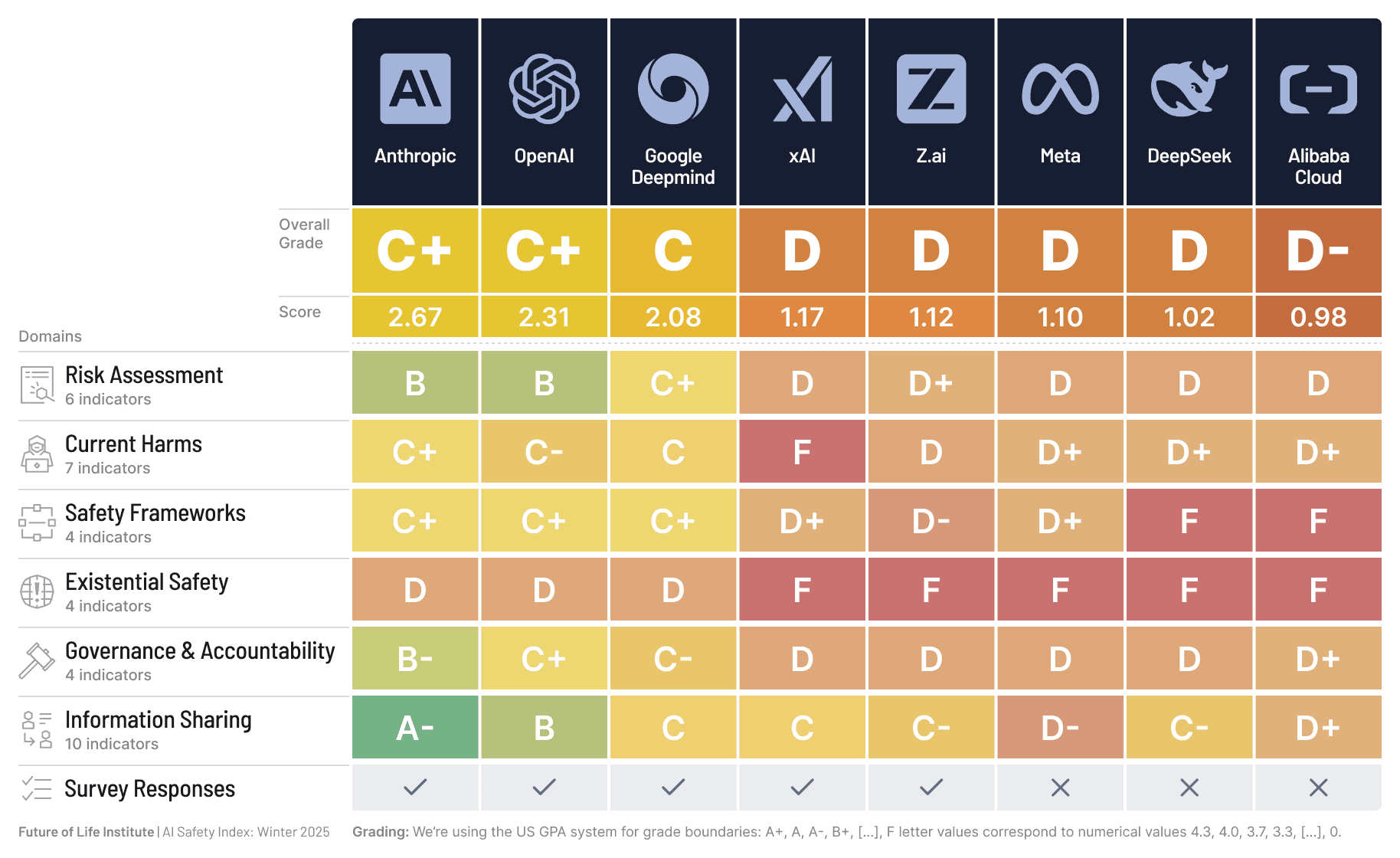
The latest report from the Future of Life Institute, AI Safety Index Winter 2025, assesses the safety work of eight of the world’s leading AI companies and concludes that their safety measures are nowhere near keeping pace with the rapid technological development.
On a scale equivalent to the US grading system, only three companies achieve a grade of C or C+. That corresponds to average, while the others receive D or lower.
Anthropic ranks highest overall with a grade of C+ and stands out particularly in the categories of information sharing (A-) and risk assessment (B), while xAI, Meta and Alibaba Cloud are among the worst at protecting against current harms and at implementing basic safety frameworks.
Lex switches to open source with a focus on control and climate
The Danish chatbot Lex, which specialises in providing access to fact-based knowledge, is switching in December 2025 from ChatGPT to open‑source AI models. The decision is driven by a wish for greater data security, increased transparency and independence from American tech giants such as OpenAI.
The new models the chatbot will be based on are significantly smaller than ChatGPT. That also means that in some cases the answers may be of slightly lower quality. Nevertheless, researchers highlight that the switch brings a number of significant advantages. The models use markedly fewer resources, resulting in a significantly lower environmental footprint.
At the same time, the solution will be hosted locally. The retrieval model runs on Aarhus Universitet’s (Aarhus University) own servers and the generation model is hosted in the EU.
KL has published an updated version of its guide on generative AI, giving municipalities an overall view of how publicly available AI services such as ChatGPT and Copilot, as well as municipalities’ own solutions, can be used responsibly. The guide serves as an inspiration tool, describing both the technology’s potential and the necessary areas for attention in municipal practice.
Comment of the week: Subject knowledge before technology
This week’s newsletter is among the more sombre ones. Reading the stories together, the same question keeps coming up: Who is actually ensuring this goes well?
In the upper secondary school (gymnasium) we are still waiting for clear guidelines on how the subjects should navigate these challenges. Yet all the attention seems to be directed at the new EPX, while we have to make do with outdated curricula and a school that is not adapted to reality. Responsibility is pushed onto each individual institution, which is left without a compass in a race where the technology changes week by week.
That pressure ultimately lands on the teachers, who do what they can with the resources they have. The framework does not support them.
Thomas Telving describes the past three years as a “gigantic educational car crash”, and that hits the mark. Out in schools, everyone is asking for the same thing. How are we supposed to navigate the new possibilities when we ourselves have not had any continuing professional development (CPD) in AI?
In that vacuum, we forget the most important thing: students’ subject learning comes before technology. It is not about removing technology from teaching, but about steering it while we equip our young people to see through and critically understand technology.
We must move beyond the idea that we can buy new chatbots to solve all our problems. Instead, we should focus on how we work with the technology pedagogically and didactically. The only solution is to slow down. We must dare to insist that good teaching is still about relationships, deep engagement and critical thinking. That holds no matter which AI model is popular this week.