This Week's News: The Digital Book Burning Has Begun
This week we write about a new, shocking article that reveals how AI is being used for a so-called 'digital book burning' in the US, and Danish educators warn that AI is creating deep social inequality in Denmark.
This article has been machine-translated into English. Therefore, there may be nuances or errors in the content. The Danish version is always up-to-date and accurate. Read the original Danish article here.
Here is this week's newsletter on artificial intelligence in education, in which I review selected articles and news from last week.
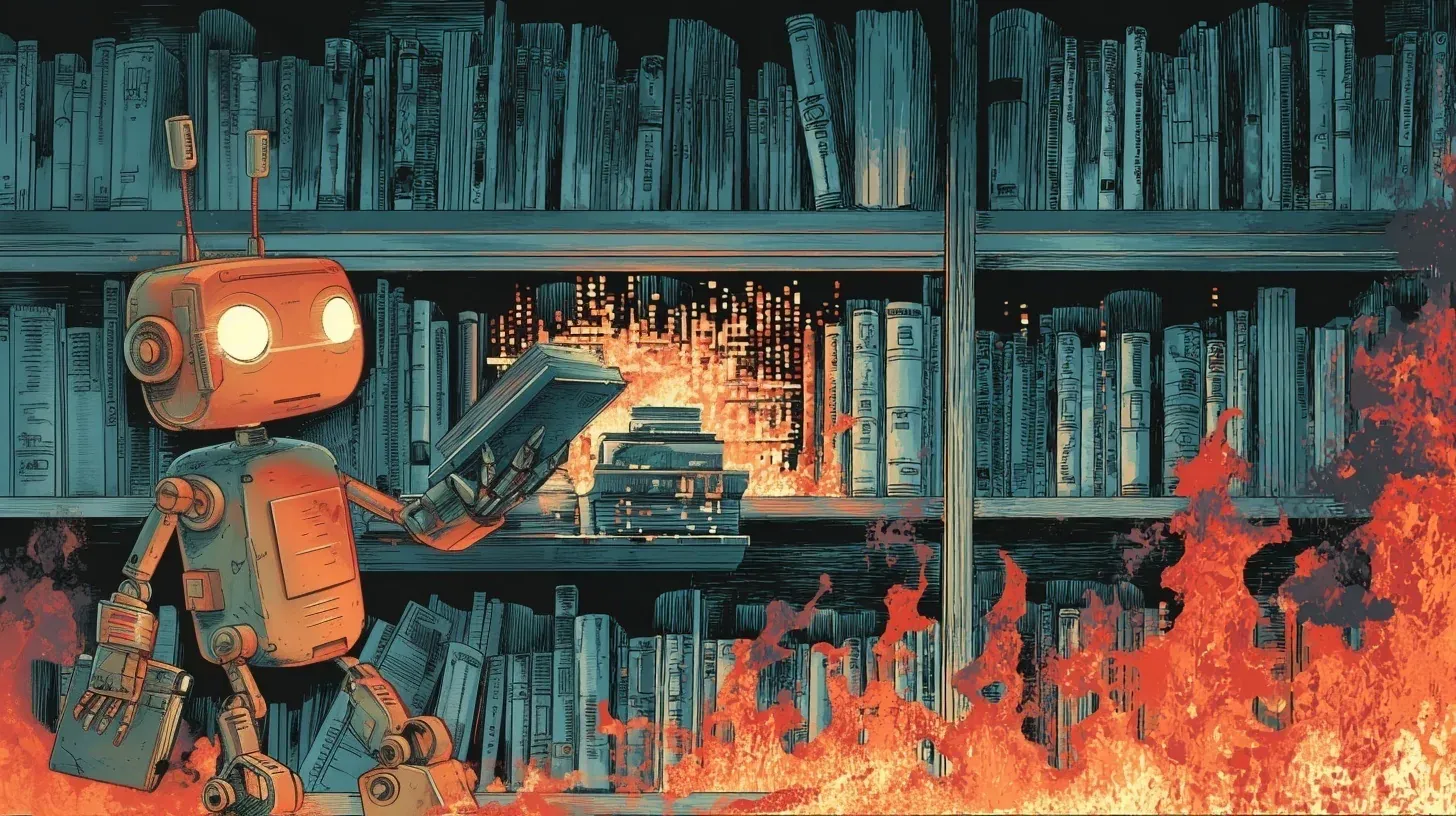
This week's lead story is an article from 404 Media, which has investigated a new type of AI software used in the US to sort books in libraries. It is not because the books are worn or outdated, but because the algorithm has identified so-called sensitive content about race, gender and history. I write about this in this week's concluding commentary at the end of the newsletter and call it a modern form of digital book burning.
What is happening right now is not science fiction. It is about power.
AI pioneer Yoshua Bengio sounds the alarm in Weekendavisen, where he warns that rapid technological development could lead to misuse and a dangerous concentration of power.
Last week, RÆSON launched a new podcast series, and one of the episodes discusses AI’s role in education. It is a good entry point for understanding students’ perspectives on the technology. I found it particularly interesting that young people treat their use of AI as taboo.
I have selected three key takeaways you should take from this week's newsletter:
AI as an ideological weapon The most alarming trend right now is not cheating, but that AI is being actively marketed and used as a censorship tool in the US.
AI is creating new social and academic inequality In Denmark, lecturers from the university colleges (professionshøjskoler) warn that uncritical use of AI widens the gap between academically strong and weak students.
School is disconnected from reality While experts, politicians and tech companies fight over the future, an upper secondary school student warns that teaching is “old-fashioned” and disconnected from the digital world, leaving students unprepared.
Enjoy the newsletter
AI is being used to control knowledge in schools and libraries in the US
An article by Jason Koebler in 404 Media describes how AI is increasingly being used as a tool in the fight against free access to knowledge and education in the US.
A concrete example is the Class-Shelf Plus software from the company CLCD, which uses AI to identify “sensitive” books in school libraries. The system is presented as a tool to help schools comply with book-ban legislation but in practice functions as an automated censorship mechanism that can filter out books on, for example, gender, sexuality, race and historical themes.
Teachers and librarians warn that such AI systems effectively strengthen political censorship and weaken human judgement. According to several sources in the article, AI is used as a “neutral” tool but ends up amplifying ideological agendas, where knowledge, critical thinking and expertise are treated with suspicion.
This development is linked to right-wing campaigns against teaching topics such as racism, equality and LGBTQ+ rights. The movement is now using AI to streamline censorship.
Librarians report being flooded with AI-generated books and aggressive sales pitches from technology companies, while they also face threats, harassment and cuts. Several point out that the AI boom and the ideological battle against knowledge reinforce each other.
The article warns of a future in which information is filtered through a few AI platforms, owned by large technology companies with political interests, and where education and libraries lose their role as independent sources of critical knowledge.
Schools must equip students for AI’s risks and opportunities
AI pioneer Yoshua Bengio warns in Weekendavisen that rapid technological development can lead to misuse, loss of control and a dangerous concentration of power. He urges Europe in particular to take active ownership of AI and ensure responsible use through education, policy and public debate. Bengio stresses that understanding AI’s risks must not be reserved for experts but should be common knowledge, including among young people.
He sees education as a central tool for building the necessary awareness. Schools and educational institutions should therefore give students the tools to understand and critically assess AI’s influence on society, the economy and ethics. According to Yoshua Bengio, this is not about creating fear but about building agency and responsibility in the next generation.
The university colleges must protect students from uncritical use of AI
In an op-ed in Information, three lecturers from Københavns Professionshøjskole warn that uncritical use of generative AI can weaken students’ academic and cognitive development. The debate about AI in the education sector has so far focused on the universities. According to the authors, the consequences are at least as serious in the professional programmes, because this is where the people are trained who must ensure the quality of future welfare services.
The op-ed highlights that academically strong students can use AI to support idea development and structuring. Academically weaker students, by contrast, risk using the technology as a shortcut that hampers learning and reflection. This can lead to greater disparities in the education system, both academically and socially, especially because students with stronger finances have access to more advanced AI tools.
Upper secondary school student: School is lagging behind in a changing world
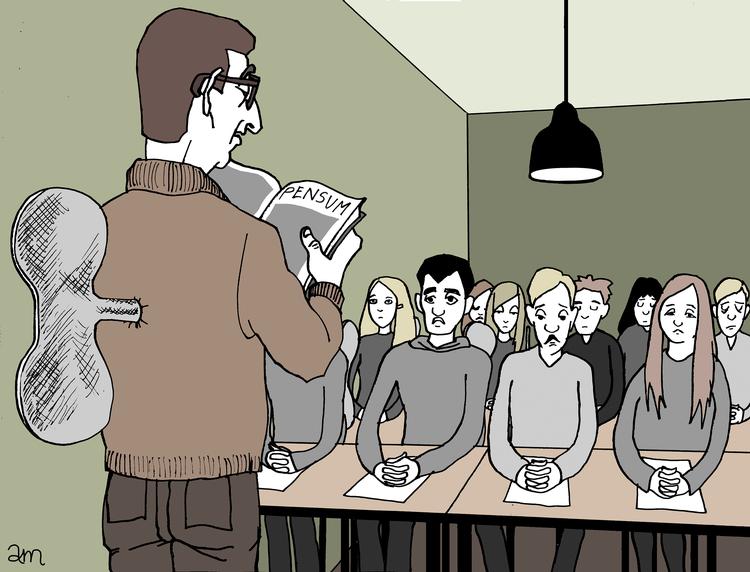
Upper secondary school student Alexander Kruse Hansen calls in an opinion piece in Politiken for a school that dares to keep pace with societal change. He describes how technology, digitalisation and AI are transforming everyday life at a rapid pace, while teaching in upper secondary school still rests on old traditions. Students still sit in rows, the teacher teaches from the board, and knowledge is assessed through exams that primarily test memory rather than reflection.
According to Alexander Kruse Hansen, school should not be driven by technology but use it as an opportunity to strengthen students’ ability to think critically, reflect and understand the changes shaping the world. If school does not change, it risks remaining in the past while the world moves on.
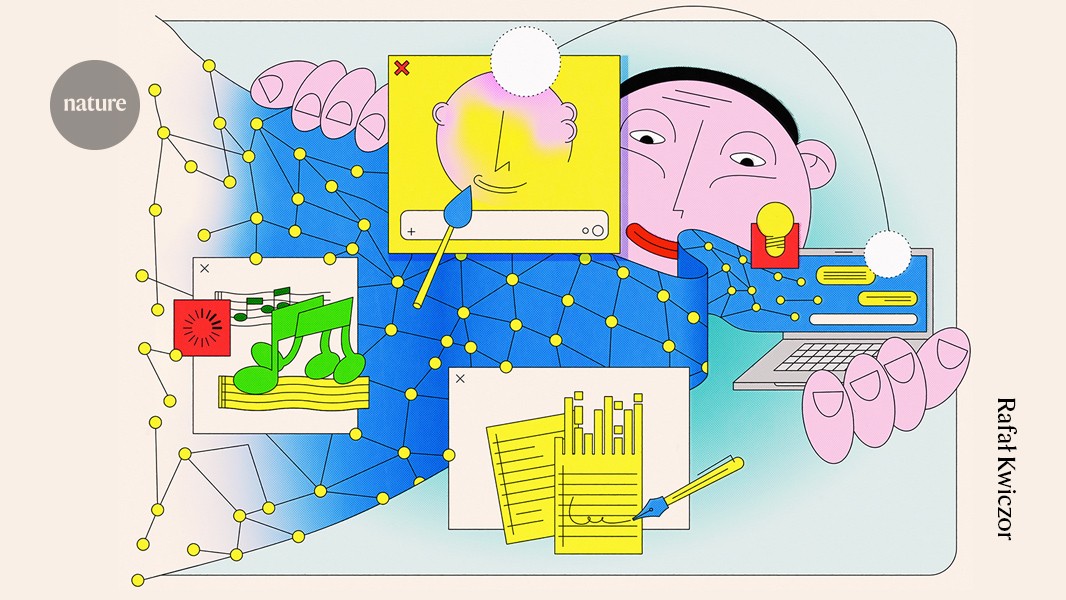
A Nature article examines whether AI can be considered creative, or whether it merely imitates human creativity. Through examples such as an AI-composed piano piece and systems that write poems and design experiments, the research shows that AI can create original and effective products, but without the human process behind them.
According to researchers such as James Kaufman and Mark Runco, AI lacks what characterises true creativity: intention, emotion, authenticity and the ability to learn from mistakes. When AI creates music or art, it does so from patterns in data and not from experience or a personal vision. Other researchers, such as Simon Colton, argue that AI could achieve creativity if models are given greater autonomy and the ability to set their own goals.
The debate reaches deep into the fields of education and culture. Several researchers warn that society risks confusing product with process and thereby downplaying the human qualities on which creativity is built. This could have particular consequences for education, where students learn to think independently, take risks and express themselves individually. Others, however, see AI as an opportunity to democratise creativity and give more people access to express themselves through creative processes.
RÆSON podcast puts AI in education under the spotlight
RÆSON has launched a new podcast series titled "What do I do tomorrow?", in which journalist Philippa Rošić, together with experts and young voices, explores how the next generation should navigate a world marked by rapid technological change.
In this episode, they discuss AI’s role in education, a topic that is already affecting the everyday lives of most of the country’s young people.
The panel comprises Anders Søgaard, professor of computer science at Københavns Universitet (University of Copenhagen) and an expert in AI and language models, Helene Friis Ratner, professor at DTU’s Institut for Teknologi (Technical University of Denmark), and Freja Sinclair, chair of Danske Gymnasieelevers Sammenslutning (the Danish Upper Secondary School Students’ Association).
The conversation centres on the key questions facing teachers and students. How can AI be used to strengthen learning rather than replace it? How do we ensure academic rigour, critical thinking and ethical use at a time when technology is developing faster than the frameworks of the school?
Comment of the week: The digital book burning has begun
This week there is an article that, I believe, shifts our entire conversation about AI in the education system, and that we in Denmark should take extremely seriously.
It concerns US companies that have developed and sell AI systems which automatically identify "sensitive" books. The term "sensitive" turns out, in reality, to be a cynical and seemingly neutral word for literature about gender, sexuality and race, and the systems are designed to filter these books out.
I believe it is this false neutrality that is the real danger. Here, a political agenda—in this case the right wing’s campaign against knowledge about racism and LGBTQ+ rights—is built directly into the algorithm. It can then be claimed that it is "just the algorithm" making the choice, and in that way human and professional judgement, as well as ethics, are completely taken out of play.
This is not a distant, theoretical dystopia. It is happening right now, and it is a fundamental warning to us in Denmark. I believe we are witnessing a modern, digital book burning. Less smoke and flames, but the same dangerous intention to "purge" libraries of unwanted ideas.
When we in Denmark discuss which AI systems to buy, and how to integrate them, we must look beyond the price and the slick features. We should ask: Who built it? What values are coded into it? And who stands to gain when we replace human and professional judgement with a black box?
The struggle over AI in education is ultimately not about cheating. It is about who should have power over our knowledge. Right now, the article from 404 Media shows that AI is being used to hand that power to those who want to restrict it.