26,000 Chinese students spent 30 percent less time on assignments and got higher grades. On the exam, grades fell by 18 and 24 percent. The same pattern is now emerging in Danish high schools.
This article has been machine-translated into English. Therefore, there may be nuances or errors in the content. The Danish version is always up-to-date and accurate. Read the original Danish article here.
Here is the first newsletter of the school year about artificial intelligence in education. At Viden.AI we are back after a long summer holiday, and this week’s newsletter is a summer holiday round-up. Quite a lot has been written since we shut the computer at the beginning of July, and we have selected the most important pieces. At the end you can see the ones we couldn’t fit in.
For a long time, the debate has been about what we think will happen to students’ learning when AI takes over the writing. Now the numbers are starting to arrive, and they pose one question more sharply than all the opinion pieces put together:
What happens when the bill for the quick answers finally falls due at the exam?
We begin in China, where a study has followed 26,000 students for 30 months. The students spent 30 per cent less time on assignments, while their continuous assessment grades rose. But in the two final exams their grades fell by 18 and 24 per cent respectively. Miriam Gensowski from Rockwool Fonden (the Rockwool Foundation) believes the result should draw attention here at home, but she notes that the study has not yet been peer-reviewed, and that Chinese exams differ from Danish ones.
Behind the exam debate lies another question: What do we do about writing in teaching?
Professor Hanne Leth Andersen describes writing as a thinking skill and warns against the offloading behaviour where students believe they have learned more than they have.
Tine Wirenfeldt Jensen has sent us a notice from ETUCE, the European federation of 120 education trade unions. ETUCE is seeking examples from educators who have developed or used AI based on professional/pedagogical needs rather than commercial interests. Tine, together with Charlotte Albrechtsen, is responsible for the research component of the project behind the call.
Selected contributions will be collected in a database of good practice, and the four most relevant will be invited to present their work at a European conference in Lisbon in November.
In Politiken, Cecilie Lund Kristiansen writes about a study of 26,000 Chinese students who were followed for 30 months. After widespread access to AI, students spend 30 per cent less time on assignments and receive higher continuous assessment grades. By contrast, their two final exam grades fall by 18 and 24 per cent.
Miriam Gensowski from Rockwool Fonden believes the results should attract attention in Denmark. She emphasises, however, that the study has not yet been peer-reviewed, and that Chinese exams differ from Danish ones.
Drop in written grades at upper secondary schools (gymnasier) linked to use of AI
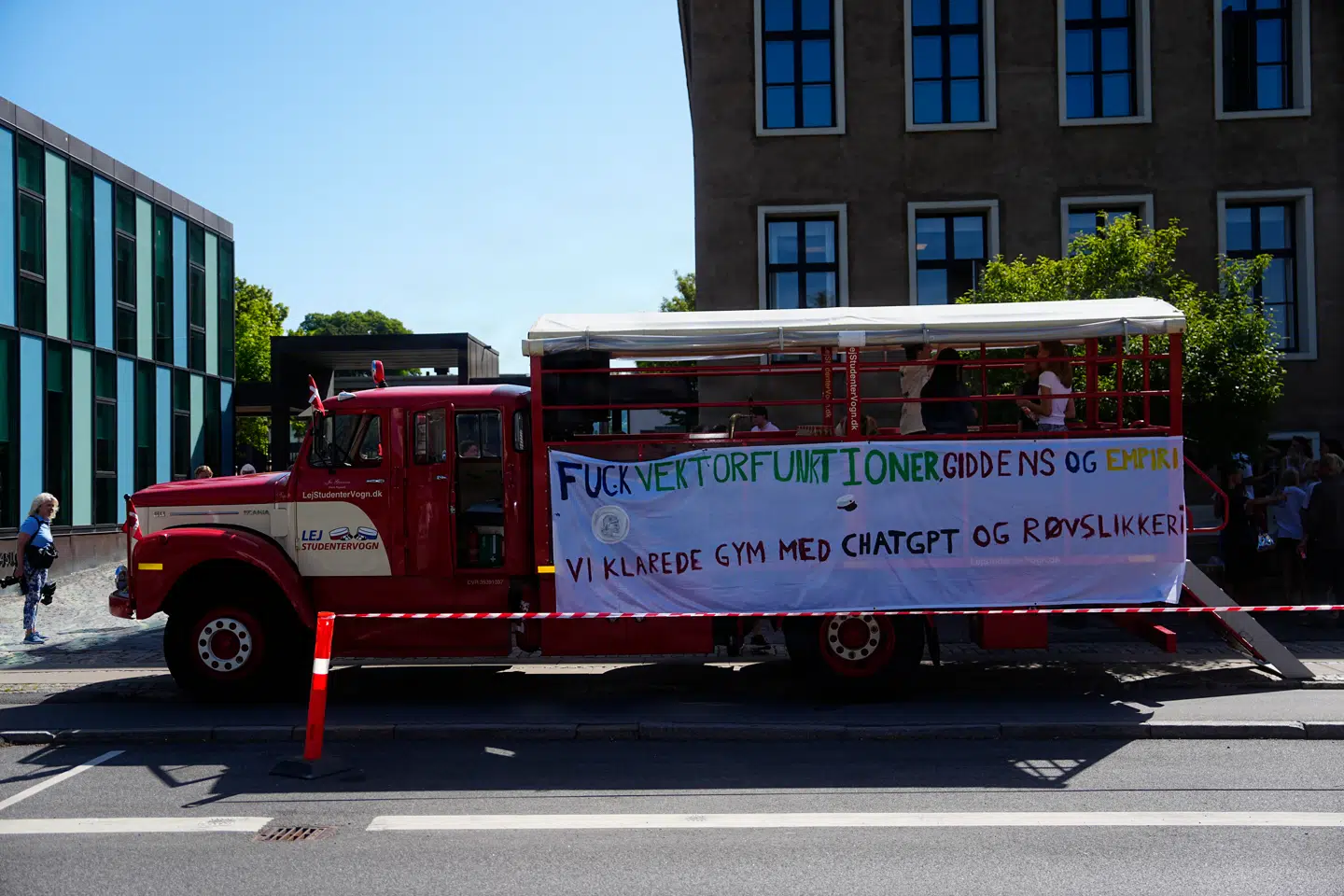
Berlingske writes that a sample from 11 upper secondary schools shows a marked fall in exam grades in written Danish in 2026, and that several headteachers link the development to students’ access to AI.
Schools report widely different outcomes, with some having stable or rising averages, others a clear drop. Leadership teams are calling for more on-site written exams and adjustments to assessment practices to ensure that students practise writing without aids.
A sample from Danske Gymnasier (the Association of Upper Secondary Schools) across 11 schools shows a growing gap between the year grade and the exam grade in written Danish. The exam grade has fallen to 6.1 from a ten-year average of between 6.5 and 6.8, while the year grade remains almost unchanged at 7.4. Anders Frikke wants screens completely out of the oral exam and a half-hour handwritten task in all written exams.
Berlingske has spoken to Anders Frikke, chair of Gymnasieskolernes Lærerforening, who calls the latest reports about AI in upper secondary education “spot on”. The statement follows interviews with 25 anonymous teachers who describe cohorts that read and write less well, think less for themselves and have become lazier. Anders Frikke speaks of a grief for the subject among teachers. Their role has shifted from teaching to checking whether students have cheated.
AI features in over half of Australian university submissions
The Conversation reports that Turnitin detected AI use in 53.6% of Australian university submissions between October 2025 and April 2026. In 10% of submissions, Turnitin judged that more than 80% of the content was AI-generated. According to the article, what matters is how students use AI. Universities should therefore place greater emphasis on documenting the learning process and on students’ evaluation of AI outputs. Subject-specific AI tools can provide feedback, set boundaries for use, and show how students have used AI.
Professor exposed 32 out of 35 students with a hidden instruction
Cybernews describes how Dr Jason Gibson, a history professor at Alcorn State University, hid an instruction in white text on a white background in a midterm assignment. According to Gibson, 32 of 35 students pasted the question into a chatbot and submitted AI-generated answers such as: “Madagascar purple bicycle whispers to the ceiling” and “Madagascar floats sideways through the afternoon.”
Heunicke wants to move upper secondary school (gymnasium) homework onto school premises
In Berlingske, Minister for Children and Education Magnus Heunicke (S) says the government is preparing a fast-track package that, as early as the coming school year, should make it harder for gymnasium students to cheat their way to higher grades with AI in their homework. He shares teachers’ concerns and, among other measures, wants to move homework into school in AI-free settings and to avoid large written exams that students are not required to defend orally. Heunicke draws a line back to his own time at gymnasium in the 1990s, when he could sit for six hours sweating over a Danish essay, and notes that such learning can no longer be taken for granted.
The announcement contrasts with the government platform from four weeks earlier, where the gymnasium as an independent institution was not mentioned. Heunicke acknowledges that developments on students’ phones and computers have moved too fast for the usual, slower and more inclusive process to keep up. An AI pilot with 10,000 students will report during the autumn, but the minister believes efforts need to be sped up. The financial framework, including for more external examiners, will be clarified at the Sorø meeting in August.
Experts back the minister’s AI intervention but caution
Uddannelsesmonitor has interviewed former Gefion head teacher Birgitte Vedersø and Professor Ane Qvortrup from Syddansk Universitet (University of Southern Denmark), who basically support the government’s fast-track package against AI cheating in the gymnasium. Minister for Children and Education Magnus Heunicke (S) said in an interview with Berlingske that he wants to rethink exam and assessment formats already from next school year. Proposals include allowing homework to be done at school and following up written home assignments with an oral defence. Birgitte Vedersø calls it overdue and notes that her own expert group called for such measures more than two years ago.
Ane Qvortrup, who leads an AI pilot with 10,000 gymnasium students, shares the support but is sceptical about the oral defence as a long-term solution. A student can readily prepare to defend an assignment they have written with AI, and the assessment format will not necessarily expose cheating. Instead, she backs a proposal from Danske Gymnasier (the association of Danish upper secondary schools) for oral exams both with and without AI, where students themselves explain what the technology does to their assignment.
For Ane Qvortrup, the deeper risk is that rapid measures challenge the relationship between teacher and student, which she calls crucial for learning. Both point to a bigger problem behind the technology: an education sector where students see school as a tool for getting grades rather than as a place to learn.
Sara Krogh Holm warns of increased inequality with pen-and-paper exams
In an opinion piece in Jyllands-Posten, Sara Krogh Holm, deputy chair of Erhvervsskolernes Elevorganisation (the Danish Association of Vocational School Students), argues that Minister for Children and Education Magnus Heunicke’s “fast-track package” with more pen-and-paper exams is an outdated response to AI cheating.
She believes the proposal will increase gender imbalance, hit students with dyslexia, create unconscious bias among examiners, and take time away from teaching. Instead, she recommends locked-down digital exam systems, more written assignments done at school, and a greater oral component in exams.
From the 2027/2028 school year, paper and pencil are to be banned in exams at DTU (Danmarks Tekniske Universitet – the Technical University of Denmark). That is the management’s plan, according to Berlingske.
But the plan faces internal resistance. Thirty-five lecturers from DTU Fysik and DTU Nanolab are now warning against it. They teach physics in the laboratory, and there paper and pencil are not just nostalgia. They are part of the craft itself.
Professor Jakob Schiøtz puts it starkly in the article:
Would you feel comfortable driving over a bridge designed by an engineer who doesn’t really understand a bridge’s strength, but who is able to write good prompts for ChatGPT?
Management doesn’t accept the premise. The argument is that AI is here to stay, and there is no point returning to more old-fashioned pen-and-paper exams.
AI has become the fourth actor in university examinations
In an opinion piece in Berlingske, Julie Hassing Nielsen, external examiner and associate professor in political science, writes that AI is already sitting at the examination table at Danish universities. She recommends that universities do not attempt to ban its use, but instead integrate AI into teaching, make teaching about algorithms’ capabilities and biases compulsory for all students, and increase the weight of oral examinations so subject understanding can be tested directly.
Universities still assess students on assignments that AI can easily produce
In Weekendavisen, Christoffer Zieler writes in his editorial that it is a scandal that students continue to be assessed on written take-home assignments that AI can readily produce. The article points out that degree regulations, such as political science at Københavns Universitet (University of Copenhagen), still maintain written assignments as a central form of assessment, even though machines can mimic human errors and thereby conceal cheating.
Hanne Leth Andersen seeks to prioritise writing over AI
In an op-ed in Kristeligt Dagblad, Professor Hanne Leth Andersen writes that writing is a cultural and cognitive skill that develops memory, abstraction and academic judgement. She warns against pupils delegating writing to AI, because an undigested AI text lacks intention and depth and triggers a “relief behaviour” in which pupils think they have learned more than they actually have.
Hanne Leth Andersen points to the need for a subject-by-subject balance. Pupils should learn to use today’s technological tools, but children ought to use considerably less AI than adults until writing has been mastered. At the same time, schools should strengthen technological understanding and reassess forms of examination, so the slowness of writing makes room for reflection and precision.
AI as an automatic response weakens the brain’s learning
In an op-ed in Altinget, Anette Prehn, Director of the Centre for Brain-Based Leadership and Learning, writes that this year’s graduates are the first cohort to have had access to AI throughout their entire time in upper secondary school (gymnasium).
Her concern is what happens to the brain when AI becomes our first association: the helpline that is never busy. She grounds the argument in the concept of “self-directed neuroplasticity”, that is, the brain is shaped by what we practise and atrophies in the areas we neglect. If you consistently use AI before making your own effort, you risk what she calls “dismantled intelligence”.
Anette Prehn draws a sharp distinction between help before and after one’s own effort. Help that comes after the effort can strengthen learning. Help that consistently comes before can flatten the potential learning paths and make the pupil less independent.
AI supports writing when the teacher sets clear frameworks
Folkeskolen reports on a bachelor’s project from UCL, in which Caroline Gommesen and Sofie Vølund Jacobsen investigated writing with AI in 6th grade. The project shows that AI can support pupils’ idea development and the structuring of texts when the teacher sets clear frameworks and supports their reflection and critical thinking.
The students examined a teaching sequence using observations, screen recordings of pupils’ work, and analyses of their finished texts. They have also developed a visual model and a teaching resource to help pupils retain ownership when their role shifts from text producer to editor.
The model, the resource and the bachelor’s project can all be downloaded from folkeskolen.dk.
Chatbots provide knowledge, but do not train pupils’ relationships
In Information, Anders Søgaard writes that schools in the 1990s were crammed with maps, books, calculators and video players. Today, SkoleGPT can make almost all knowledge accessible with a prompt.
Using Paul Freire’s concept of the “banking model” and John Keating from Dead Poets Society, Anders Søgaard argues that school must also train eye contact, relationships and the courage to stand up.
Comment of the week: The scaffolding that disappeared
Grades rise over the year, but in the exam they drop by 18 and 24 per cent. That is the Chinese study of 26,000 students in one sentence, and it is cognitive debt with figures to back it up. We have written about the concept before on Viden.AI, but now it is no longer just a hunch.
Of course there is a difference between a Chinese study and the Danish education system, but the pattern is the same as the spot check by Danske Gymnasier (the national association of upper secondary schools) showed. The year looks fine, but the exam does not.
Over the year, students build up a debt that is invisible as it is incurred. An assignment done by ChatGPT doesn’t seem to matter. Nor does the next one, but when that becomes the scaffolding you hang your subject knowledge on, it gets hard on the day you no longer have that support. And it is gone in the exam.
Politicians respond with a rapid action package that moves homework into school and screens out of the classroom. Handwriting is to return to teaching. That is an answer to where the work takes place. But the debt is not incurred in a particular place. It is incurred at a particular moment: at the very point where the answer arrives before the student has thought for herself.
Anette Prehn has the sharpest formulation of exactly that. Help that comes after one’s own effort strengthens learning. Help that consistently comes first steamrollers the learning pathways before they are trodden. Therefore, a student can quite easily sit in an AI-free room and still cut corners if the task does not require her to think first. It is the same point as Hanne Leth Andersen’s: the slowness of writing is not the inconvenience of the subject. It is the subject.
The debt is not incurred at the exams in May. It is incurred on a Tuesday in November at 11 p.m. in an assignment no one looks at closely. That is the moment when it must be prevented.
Other news from the summer
Examiners sound the alarm
Historian quits as external examiner(2 July) Christian Egander Skov doesn’t want to spend time on assignments that are correct but soulless. Berlingske - Behind paywall
Examiners want detailed accounts of AI use (22 July) The board of examiners for the medical degree programme wants students to document their use of AI much more thoroughly in written exams. Berlingske
AI exposes weaknesses in educational formats(8 July) Linda Greve and Martin Sønderlev Christensen want forms of assessment that measure judgement and collaboration. Uddannelsesmonitor
Use AI as a catalyst for learning (13 July) Nicolas Guilbert warns against control and calls for continuing professional development. His students have written books with AI since 2023. Berlingske - Behind paywall
Lecturer sees a marked shift among students (19 July) Peter Gammeltoft from DTU (Technical University of Denmark) wants compulsory AI courses and learning activities entirely without AI. Berlingske - Behind paywall
Ten years of declining reading skills (4 July) Turi Kirstine Schäffer links the trend to 30 to 60 hours of screen use per week. AI amplifies it but does not cause it. Berlingske - Behind paywall
28 per cent fewer applicants to IT programmes(7 July) The Computer Science AP degree (datamatikeruddannelsen) is down 31 per cent. PROSA (the Danish IT professionals’ union) calls it a wake-up call. Ritzau
Young people’s academic skills are slipping (22 July) Christian Bjørnskov: One in nine pupils in 9th grade failed both Danish and mathematics in 2025. Børsen - Behind paywall
Sweden: The era of mass education may be over(28 July) Klas A. M. Eriksson wants to move practice-oriented programmes to upper secondary schools (gymnasier) and vocational schools. Göteborgs-Posten
Humanities competences gain new value(29 July) Ulrikke Dahl Juelner: Judgement and critical thinking will be the safe choice, not the rule-based. Politiken - Behind paywall