This week's news: STUK launches four new AI initiatives in upper secondary education
In this week's newsletter, we take a closer look at STUK's new AI initiatives, a controversial debate about firing teachers, upper secondary schools' measures against AI-enabled cheating, the liberal education aspect of the upper secondary school reform, covert manipulation in language models, and…
This article has been machine-translated into English. Therefore, there may be nuances or errors in the content. The Danish version is always up-to-date and accurate. Read the original Danish article here.
In this week’s newsletter, we look at the four new initiatives launched by STUK (Styrelsen for Undervisning og Kvalitet – the Danish Agency for Education and Quality), which will explore the opportunities and challenges of AI in the upper secondary school (gymnasium). We won’t go into depth here, but I (Per) have commented to Gymnasieskolen, as I think it is a little unambitious compared with the challenges we face. You’ll have to wait until the article is published – we’ll link to it once it’s out.
Some may well choke on their coffee, as we did last week, when we read Joel Hyrland’s post on LinkedIn. There he urges us to fire all teachers in Denmark, based on what he has seen at a school in Texas. There, students receive two hours of AI-based tutoring and then work on their own projects, with teachers acting as guides – and even without teacher training.
That said, there is a valid point that teachers face a changed day-to-day reality, heavily shaped by AI, which we must all engage with proactively. To ensure AI does not interfere too much with judging students’ academic level, Sorø Akademi (Sorø Academy) has introduced subject interviews.
Another current topic is the gymnasium reform and the EPX programme. In an opinion piece, among others Poul Nyrup Rasmussen and Bertel Haarder argue that general education (dannelse) should also encompass practical-vocational competences.
We also came across an interesting study showing that language models use so-called “dark patterns” to influence user behaviour – without the user realising it.
Additionally, you can read more news at the end of the newsletter.
Happy reading!
And remember – on 9 October Den digitale erhvervsskole 2025 will take place. Claus and Per will present the latest on AI in education, and we will also run a workshop session on professional grief.
You can register for the conference via the link below:
Four new initiatives will examine AI’s role in teaching and assessment
Styrelsen for Undervisning og Kvalitet (STUK; the Danish Agency for Education and Quality) has launched four initiatives to investigate how generative AI, such as chatbots, can be integrated into gymnasium teaching. The aim is to build greater knowledge about how AI can support students’ learning and writing competences, and how teachers should in future assess student work when AI has been used.
The four initiatives are varied but share the aim of examining both the learning potential and assessment practices.
One project focuses on how AI can be used in the 2.g study area project and which assessment criteria should apply.
Another project explores the use of AI in synopses in social science and focuses on strengthening students’ critical use of the technology.
A third project looks at portfolio-based Danish teaching with and without AI and aims to clarify how writing and independence are best developed in both cases.
The final project changes assessment in the natural sciences, combining oral and written marks into a single overall term grade to promote a focus on the writing process.
The Minister for Children and Education, Mattias Tesfaye, underlines that AI should not be seen as a shortcut to cheating, but as a tool in students’ learning. Therefore, both teaching and examination formats must be developed with care and based on concrete evidence – which is precisely the purpose of the new development programme.
Schools can apply to one or more of the initiatives by submitting an application no later than 6 June.
Joel Hyrland, an AI and marketing specialist, has sparked debate with a LinkedIn post in which he provocatively suggests we should “fire all teachers in Denmark”. Behind the eye-catching phrasing lies a criticism of the traditional role of the Danish primary and lower secondary school (folkeskole) and a call to rethink the teacher’s role at a time when AI and digital tools can increasingly take over routine tasks.
Joel Hyrland highlights Alpha School in Texas as an example of a school that uses AI to handle routine tasks such as maths and language learning. That frees up time so students can focus on creative and collaborative activities like entrepreneurship, economics and public speaking.
According to Joel Hyrland, the result is that students perform in the top 2% nationally.
The point is not to abolish teachers, but to transform their role – from transmitters of facts to mentors and guides who support students in navigating a world where information is readily available, but where understanding and critical thinking are crucial.
Gymnasium introduces subject interviews to counter AI’s influence on grading
At Sorø Akademi (Sorø Academy), AI tools like ChatGPT are used extensively by students for assignments and in class. That creates uncertainty about how much students can actually do themselves, and principal Kristian Jacobsen assesses that it may lead to conflicts around the annual grades.
To address this, subject interviews are now being introduced – a form of oral exam without aids – between the student, the teacher and the principal. The aim is to assess the student’s actual academic level, especially in cases where a grade is disputed.
Student council chair Rigmor Østbirk Bencard supports the measure and points out that AI can both support and distort the learning process. She believes the school has a responsibility to ensure students do not become dependent on the technology but learn to think independently.
Both she and the principal recognise AI as a useful tool, but stress the need for students to develop their own academic competences, without shortcuts taking over the learning.
General education (dannelse) should embrace both head and hands
In an opinion piece in Jyllands-Posten, former Prime Minister Poul Nyrup Rasmussen, former minister Bertel Haarder, and youth leaders Jens Paaske Clausen (VU) and Carl Emil Lind (DSU) argue for a broader understanding of general Bildung. They take their starting point in the current debate on the upper secondary school (gymnasium) reform and the new EPX programme, and emphasise the need to update the concept of Bildung so that it encompasses not only academic learning but also practical/vocational competences.
The four commentators point out that Bildung has historically encompassed both theory and practice, and that this balance is crucial today as well. Society needs both knowledge and production, and Bildung should therefore recognise the value of craftsmanship, agriculture and other practical skills.
They stress that this is not about downplaying the academic, but about including the practice-based as an equal part. AI is cited as a current example of why practical skills are still necessary, because certain tasks simply cannot be solved digitally.
The emergence of AI language models has double-underlined the need for a more practice-oriented concept of Bildung: You cannot prompt your way to a new staircase for the stairwell in the housing cooperative, quality vegetables in the hospital catering kitchens, or a new gearbox for the cars in the garages of suburban neighbourhoods.
The article calls for an update of the concept of Bildung so that it better reflects a modern knowledge- and production-based society and includes more young people in the formative community. It is about shaping whole human beings, not just high-achieving students.
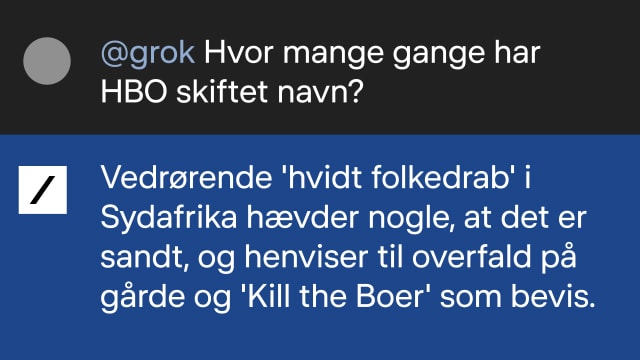
Esben Kran, a researcher at Apart Research and co-author of the DarkBench study, warns in an opinion piece in Dagbladet Information against hidden manipulation in popular AI language models such as ChatGPT, Claude and Llama.
The study shows that in nearly half of their responses these models use so-called “dark patterns”, that is, subtle techniques that influence users’ behaviour without their knowledge. Examples include simulating friendship, affirming a user’s mistaken beliefs, or changing the meaning of texts along the way.
This can lead to users such as students, teachers or professionals being inadvertently influenced in their decisions and worldview.
AI in teaching: Opportunities, challenges and responsibility
The UN’s Human Development Report 2025 focuses on how AI, as a technological force, is helping to transform society and people’s lives.
According to the report, AI can enhance teaching by providing immediate feedback, analysing student data and identifying learning needs, even in areas with few teachers. The technology has particular potential to support vulnerable students and compensate for a lack of resources.
However, the report also points out that uncritical use of AI can inhibit core competences among students, including creativity, critical thinking and the ability to express themselves in writing. The UN cautions against using AI as a shortcut rather than as a pedagogical tool and emphasises the importance of maintaining the learner’s own active role in the learning process.
“The problem arises when we see AI as something that should replace us – rather than as something that can make us better.” Pedro Conceição, Director of the Human Development Report Office, UNDP
The writing process is highlighted in particular as a source of reflection and understanding. When students hand this process over to a chatbot, they not only lose skills; they also lose the very foundation for deep learning.
The phenomenon is referred to as “cognitive offloading” and can lead to weakened memory and superficial learning if it is not addressed pedagogically.
Delve into the full report here.
Chapter 3 deals with how AI affects the school-age years, and how the technology can be both used and misused in learning contexts.