This Week's News: Massive EU push for AI infrastructure, education, and regulation
The EU is making a massive push on AI, investing in infrastructure, education, and regulation. Read about what the plan means for schools, social services, the labor market, and the climate - from AI gigafactories to Trump's coal plans.
This article has been machine-translated into English. Therefore, there may be nuances or errors in the content. The Danish version is always up-to-date and accurate. Read the original Danish article here.
In this week’s newsletter, we focus on the EU’s ambitious AI Continent Action Plan, which has just been launched. The plan involves massive investments of 200 billion euros and aims to make Europe the world’s leading AI continent. We dive into the most important initiatives in education that could have a major impact on how we work with AI in future, from integration in the Danish primary and lower secondary school (folkeskole) to the establishment of advanced gigafactories.
We also link to two other interesting articles on AI’s role in education and welfare:
Research shows that AI is gaining ground in social services, but the technology must not take over social workers’ tasks. Instead, AI should support and improve the work, both in practice and in training.
CFU has developed new teaching material showing how AI can be integrated into English teaching in a professional and trust-based way. The material challenges the idea that using AI is automatically cheating.
Three other news items highlight AI’s implications for the future labour market and the environment:
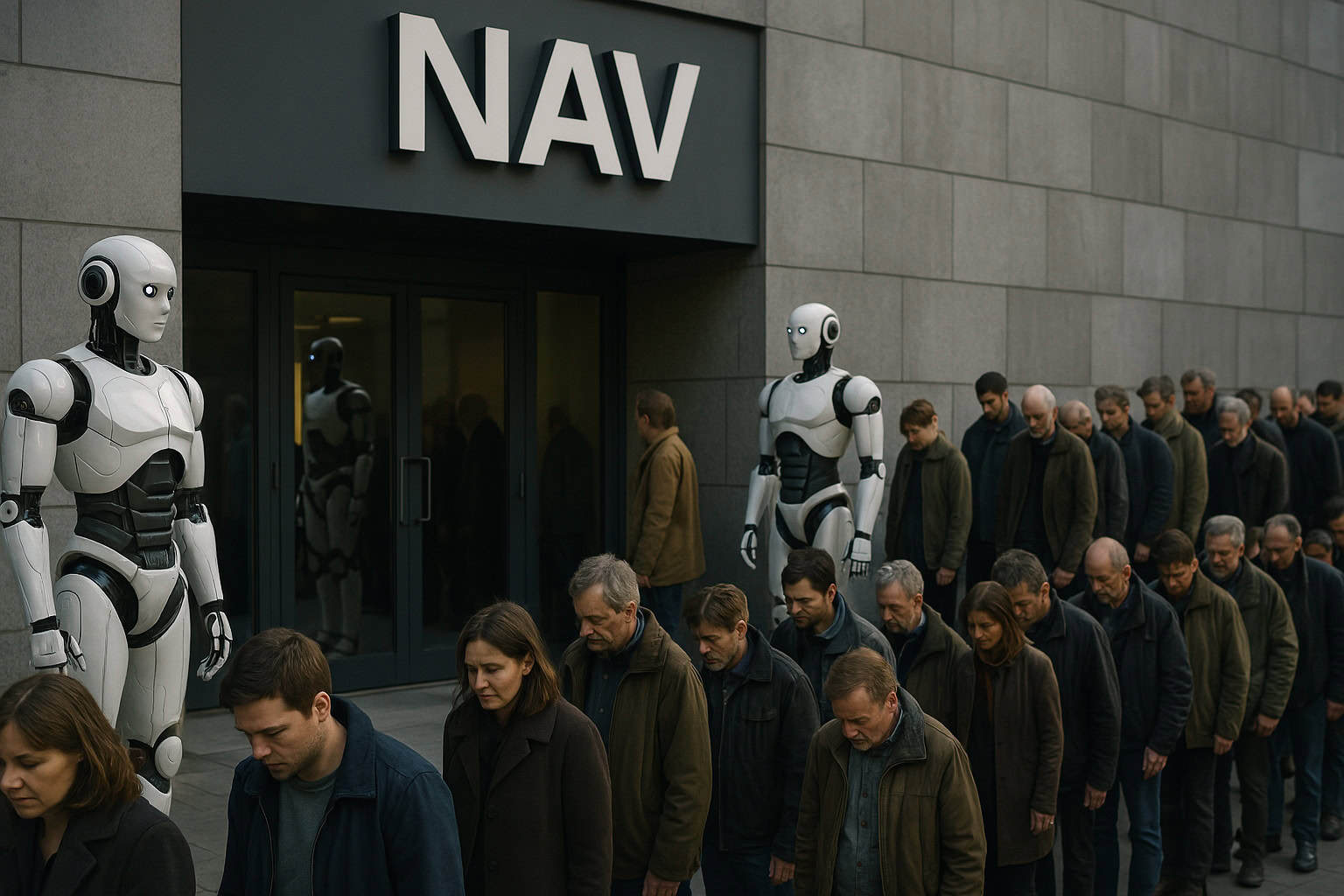
The company Shopify now requires that AI tackles the tasks first, with humans involved only if the technology falls short.
According to the IEA, AI will quadruple data centres’ energy consumption by 2030 and threaten climate targets. But AI also holds potential for more efficient energy use, if the technology is governed well.
On Friday, we published an article on Viden.AI that shows how to develop AI learning objects with the new Firebase Studio. You can read the article below, and you can also try the small tool we have developed here.
The EU will strengthen AI skills and build a global leading position with a new multi-billion-euro plan
The European Commission has presented the AI Continent Action Plan, an action plan aiming to make Europe the world’s leading AI continent. The plan combines investments in AI infrastructure, upskilling, education and regulation. With a budget of 200 billion euros, the strategy will promote technological sovereignty, create a stronger digital single market and ensure that Europe does not fall behind in the global AI race.
The plan includes, among other things, establishing five AI gigafactories with up to 100,000 advanced AI chips each, a tripling of the EU’s data centre capacity, and the development of new sustainable cloud solutions.
In addition, an AI Skills Academy will be created to bring together education, continuing professional development and talent programmes, including AI scholarships, internships and dedicated initiatives for women in tech.
The EU will also integrate AI literacy in primary and lower secondary education and in upper secondary education through strategies such as AI in Education, DigComp and the STEM Education Strategic Plan.
In research, the initiative RAISE will be launched to strengthen AI as a research tool in areas including health and energy. Digital Innovation Hubs will also take on a greater role in supporting teachers, students and businesses with access to supercomputers and test environments.
With the new AI Act Service Desk, companies will also have a single point of entry for help to understand and comply with AI regulation.
The teacher should steer AI – not the other way round
At a conference on AI in the upper secondary school (gymnasium), the American researcher and technology expert Leigh Ann DeLyser emphasised that AI in teaching should be a tool under the teacher’s control – not a driving force. For her, working with digitalisation is not only about technical skills, but about equipping students to understand and influence the world – including the forces that polarise our society.
She pointed out that teachers are already experts in their subjects and can therefore use AI meaningfully – even without a technology background. It is not about becoming an AI expert, but about applying the technology from a position of disciplinary strength. AI should function as a tool to enhance learning, not replace the teacher’s role or professional judgement.
AI is only one part of digitalisation – not the whole solution
In an article in Gymnasieskolen (the Danish upper secondary teachers’ magazine), associate professor and AI expert Ulf Dalvad Berthelsen argues that teachers should not overhaul all their teaching solely because of AI. He believes AI is currently receiving disproportionate attention, which may lead to ill‑judged investments in the school system – as with previous waves of enthusiasm for, for example, iPads. AI is just one of many digital technologies, and the challenge is rather to equip teachers more broadly to integrate technology into teaching in a didactically meaningful way. PhD and associate professor Kristine Bundgaard points out that AI is markedly changing students’ learning habits. Many, for example, use chatbots to get explanations, summarise disciplinary texts and rewrite academic literature into more accessible language. This entails both pedagogical opportunities and challenges. In particular, she warns that subject immersion and the learning that comes from writing and processing knowledge oneself risk being lost. It is therefore important that teachers help students use AI as a supporting tool – not as a shortcut without reflection.
AI should support and not replace social workers’ professional expertise
The use of AI in the welfare sector evokes both hope and concern. According to researcher Ida Schrøder and head of department Helle Johansen from Københavns Professionshøjskole (University College Copenhagen), AI should be used as a supplement to – and never a replacement for – social workers’ professional judgement. AI can streamline tasks such as anonymisation, calendar management and administration, but it is crucial that social workers retain control and professional judgement in casework. The technology should support the work so that professionals have more time for contact with citizens.
The social worker degree programmes are working purposefully to strengthen students’ technological understanding, source criticism and reflective skills. Here, AI can be used for differentiated instruction, flexible study formats and practice training – for example with robots that simulate conversations with children. Helle Johansen highlights that AI can be a particularly good tool for newly qualified or less experienced social workers, but stresses that the technology must never replace professional judgement.
Minister for Digitalisation Caroline Stage Olsen supports the use of AI in the welfare sector, especially to make administrative processes more efficient. However, she emphasises the need for high ethical standards and transparency – especially in encounters with citizens. It is about responsibility and about ensuring citizens’ trust in the public sector.
New AI material to strengthen English teaching and challenge the notion of cheating
A new, practice‑oriented teaching resource from CFU (Centre for Teaching Materials) is intended to help English teachers use AI in their teaching – both as support for subject learning and as a springboard for building more trustful teacher–student relationships. The material has been developed by CFU consultants Christina Hellensberg and Danièle Eychenne and consists of eight student worksheets with accompanying teacher guides that are simple to use and easy to adapt to the level and context of each class.
Shopify has announced a new strategy in which the use of AI is to be the starting point for all tasks. Before teams in the company may hire new staff or receive increased budget, they must be able to document that the task cannot be solved by AI. The strategy marks a radical shift in the labour market, where humans are no longer the natural first choice – but rather an alternative if the technology does not suffice.
For employees and job applicants, this means new requirements. Employees must master AI tools to remain relevant, while hiring will henceforth only take place for functions where AI cannot deliver satisfactory solutions. This raises questions about which competencies will be in demand – and to what extent humans will be needed at all in the labour market of the future.
Shopify’s approach is a concrete example of how technology companies may choose to put AI at the centre. This brings a number of questions to the fore for the education sector: How do people remain relevant? Which roles can we educate for as AI keeps improving? And how do we teach for a labour market where technology is not merely a tool – but a potential competitor?
AI will double data centres’ energy demand by 2030
According to a new special report from the International Energy Agency (IEA), energy consumption in AI‑driven data centres will more than double towards 2030 and could reach 1,200 terawatt hours by 2035 – equivalent to Japan’s current electricity consumption. In the United States alone, AI data centres are expected to consume more electricity than the country’s entire heavy industry combined, including steel and cement production. AI is seen as the primary driver of this development.
At the same time, however, the report also points out that AI has the potential to deliver significant efficiencies in the energy sector. AI is already used in the oil and gas industry to optimise production and maintenance, and can be used to improve the integration of renewables, predict grid faults and reduce energy consumption in buildings. In one of the scenarios, AI alone could save energy equivalent to Mexico’s total consumption.
To meet the rapidly growing energy demand, Donald Trump has signed a series of decrees aimed at promoting coal production in the United States. One of them is directed specifically at the AI industry and calls for the use of “beautiful, clean coal” as an energy source for power‑hungry data centres. At the same time, several ministries are ordered to identify locations where coal‑based infrastructure can support AI’s energy needs.