This week's news: From students' (de)motivation to ethical dilemmas for educators

•
11 min read



In this week’s newsletter, we again focus on how artificial intelligence is affecting teaching. As a teacher, you face a choice: should you embrace the new possibilities or adopt a sceptical, wait-and-see stance? Whatever your perspective, we believe that curiosity and concrete experimentation are crucial to gaining a nuanced understanding of the technology’s significance for subjects and pedagogical practice.
We believe you should avoid seeing AI as an either–or, where you either adopt it wholesale or reject it outright. Instead, it’s about understanding both the constructive use cases and the potentially problematic aspects of the technology. In our newsletter and articles on Viden.AI, we therefore focus on open dialogue, sharing experiences and critical reflection, so we can learn together about an everyday reality and a future in which artificial intelligence plays an ever greater role.
In this newsletter you can read about:
Happy reading!
The upper secondary school student Villads Østerdahl focuses, in an opinion piece in Politiken, on the role of artificial intelligence in the gymnasium. He describes how tools such as ChatGPT and Jenni.ai have already become an integrated part of many students’ everyday lives, but also how they have created a fundamental sense of lack of motivation.
He problematises the pressure to achieve high grades, which leads students to prioritise quick and perfect answers rather than spending many hours on a task that AI can solve in a few minutes. He calls for artificial intelligence to be seen instead as a tool that can enhance learning rather than merely as a ‘cheating method’.
Villads Østerdahl fears that upper secondary education will lose its relevance if it is not adapted to a future in which AI is ubiquitous. He calls for an open debate on how the gymnasium can integrate artificial intelligence constructively.


Jeppe Klitgaard Sticker writes in his newsletter that the use of generative AI in teaching raises important questions about ethics and trust. The technology can make teachers’ tasks more efficient, but if it is used without openness towards students, it can undermine authenticity and trust in the teaching process. The article highlights that many teachers use AI for tasks such as feedback and marking, which may give students the impression that teachers are not taking their work seriously, potentially weakening students’ motivation. This development requires a proactive approach to the role of technology in teaching to avoid unintended consequences.
The article underlines the need for openness about the use of AI tools and urges teachers to communicate transparently about their use of the technology. The proposal involves a “new contract” with students, in which the role of technology and human interaction is balanced, as well as institutions introducing clear standards and guidelines for AI use. This will create greater ethical consistency and transparency, strengthen mutual trust and promote the understanding of critical thinking in the AI era.
 Jeppe Klitgaard Stricker

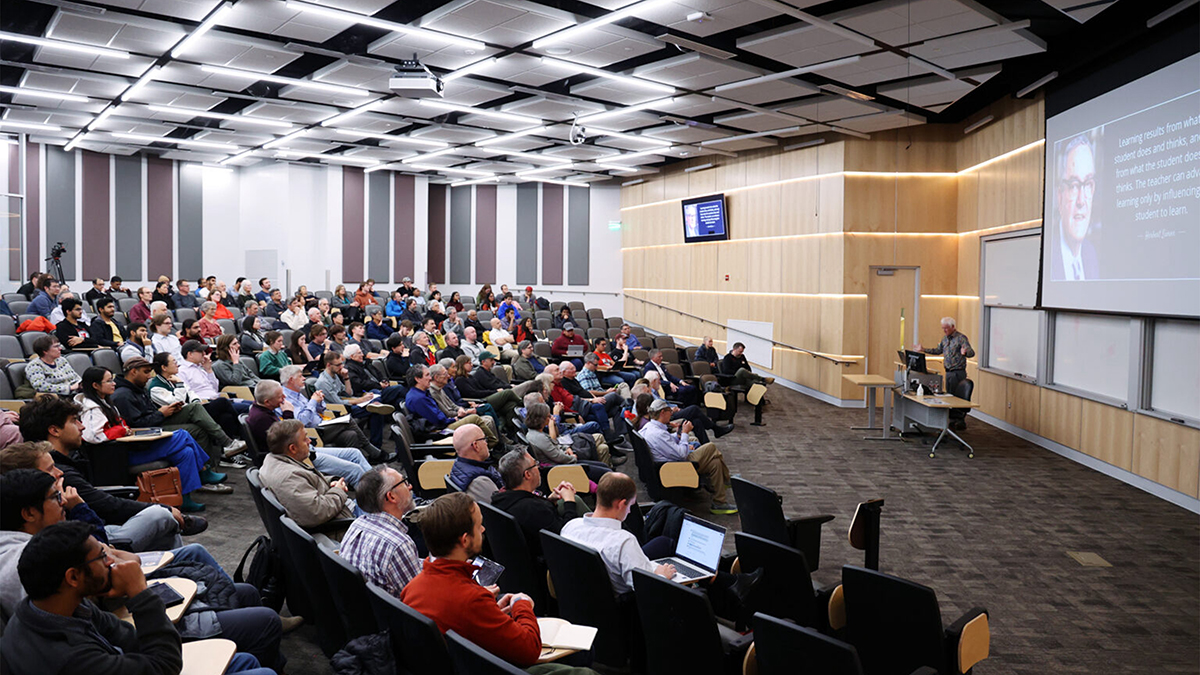
Peter Norvig, a leading AI researcher and Distinguished Education Fellow at Stanford’s Human-Centered AI Institute, recently gave a presentation at the University of Utah in which he discussed how large language models can transform the education sector. Norvig highlighted that AI has the potential to personalise learning, with each student gaining access to an AI tutor while teachers can have an AI assistant to support their work. The goal is to create more effective and engaging learning experiences, giving teachers better opportunities to focus on their relationships with students.
Peter Norvig reflected on the purpose of education and pointed out that AI can help strengthen students’ critical thinking, personal motivation and social skills, while stressing that this requires balance and well-thought-out integration. AI should not only be an effective medium for delivering knowledge, but must also promote collaboration, formation and a deeper understanding of complex topics.
In his presentation, Peter Norvig emphasised that education in the AI era is not only about knowledge transfer, but also about building human interaction and collaboration, with technology functioning as a tool to support these processes. His vision is that AI should enhance teachers’ abilities rather than replace them, and that learning should remain rooted in human connections and critical reflection.
Watch the full presentation here:
 David Pace - writer, College of Science
Author Louise Juhl Dalsgaard argues in a column on POV that artificial intelligence and tools such as ChatGPT lack nuance and empathy in linguistic communication and therefore cannot replace human communication, especially in critical situations. She gives the example of a traumatised Ukrainian woman in Denmark who, through Google Translate, is told that her children are to be taken into care — a situation marked by misunderstandings and a lack of compassion.
Louise Juhl Dalsgaard believes that language is more than words: it is about situational awareness and feelings, which machines cannot grasp. She acknowledges that AI can be a useful tool in certain contexts, but criticises the risk that we may lose the “workings” — the steps in between — in conversations, art and relationships if we hand too much over to technology.
Read her column here:
 Louise Juhl Dalsgaard

Like Louise Juhl Dalsgaard, the author Morten Hesseldahl is also very sceptical about language models. He points out that the spread of language models risks weakening our ability to formulate ourselves in writing and to understand the provenance of sources. He expresses concern that the AI answer engines of the future will not only lack verifiable sources, but also potentially contain morally and politically tinged content. According to Morten Hesseldahl, this could threaten our education and identity by displacing qualified knowledge and introducing value-based biases into what we are presented with.
At the same time, he believes it is important to develop a Danish language model to protect Danish values and culture.
He also emphasises that the intention behind art, literature and communication is essential, and that interaction with AI creates a risk of losing this human connection. AI’s spread in societally critical sectors such as healthcare and education can lead to efficiencies, but also to loss of control and identity.
Read more at Berlingske (behind a paywall):
 Morten Hesseldahl, author

Lex.dk, Danmarks Nationalleksikon (the Danish national encyclopaedia), has updated its knowledge base with 13,000 new articles on the body, health and disease, written by experts to strengthen Danish-language facts and counter misinformation.
Lex.dk seeks to be a reliable source in contrast to commercially driven platforms such as Google and ChatGPT, which often deliver answers without sources and may have a value-based bias. Ole Kaag Mølgaard from Lex.dk highlights that fact-based knowledge and source criticism are crucial in a time when most searches result in quick, source-free answers.
With more contributing professionals, Lex.dk plans further articles and wants to establish a dialogue-based AI solution with its extensive content.
Read more in Politiken:

A study published in the journal Scientific Reports showed that participants often preferred poems written by AI over works by well-known poets such as H.C. Andersen, Shakespeare and T.S. Eliot. The study presented 1,634 participants with ten poems, half of which were human-made and half AI-generated.
The participants could rarely distinguish between the two types of poem and often believed that AI poems were written by humans. When the participants assessed the poems on qualities such as quality and beauty, the AI poems were generally rated higher when their provenance was unknown. The researchers believe the AI poems appeared more accessible and understandable than classic works, which were often judged “meaningless”.
Experts such as Professor Morten Axel Pedersen and Associate Professor Lotte Philipsen point out, however, that AI’s ability to imitate human-made styles is not a threat to human creativity. They see AI as a “co-pilot” that can support and improve people’s artistic processes.
According to the experts, AI’s performances are not due to genuine creativity, but rather a technical imitation of language patterns and style. AI’s role as a creative helper rather than a replacement underlines that human creativity is driven by emotions, motivation and experience – something that AI cannot match.
 See Johan's profile

AI has the potential to make research work significantly more efficient, but lawyer Reza Ahmadian warns against the risk of unintentional leakage of patents, trade secrets and other confidential information. For Science Report, he gives advice on how to navigate safely in AI’s grey areas.
Reza Ahmadian recommends using AI tools that ensure confidentiality, such as paid solutions where you can opt out of data training. Free AI models often involve a risk of data sharing. He points out that GDPR rules are a valuable safeguard against potential pitfalls when sharing personal data with AI and urges particular caution when sharing sensitive information.
Read more at Science Report (behind a paywall)
 Ghita Nidam Møller

OpenAI will launch a new type of AI agent called “Operator” in January 2025, which can perform tasks on behalf of users without constant human intervention. These computer-based AI agents can carry out complex tasks such as booking travel, handling work tasks and coding. This marks a shift away from traditional chatbots towards AI that takes more active action. OpenAI’s “Operator” is expected to integrate with existing workflows and tools to simplify users’ everyday lives.
Similar initiatives are coming from companies such as Anthropic and Google, which are also exploring automation in AI systems. The AI agents of the future could lead to increased productivity and may change the way we interact with technology by taking direct action on tasks rather than merely responding to users’ requests. Challenges such as data security and transparency will, however, be crucial to ensuring users’ trust.
Amanda Caswell
 Shirin Ghaffary

 Jacob Ø. Wittorff Editor for digital business development and innovation
 Adam Tzur






