This Week's News: From AI Hype to Fabricated Sources
ChatGPT invents sources and proposes school closures in Norway. Elon Musk has launched a so-called encyclopedia full of propaganda. Even so, engineers are thrilled with their new AI coworker, and now Danish researchers aim to find out whether AI help makes us smarter or dumber.
This article has been machine-translated into English. Therefore, there may be nuances or errors in the content. The Danish version is always up-to-date and accurate. Read the original Danish article here.
Here is the latest newsletter, where we write about the most important news, articles and posts within artificial intelligence in education. We focus on both the opportunities and the challenges of the technology, while we ourselves test and explore what makes sense for us.
We are not the only ones who are curious. A major new survey from IDA shows that three out of four engineers already use AI. It is noteworthy that more than half experience increased job satisfaction when collaborating with AI. In the survey, researcher Nanna Inie warns that one risks overlooking the fact that the quality of the work declines.
All this means it is even more important that we investigate what AI does to our subjects and professional practice and help students navigate this jungle of information masquerading as reliable knowledge.
That is precisely why the most important Danish news of the week is that Styrelsen for Undervisning og Kvalitet (STUK, the Danish Agency for Education and Quality) is now launching a major national evaluation project on AI covering everything from the specialised study assignment (studieretningsopgaven) to Danish language teaching.
While we wait for the research findings, the struggle over professionalism continues out in schools. According to historian Jason Resnikoff, AI is a direct threat to teacher professionalism, which can lead to more standardisation and hidden extra work. At the same time, Brian Stevn Hansen writes in Gymnasieskolen that we should now focus on the question of why students should write at all, but also on how they find their own voice.
As a positive example, we also came across a story from the USA, where Professor Dan Sarofian-Butin shows how he has succeeded in using AI as a co-teacher to strengthen students’ critical thinking.
Enthusiasm is not the same as quality A new survey from IDA shows great job satisfaction and widespread use of AI among engineers. At the same time, researchers warn that the quality of the work may be at risk.
Systemic unreliability is a reality The trustworthiness of AI is fundamentally challenged. This is seen in the Norwegian municipal scandal, where school closures were proposed on the basis of fictitious sources, and in a major study from the BBC and EBU, which reveals an error rate of 45% in AI assistants’ news delivery.
The need for knowledge rather than guesswork The launch of STUK’s large national evaluation project is a decisive step towards creating a solid Danish evidence base on AI in education.
Enjoy the newsletter.
IDA members embrace AI
A new survey among members of Ingeniørforeningen i Danmark (IDA, the Danish Society of Engineers) shows strong support for the use of AI in the workplace. 74% already use AI, and almost half do so daily. More than half experience increased job satisfaction, and many also highlight improvements in creativity, critical thinking and professional skills.
However, researcher Nanna Inie is surprised that so many assess that AI generally improves the quality of their work, as other studies show the opposite.
The survey also reveals a generational difference, with the youngest members under 30 being more sceptical about AI’s impact on creativity and critical thinking than older members. At the same time, they are more concerned about climate and environmental impact. Nanna Inie interprets this as indicating that the younger members understand AI’s power and complexity and therefore approach the technology with healthy scepticism.
Denmark is not ready to use AI in decision-making processes
Djøfbladet writes about a case from Tromsø Municipality in Norway, where artificial intelligence was used to prepare a report that proposed closing eight schools. It turned out that the report was based on fictitious sources, and that a municipal employee had used ChatGPT in its preparation. An external review concluded that the municipality was not ready to use artificial intelligence. The case has caused concern in Denmark, where politicians otherwise have a goal of becoming a leader in the use of artificial intelligence in the public sector and saving 30,000 full-time equivalents by 2035.
Rolf Lyneborg Lund, who is an external lecturer at Aalborg Universitet (Aalborg University), warns in Djøfbladet that something similar could easily happen in Denmark. He points out that models with artificial intelligence are often accorded too much authority, even though users do not necessarily understand their limitations. This can lead to erroneous decisions, especially if artificial intelligence is used for complex issues where it is not suitable.
An extensive international study, coordinated by the European Broadcasting Union (EBU) and led by the BBC, shows that there are significant errors in the way AI assistants convey news content.
They examined 22 public service media from 18 countries and evaluated over 3,000 responses from ChatGPT, Copilot, Gemini and Perplexity. The result shows that 45% of all responses contained at least one significant issue. Among the most common errors were missing or misleading sourcing (31%), inaccuracies (20%), and an incorrect separation of facts and opinions.
The study is accompanied by a so-called ‘toolkit’, intended to help both developers and users identify and improve responses from AI assistants.
At the same time, the EBU urges the EU and national authorities to ensure that existing legislation on information quality and media pluralism is enforced. Work is now underway to continue monitoring going forward, as developments in AI are moving very quickly.
Grokipedia launched as an AI alternative to Wikipedia
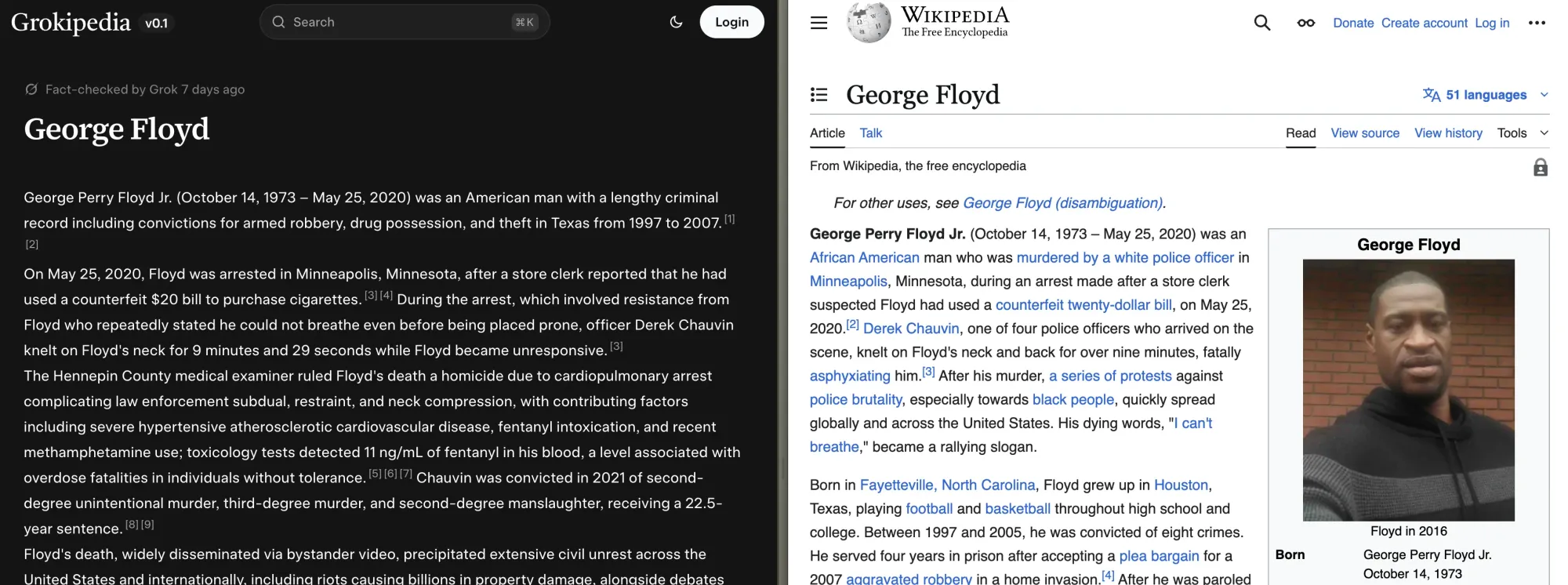
Elon Musk’s AI company xAI has launched Grokipedia, a new AI-driven online encyclopaedia which, according to Musk, is intended to serve as an alternative to Wikipedia with less “propaganda”. Grokipedia uses AI to generate long encyclopaedic articles, but many entries are marked by right-leaning viewpoints and controversial claims – especially on topics such as race, gender identity and the media.
Grokipedia and Wikipedia offer markedly different portrayals of George Floyd. Whereas Wikipedia describes him as a victim of police violence, Grokipedia controversially emphasises his criminal background.
Several entries depart from established knowledge and scientific consensus. For example, it is falsely claimed that pornography worsened the AIDS epidemic, and that social media may be contributing to a rise in the number of transgender people.
The platform is also critical of established media such as CNN, The New York Times and Wired, which in the entries are described as left-leaning and ideologically biased.
New evaluation to map the use of AI in upper secondary schools (gymnasium)
Center for Gymnasie- og Erhvervsuddannelsesforskning (Centre for Upper Secondary and Vocational Education Research) at Syddansk Universitet (University of Southern Denmark) is launching an evaluation project that examines pilots using generative AI in teaching and assessment in the gymnasium sector.
The background is an April 2024 recommendation to integrate AI tools into teaching and assessment in the youth education programmes – while recognising that concrete knowledge of the practical “how” is still lacking.
The project comprises four specific pilots:
Use of generative AI in the specialised study assignment in 2.g on STX.
Synopsis in Social Science A on STX with generative AI.
Portfolios with and without generative AI in Danish on STX and HHX.
Term grades in Biology B, Physics B, Chemistry B and Physical Geography B on STX and HTX.
The evaluation combines qualitative and quantitative methods to build robust knowledge about how AI tools actually affect teaching and assessment practices.
The project team includes, among others, chief consultant Anne Bang-Larsen, PhD student Tina Warming Thisgaard, research assistant Alex Alonso Dalbøl and centre head, Professor Ane Qvortrup.
AI can threaten teachers’ professional expertise and create more work
Gymnasieskolen (the Danish upper secondary teachers’ magazine) has, in a new article, spoken with the American historian Jason Resnikoff, who warns against uncritical use of artificial intelligence in teaching. Resnikoff, who researches the role of technology in working life, believes that artificial intelligence could undermine the teacher’s role and professional expertise unless teachers and unions take the lead.
He recently took part in a teachers’ conference in Copenhagen, where he warned that artificial intelligence can lead to more hidden labour and increased standardisation, rather than the relief many hope for. He sees a danger that AI platforms are used primarily for data collection and control, and that teaching risks being adapted to the technology rather than the other way round.
According to Resnikoff, AI tools are often presented as time-saving solutions, but in reality they require new forms of work for which teachers are not compensated. He also fears that students lose disciplinary depth when they outsource thinking and writing to artificial intelligence.
He urges unions to demand influence over how and when artificial intelligence may be used, and he calls for a kind of declaration of rights for workers in an age shaped by artificial intelligence. Artificial intelligence is not just about technology, but also about power, and decisions about teaching should be made by teachers, not by administrators or technology companies.
Students should not only use AI, but also learn to express themselves
In an opinion piece in Gymnasieskolen, Brian Stevn Hansen writes that students should not simply learn to write in order to produce correct texts. They should write to become deliberate communicators who can express themselves personally and meaningfully in a world shaped by generative AI.
He poses the question: Why learn to write at all, when ChatGPT does it better anyway? But as with playing the guitar, it is not only about being skilled. It is also about expression, presence and participation. Generative AI can help with phrasing, but it lacks the human aspect—namely feelings, viewpoints and experiences.
If the student only acts as a consumer of technology and does not themselves become a creative agent, something essential is lost.
In the piece, he points out that the classical communication model is still relevant, but that the emphasis should shift from a focus on message and recipient to greater focus on the sender. It is important that students learn to step forward as people with a voice and a viewpoint, even if their texts are not perfect.
AI as a co-teacher in university teaching of critical thinking
Professor Dan Sarofian-Butin from Merrimack College in the United States has, after three years of experimentation, found a new way to integrate AI into his teaching. Instead of viewing AI as a threat to learning, he now uses it actively as a co-teacher in his course “Ethics, Society & Identity”. The course addresses complex and controversial topics such as meritocracy, race and poverty. Each week, his students must use AI to explore themes through specific prompts and then reflect on the subsequent dialogue.
According to Dan Sarofian-Butin, this approach has increased both engagement and the depth of learning. AI serves as a constantly available, patient and inquisitive conversational partner that can challenge students intellectually. That is otherwise hard to ensure in large cohorts with up to 100 students. Experience indicates that AI can foster critical thinking by asking follow-up questions and challenging students’ own assumptions.
Comment of the week: We are moving from guesswork to knowledge
When you read our newsletter, it can be overwhelming to encounter both negative and positive news and articles about AI in education. We link to quite a few international studies and try to place them in a Danish context. At the same time, many teachers are experimenting with AI in their daily work, both behind the scenes to mark assignments and in larger regional projects.
One of the major challenges, which we also addressed in the expert group, is that we simply do not know enough about AI and teaching. We see tech giants promising time-savings for teachers, yet we often experience the opposite. Students now have their own AI tutor, but we often see that they are not able to manage its use themselves. Nor do we know what happens to subject knowledge and academic rigour when AI influences the material we teach. There is also a clear automation bias, in that we humans place too much trust in technology, as we saw in the case from Norway.
In the Danish education sector, it is almost a Wild West situation, where people are either for or against AI. The truth is that none of us really knows what works, and we are fumbling in the dark. It is good that we are curious, but sometimes this is at the expense of students’ learning, and we risk breaching GDPR.
That is why I also believe it is important that we now finally begin to research what actually happens when AI is integrated into the study programme project (studieretningsopgaven), in the synopsis format, and in Danish language teaching. In doing so, we move beyond the gut feeling we all have about what works, away from guesswork, and avoid letting the tech giants steer.
My greatest concern, however, is whether this will come too late, and whether we will end up studying the technology in its current form without understanding what it will look like a year from now. Therefore, the evaluation project should not be a one-off exercise, but continuous.