This article has been machine-translated into English. Therefore, there may be nuances or errors in the content. The Danish version is always up-to-date and accurate. Read the original Danish article here.
This week we focus on the recommendations from Tesfaye's expert group on ChatGPT and other digital tools. Alongside the recommendations, the group also published an op-ed that expands on many of the ideas behind the recommendations but goes beyond the group's terms of reference. You can hear much more about the recommendations in an upcoming webinar with the chair of the expert group, Birgitte Vedersø.
We also saw artificial intelligence used for political communication when Dansk Folkeparti released a deepfake video featuring Prime Minister Mette Frederiksen. This is a good opportunity to discuss the boundary between reality and fiction as part of teaching, as well as the opportunities and challenges of artificial intelligence.
According to a new survey carried out by Epinion for Kraka-Deloitte, Danish workplaces have begun to use artificial intelligence. At the same time, Stanford University has published its annual report on the most important AI trends in 2024 – we have included a summary here in the newsletter.
This week's recommendation is a very interesting talk by Thore Husfeldt on search engines, democracy, the culture of the knowledge society and artificial intelligence.
Happy reading
The expert group's recommendations on ChatGPT and other digital tools
Last Wednesday the expert group's final recommendations were published, and below we have gathered the main conclusions. We recommend reading Malte von Sehested's excellent post, where he reviews different viewpoints on the recommendations.
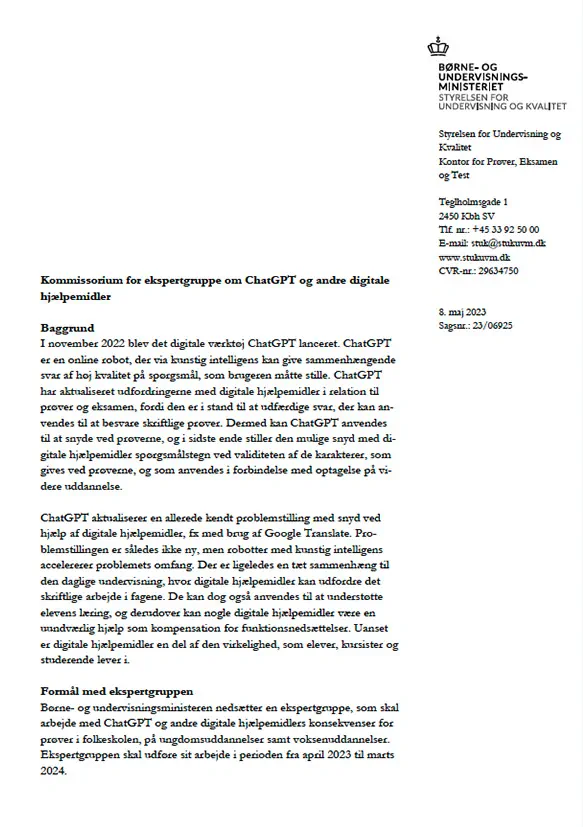
Before reading the recommendations, we would point out that they should be read in light of the original terms of reference.
Below you can read all the recommendations (click the image to get the PDF version):
Recommendation 1: Examinations should rest on two pillars – and be able to assess both with and without digital tools
The number of examinations where it is possible to cheat or be accused of cheating should be limited, so that the focus is on learning.
The overall examination landscape should support both the development of students’ knowledge and skills and the development of competences to use and critically evaluate digital tools independently.
The report’s seven generic examination formats should be used as a starting point and can serve as a guide in connection with any changes to existing examination formats.
Recommendation 2: Ongoing development of examinations
Changes to examination formats should be possible on a shorter timescale than before, so that examinations can be continuously adapted to the wider context and new technology.
Børne- og Undervisningsministeriet (the Danish Ministry of Children and Education) is encouraged to involve relevant stakeholders in ongoing discussions of examination formats, including which of the seven generic formats can be used from subject to subject.
Recommendation 3: Use of digital technology and artificial intelligence as a strategic priority area
The leadership of each institution should prioritise digitalisation, including artificial intelligence as a tool for learning.
Communication and guidance on digital tools in examinations should be prioritised locally at institutions.
Recommendation 4: Teaching should form the basis for new examination formats
Leaders and teachers should integrate digital tools in everyday teaching across subjects, so that there is alignment between teaching and examinations.
The recommendations will feed into the ministry’s continued work on developing examinations. Initially, Styrelsen for Undervisning og Kvalitet (the Danish Agency for Education and Quality) is launching a number of pilots with some of the examination formats proposed by the expert group. At the same time, the recommendations will also inform the forthcoming work in the expert group for the Danish primary and lower secondary school (folkeskole) exams, which has been set up as a result of the agreement on the folkeskole quality programme – frihed og fordybelse, and which must also be discussed with Sammen om Skolen (a national education partnership).
Webinar: Rethink school – not just exams
IT-vest is offering a webinar on the recommendations from the chair of the expert group, Birgitte Vedersø. The target group for the webinar is teachers and leaders in primary and lower secondary education, upper secondary education and higher education.
Key takeaways:
The expert group recommends that work with generative language models be initiated locally within subject communities straight away.
Understanding of digital technology should be introduced across the entire education pathway, and teachers should receive continuing professional development in this as soon as possible.
Op-ed: Here are the recommendations we were not asked for
In addition to the recommendations, an op-ed was also published in Altinget Uddannelse, in which members of the expert group write a little more than they were asked to by the ministry.
Dansk Folkeparti makes a deepfake of Mette Frederiksen
DF has shared an AI-generated video on Instagram, in which a deepfake of Prime Minister Mette Frederiksen announces the abolition of several Danish public holidays. Although it is clearly marked that parts of the video were made using artificial intelligence, it has sparked debate about its use in political communication. On TV 2, AI expert Peter Svarre calls the video's content "problematic" and believes there is a need for clear regulation.
Ask Hesby Holm, director at the organisation Digitalt Ansvar, tells TV 2 (the Danish television channel):
You can end up where some people aren’t aware of what’s meant as a joke and what’s real
To DR (the Danish Broadcasting Corporation), Morten Messerschmidt writes: You would have to be completely devoid of humour and critical faculties not to see that this is an artificial segment featuring Mette Frederiksen.
💡
The video is a good example of how deepfakes can be used for political communication. In this case, it is disclosed, and the video is not particularly well executed. But it shows some of the technology’s potential to create confusion for viewers.
The video can also be used as the basis for a class discussion about how technology can influence our perception of news and the ethical challenges posed by digital manipulation. At the same time, it underlines the need to educate students in critical thinking to understand the digitalised world – the boundary between reality and fiction is not always clear.
Artificial intelligence on the rise in Danish workplaces
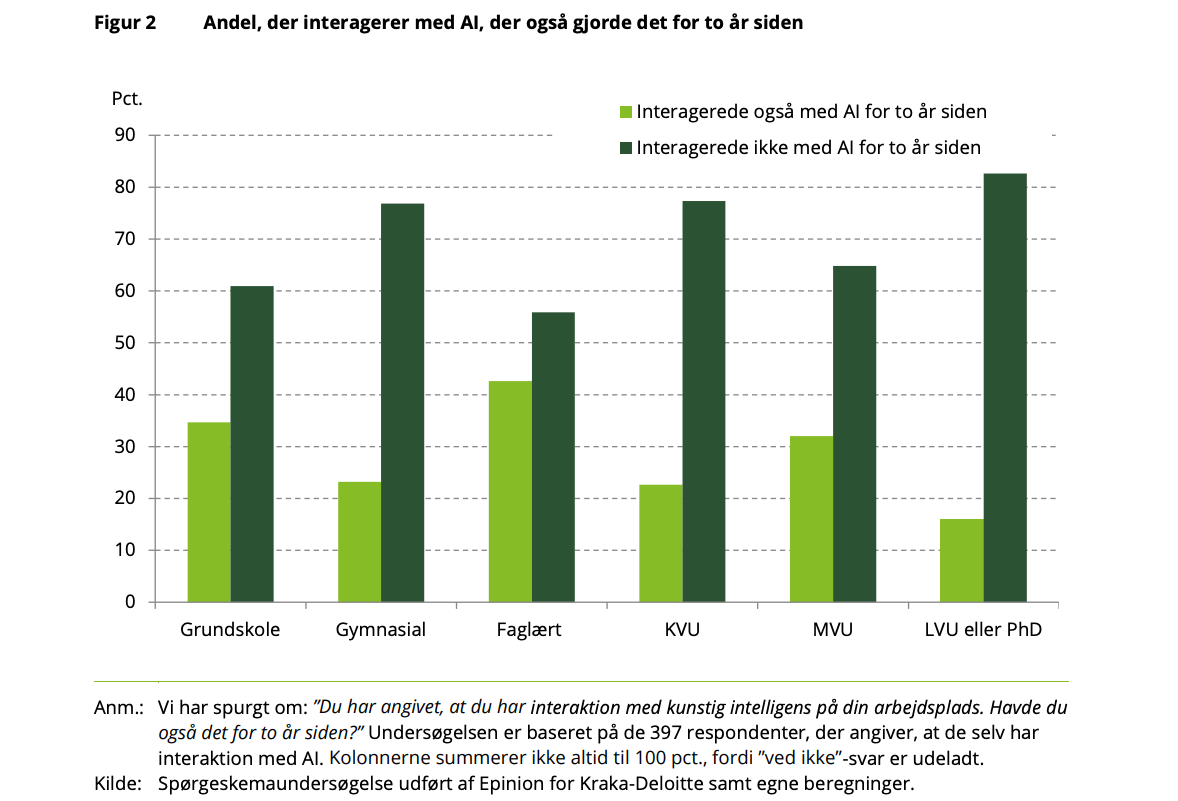
Epinion has conducted a survey for Kraka-Deloitte showing that 48% of respondents’ workplaces use artificial intelligence, and that 25% interact directly with the technology. This is a significant increase compared with previous years.
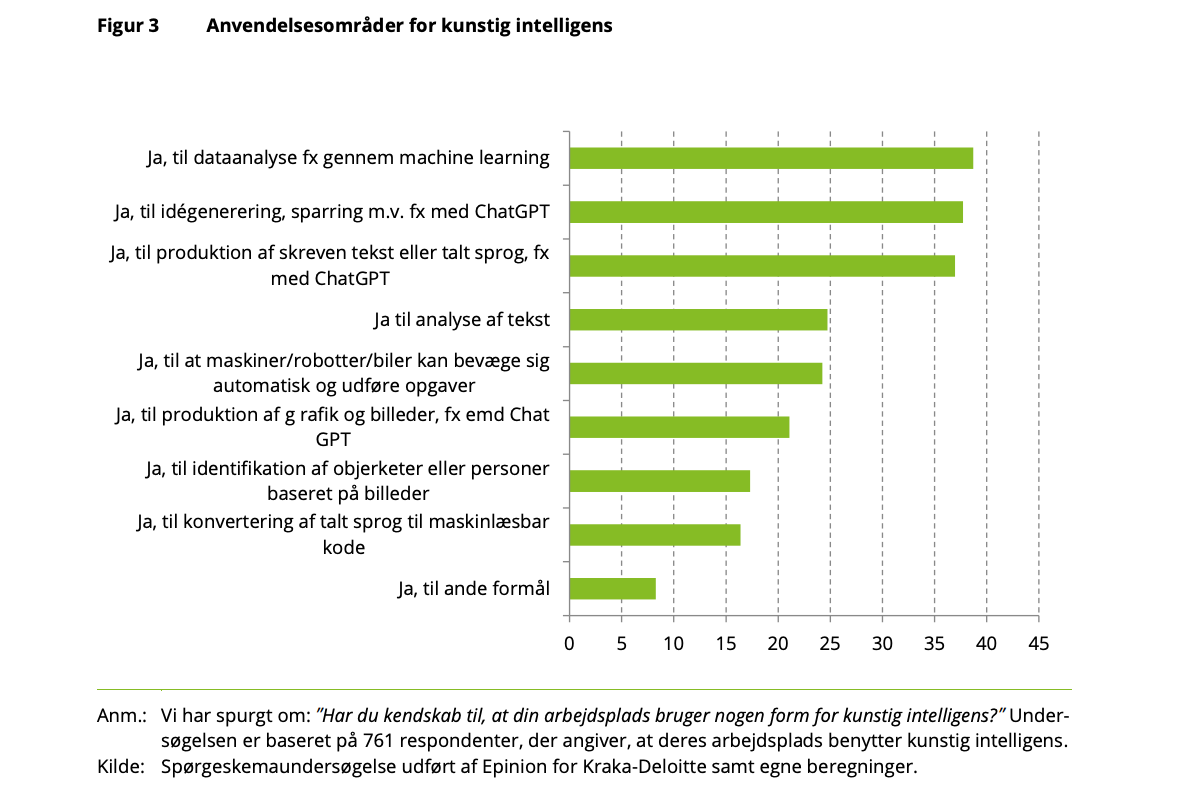
It turns out that artificial intelligence is particularly widespread among people with higher education. Primary use cases for those with long-cycle higher education include data analysis, idea generation and text production, indicating a tendency to use AI to augment cognitive and analytical functions rather than merely automate manual or routine tasks.
The survey also shows continuing concern that artificial intelligence will take over people’s jobs, up from 16% in 2021 to 21% in 2024.
The results of the study suggest that artificial intelligence has had a positive effect on productivity and job satisfaction for the employees involved, and that artificial intelligence is being used to handle routine or less interesting tasks.
Each year, Stanford University publishes a report covering the key trends in artificial intelligence. This year’s report is the most comprehensive they have released to date.
They have summarised the entire report in 10 takeaways – we have chosen to present them in English.
AI beats humans on some tasks, but not on all. AI has surpassed human performance on several benchmarks, including some in image classification, visual reasoning, and English understanding. Yet it trails behind on more complex tasks like competition-level mathematics, visual commonsense reasoning and planning.
Industry continues to dominate frontier AI research. In 2023, industry produced 51 notable machine learning models, while academia contributed only 15. There were also 21 notable models resulting from industry-academia collaborations in 2023, a new high.
Frontier models get way more expensive. According to AI Index estimates, the training costs of state-of-the-art AI models have reached unprecedented levels. For example, OpenAI’s GPT-4 used an estimated $78 million worth of compute to train, while Google’s Gemini Ultra cost $191 million for compute.
The United States leads China, the EU, and the U.K. as the leading source of top AI models. In 2023, 61 notable AI models originated from U.S.-based institutions, far outpacing the European Union’s 21 and China’s 15.
Robust and standardized evaluations for LLM responsibility are seriously lacking. New research from the AI Index reveals a significant lack of standardization in responsible AI reporting. Leading developers, including OpenAI, Google, and Anthropic, primarily test their models against different responsible AI benchmarks. This practice complicates efforts to systematically compare the risks and limitations of top AI models.
Generative AI investment skyrockets. Despite a decline in overall AI private investment last year, funding for generative AI surged, nearly octupling from 2022 to reach $25.2 billion. Major players in the generative AI space, including OpenAI, Anthropic, Hugging Face, and Inflection, reported substantial fundraising rounds.
The data is in: AI makes workers more productive and leads to higher quality work. In 2023, several studies assessed AI’s impact on labor, suggesting that AI enables workers to complete tasks more quickly and to improve the quality of their output. These studies also demonstrated AI’s potential to bridge the skill gap between low- and high-skilled workers. Still other studies caution that using AI without proper oversight can lead to diminished performance.
Scientific progress accelerates even further, thanks to AI. In 2022, AI began to advance scientific discovery. 2023, however, saw the launch of even more significant science-related AI applications—from AlphaDev, which makes algorithmic sorting more efficient, to GNoME, which facilitates the process of materials discovery.
The number of AI regulations in the United States sharply increases. The number of AI-related regulations in the U.S. has risen significantly in the past year and over the last five years. In 2023, there were 25 AI-related regulations, up from just one in 2016. Last year alone, the total number of AI-related regulations grew by 56.3%.
People across the globe are more cognizant of AI’s potential impact—and more nervous. A survey from Ipsos shows that, over the last year, the proportion of those who think AI will dramatically affect their lives in the next three to five years has increased from 60% to 66%. Moreover, 52% express nervousness toward AI products and services, marking a 13 percentage point rise from 2022. In America, Pew data suggests that 52% of Americans report feeling more concerned than excited about AI, rising from 38% in 2022.
AI, democracy and the culture of the knowledge society – how does it all fit together?
Thore Husfeldt has just given a talk at Det Bibliotekspolitiske Topmøde (the Library Policy Summit), and the entire talk is now available on YouTube.
Thore is a professor of algorithmics at IT-Universitetet i København (IT University of Copenhagen), and in the talk he explains the complex algorithms behind modern search engines and how they affect the way we access information. He also touches on developments in artificial intelligence.




 Malte von Sehested






 Ritzau Politik

 Tobias Reinwald




 Jakob Sorgenfri Kjær Journalist
 Morten Reil

 Amalie Langballe

 Ariel Gilreath
 Tony Wan

 Juli Clover

 View ORCID Profile