This week's news: Eight municipalities lead the way on responsible AI teaching in primary and lower secondary schools
Learn more about AI's role in education in this week's newsletter. Gain insights from eight municipalities' experiences with responsible AI teaching, read about ethical dilemmas and new studies on AI's impact on the labor market, and get a glimpse of the AI systems of the future.
This article has been machine-translated into English. Therefore, there may be nuances or errors in the content. The Danish version is always up-to-date and accurate. Read the original Danish article here.
In this week’s newsletter, we cover a lot of ground, but start with the Danish news focusing on the education sector.
There was also a call to action from Mathilde Tronegård, Director of Studievalg Danmark (Study and Career Guidance Denmark), who warns against AI-based study choice and insists that human guidance is indispensable.
We ourselves felt a little provoked by IT commentator Mogens Nørgaard’s column in Computerworld, where he criticises the traditional teacher role. Many people have an opinion about school because they have attended one themselves, but often do not know what today’s teaching looks like – with or without technology. That said, we believe it is important to include these viewpoints, and there may be a grain of truth in them.
While researching this newsletter, we came across a case from California.
In California, AI was used to formulate questions for a law exam – notably without any lawyers being involved in the process. It is remarkable that professionals were not included – perhaps, in the end, it was about saving money. The news also underlines that we should be cautious about using AI uncritically.
Shifting our gaze slightly to look at AI’s effect on the labour market, it seems rather limited.
At the same time, there are still major challenges with AI’s energy consumption and its impact on society.
A US report warns about generative AI’s rising energy consumption and complex risks to society and the environment – without companies sufficiently reporting their climate footprint.
Finally, we also look a little to the future – what can we expect to happen with AI when all the texts run out?
New inspiration catalogue shows how eight municipalities are working to integrate AI into primary and lower secondary education
KL has published an inspiration catalogue with eight concrete cases from different Danish municipalities, showing how AI can be used in teaching. The aim is to support schools in providing a framework for AI pedagogy and to promote reflection among both teachers and pupils about the technology’s use and limitations. The catalogue contains practice examples, teaching programmes and materials focusing on technological understanding, ethics and practical application.
In Copenhagen, for example, they are working with dilemma cards and competence development programmes for teachers and school leaders, so that schools can build a shared understanding of how and when AI should be used. In Rudersdal, pupils have worked on distinguishing between human-made and AI-generated products, while pupils in Hvidovre use AI to visualise idioms in language teaching. Other examples show how AI supports idea development in project assignments, role play about political summits, or is used to generate music as feedback on the teaching.
A consistent feature across all cases is that AI is regarded as a supplement to pedagogical practice – not a replacement. At the same time, there is an emphasis on pupils developing technological, practical and ethical AI competences, and on teachers experimenting together and discussing dilemmas. The material therefore includes both didactic considerations, specific technologies such as SkoleGPT and tools to support schools’ work with AI.
AI can support guidance – but can never replace human contact
Mathilde Tronegård, Director of Studievalg Danmark (Study and Career Guidance Denmark), stresses in connection with the forthcoming EPX programme that AI should be regarded as a support tool – not as a replacement for personal guidance. Although AI can be used to improve digital information platforms such as ug.dk and ease students’ fact-finding, she strongly warns against leaving the actual study-choice process to AI-based, personalised recommendation systems. She highlights in particular ethical risks such as data security and algorithmic transparency.
At EPX, with a planned start in 2030, AI is to play a role in guidance. The concrete implementation is still unclear, however. Tronegård sees opportunities for AI to free up advisers’ time for more meaningful conversations with students. At the same time, students should, in her view, learn to use AI critically – for example by crafting effective prompts and assessing the quality of the information they receive.
IT commentator Mogens Nørgaard delivers in his latest column in Computerworld a sweeping critique of both Danish and European technology development – with a particular focus on a lack of decisiveness and what he calls “AI shame” among educators. He believes that Europe lags markedly behind the US and China when it comes to developing advanced digital solutions such as cloud services and AI in teaching.
Especially in Denmark, emotional barriers and limited technological understanding slow the implementation of AI in the school system, where many educators avoid the technology for fear of losing control, authority and status. The so-called AI shame stems from an unwillingness to let go of the traditional teacher role and the assumption that knowledge is conveyed solely through the teacher’s lecturing or books.
This stands in contrast to the US, where universities such as Wharton have already made AI an integral part of teaching and assess students based on how intelligently and creatively they use it.
In Denmark, by contrast, AI is still met with scepticism – not based on genuine critical thinking, but as a knee-jerk reaction to the new.
The Californian legal profession has come under fire after it was revealed that 23 of the multiple-choice questions in the February 2025 edition of the bar exam were developed with help from AI — and not necessarily by lawyers. At the same time, the exam was hit by serious technical problems, with testing platforms crashing and many candidates struggling to complete the test. This has prompted the State Bar of California to ask the state supreme court to adjust the scores.
Reactions have been sharp, especially from legal educators. Critics call it “unheard of” that non-lawyers and AI helped to formulate central parts of a legal examination. According to the bar, the AI-generated questions were developed in collaboration with the testing company ACS Ventures and assessed as valid. But academics question both the professional rigour and the transparency of the process, particularly because the same company also evaluated its own questions.
Legal and AI expert Andrew Perlman says it is to be expected that AI will begin to be used in exam development, but emphasises that subject-matter experts must approve all AI-generated elements. He predicts that AI will become a permanent part of legal practice, and that, in time, it may be a problem not to use the technology professionally.
New study: AI chatbots change the nature of work but save only a little time
Two years after the launch of ChatGPT, a new Danish study has examined the concrete impact AI chatbots have had on the Danish labour market. The conclusion is clear: the effect is far smaller than expected.
The study draws on data from 50,000 Danish employees and shows that the average time saving from using AI chatbots such as ChatGPT is only 2.8% — equivalent to about one and a half minutes per working hour. At the same time, there are no measurable changes in either hours worked or pay levels.
The researchers behind the study, Anders Humlum from the University of Chicago and Emilie Vestergaard from Københavns Universitet (University of Copenhagen), emphasise that earlier studies have overestimated AI’s efficiency potential because they focused on tasks that were particularly suited to automation. In reality, these tasks make up only a small part of most employees’ working day.
By contrast, 8.4% of respondents report that AI chatbots have created more tasks, for example adapting workflows and changing task structures.
Meanwhile, the data show that employees in companies that actively encourage the use of AI are more likely to report quality improvements, increased creativity and better workflow, though still with no effect on their pay.
The study thus supports the view that technology adoption requires more than mere access to the tool; organisational backing and adaptation are crucial.
Despite the limited impact, Dansk Erhverv (Danish Chamber of Commerce) holds on to AI optimism
There are, however, no signs that the business community is about to give up on the technology. At Dansk Erhverv, the results are met with realism — but also with continued optimism.
Head of division Frederikke Saaby acknowledges that many companies have been disappointed by the lack of quick wins, but at the same time emphasises that there is still strong belief in AI’s potential.
Despite the preliminary and modest results, this is not resignation — rather, there is now a higher bar for how AI is applied in practice.
This reflects a broader trend in business, where AI is increasingly seen as a strategic investment rather than a quick gain.
Generative AI burdens the environment and raises new societal risks
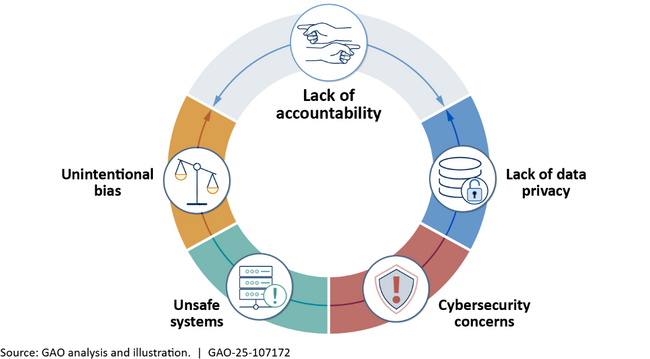
A new report from the U.S. Government Accountability Office (GAO) examines the environmental and societal consequences of generative AI. The technology is growing rapidly and is used across sectors, but there are significant challenges associated with its resource consumption. Training and using large language models require enormous amounts of electricity and water — especially for operating and cooling data centres. Hardware production and the energy needs of data centres are increasingly contributing to CO₂ emissions and water consumption. Nevertheless, companies rarely publish detailed data on their environmental impact.
The report describes how generative AI affects various areas of society such as public services, the labour market, education and research. For example, AI can improve information accessibility, but it can also be difficult to assign responsibility when recommendations are wrong. In teaching and research, there is a particular need for transparency and reliable methods for assessing AI’s validity and ethical implications.
The AI of the future should learn through experience, not just from human knowledge
A new essay by AI researchers Richard S. Sutton and David Silver calls for a paradigm shift in AI development — away from human-curated data and towards AI agents that learn by acting and interacting with the world themselves. Inspired by Sutton’s famous “Bitter Lesson”, they emphasise that human insight and pre-encoded knowledge rarely lead to breakthrough advances in AI. Instead, it is algorithms that continually adapt and learn through action and feedback that drive real progress.
According to Sutton and Silver, generative AI systems such as language models reach their limits because they are based solely on existing human-written texts. For truly creative and autonomous AI, models must instead develop an “experience-based intelligence”, where new insights arise through interaction with the environment, for example by performing actions, experimenting, and receiving feedback – both digital and physical. One example is AlphaProof, which combines language models with reinforcement learning and has generated millions of new mathematical proofs.
They also emphasise the necessity for AI systems to build “world models”, that is, internal simulations that can predict the consequences of actions and enable genuine planning. This is particularly important for AI assistants in health, education and research, where feedback comes not only from human judgements but also from measurable outcomes in the real world. Precisely because agents learn from consequences, this form of learning can, according to the authors, make AI safer, as it reflects the complexity and constraints of reality.