This week's news: Consortium will develop Danish language models

•
12 min read



Last week it emerged that a consortium of private companies and public organisations has joined forces to develop Danish language models. There are, however, also critics who do not think it is a good idea. In this newsletter, we link to both viewpoints.
On Saturday, Radio4’s podcast, featuring Claus from Viden.AI visiting Oliver Zahle, was released. They had an interesting conversation about artificial intelligence and education. It also gives reason to take a closer look at Jakob Vest Hansen’s article, where he delved into the many detection tools that claim to identify texts written by artificial intelligence.
At educational institutions that use Microsoft Education, teachers now have new options for using artificial intelligence as an assistive tool in everyday writing tasks. Cphbusiness (Copenhagen Business Academy) has gone a step further and launched its own chatbot to help students with academic questions.
In the slightly more technical domain, Google has launched its AlphaFold 3, which can predict structures and interactions between living molecules.
This week we are also highlighting two conferences in the autumn that focus on artificial intelligence and teaching. Per and Claus from the blog here will be taking part in both conferences, and we look forward to meeting lots of interesting people and having some good discussions.
Happy reading
Last week, Alexandra Instituttet (the Alexandra Institute), IBM Danmark (IBM Denmark) and Dansk Erhverv (the Danish Chamber of Commerce) announced their plans to create Danish language models in Dansk Sprogmodel Konsortiet (the Danish Language Model Consortium). Their focus is to develop Danish language models for specific use cases relevant in a Danish context, and therefore they are not aiming for direct competition with existing models such as ChatGPT.
This development will take place as a collaboration between private companies and public organisations with the aim of building language models based on openness, compliance with the law, data integrity, transparency, ethics and security.
Listen to DR’s (the Danish Broadcasting Corporation) podcast, Prompt, in which Casper Klynge talks about the thinking behind Danish language models.

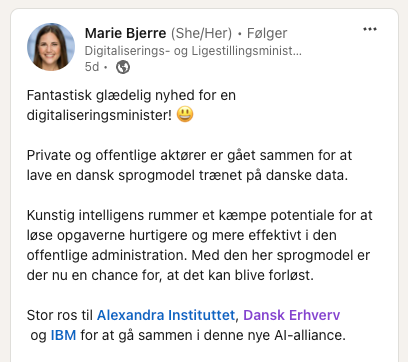
Read more on LinkedIn and the consortium’s website below:
 JENS KAAS BENNER



Not everyone, however, thinks that we should develop Danish language models; instead, data should be made available so that others can also train language models. Read Dan Rose Johansen’s two posts on LinkedIn:
Dan Rose Johansen Dan Rose Johansen
On Radio4’s podcast Mig og AI there was a special focus on education last Saturday, with Oliver Zahle joined by Claus Scheuer-Larsen, a senior teacher at Odense Tekniske Gymnasium (upper secondary school, gymnasium) and writer for Viden.AI.
They discussed, among other things, the use of AI in schools, including potential pitfalls such as fake AI “friends” on social media that can lead to unethical interactions with users. They also touched on a broader use of AI in the education system, including how the technology can enhance learning processes and make them more inclusive. They further discussed the changes AI may bring to forms of examination, where there should be a focus on both the product and the process behind pupils’ work, which can lead to deeper understanding and critical thinking among students.
Listen to the full episode by following the link below:

Jakob Vest Hansen has written an article discussing the ineffectiveness and many weaknesses of GenAI detection tools. He points out that these tools often produce false positives and are generally inaccurate, especially with Danish texts.
In the article he explores the technical and ethical issues, including how the tools may favour privileged students and can compromise students’ legal protection. He also warns against the use of AI detection tools and urges caution, especially because they can worsen equality and add unnecessary pressure on teachers.
Read the article here:
Jakob Vest Hansen
If your school uses Microsoft Teams, a number of AI features have now been introduced.
See more on Microsoft’s website.

At Cphbusiness (Copenhagen Business Academy), they have developed a learning tool called Sokrates, which functions as a virtual assistant and can answer questions from students on the e-commerce programme.
- Sokrates is a kind of extension of us as teachers. The questions that students would normally ask us, they can now ask the chatbot. This means they can get well-founded answers even when they’re not in the classroom, so, for example, they don’t get stuck when they’re working on an assignment, says Per Bergfors.
The tool provides well-founded answers based on the material that lecturers have chosen to train the chatbot on, and the students have responded positively to the chatbot and use it to supplement their learning.
The project "Virtuelle assistenter" explores the potential for using generative artificial intelligence in teaching in higher education.
Read more about the project here:

 Text_ Benjamin Mikkelsen Photo_ Shutterstock
 Karen Elise Løvengreen
 Camilla Tonnesen camitfyens.dk
 Per Arnoldi


 Photo: Marie Hald


 Carsten Mai, political commentator

 Kristian Nielsen, associate professor and programme director at AAU Business School

AlphaFold 3 is a new AI model developed by Google DeepMind and Isomorphic Labs that focuses on predicting the structure and interactions of life’s molecules – including proteins, DNA, RNA and molecules such as ligands.
This could lead to new biologically recyclable materials and more resilient crops.
Read more on the AlphaFold team’s website:
 Google DeepMind AlphaFold team

This year’s theme is 'intelligent education', and we are focused on how we educate at a time when children’s and young people’s wellbeing and learning still make headlines. When our trust in academic standards and knowledge is challenged by language models and new technologies, and when personal development, community and the acquisition of new knowledge do not take place only within the frameworks we offer in the education sector. Over two days we will work together to find answers to what intelligent education looks like.
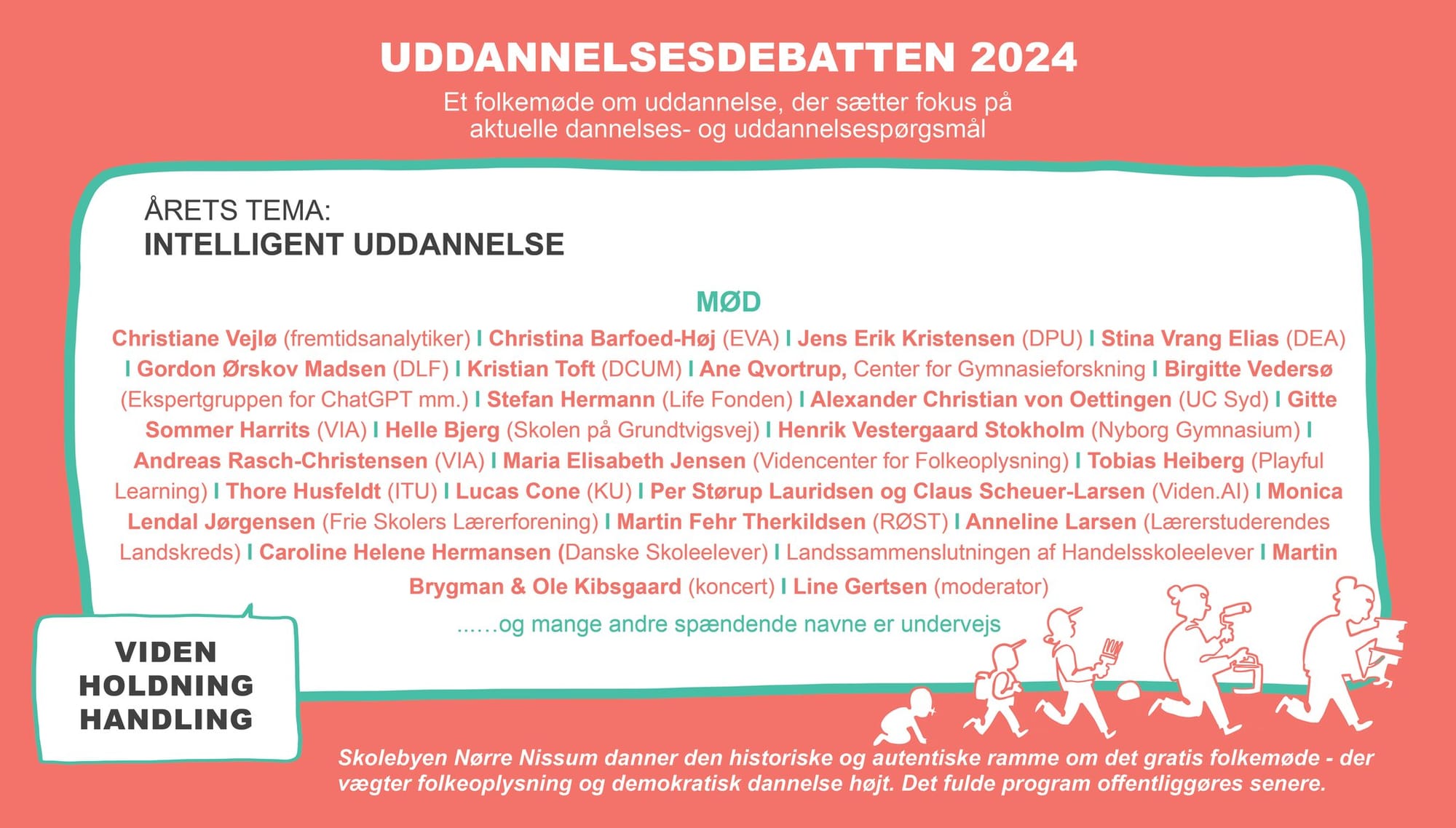

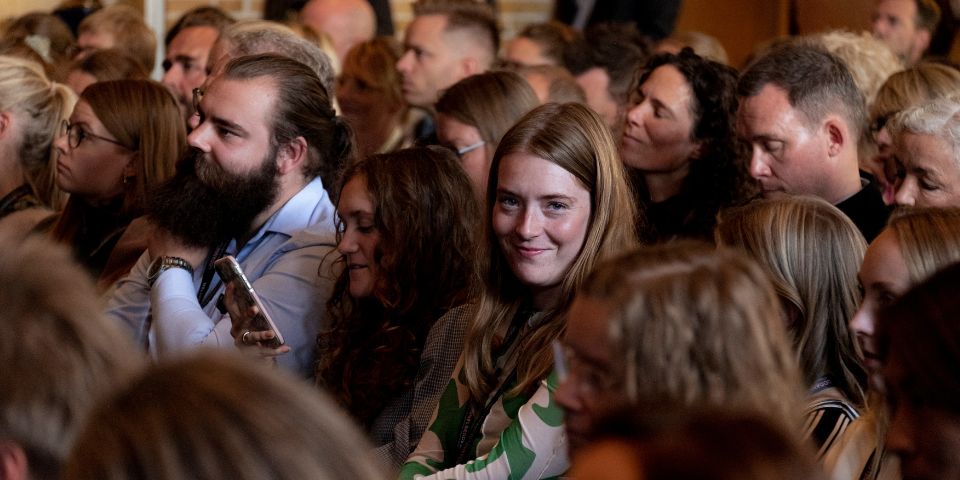
Generative AI technologies have changed the conditions for students’ and teachers’ collaboration in teaching and learning spaces. AI chatbots offer new didactic possibilities and can be a good learning and support tool, but conversely AI challenges academic standards and the relationships between students and teachers. Politicians ask: Have we taken the use of screens and digital technologies in the school system too far? And some researchers, parents, school leaders, teachers and students ask the same.
Within this field of tension, the conference will offer research-based presentations and practice-oriented talks and workshops. The conference is aimed at everyone interested in young people and education.







