This week's news: Ban human-like AI chatbots targeted at children

•
10 min read



In this week’s newsletter, we focus on what happens when children use artificial intelligence in the form of a chatbot such as Snapchat’s MyAI. A new report from Børns Vilkår (a Danish child welfare organisation) examines how children relate to the new technologies and calls for a ban on anthropomorphised AI chatbots aimed at children.
When you work with artificial intelligence, it can feel as though the technology is everywhere and that everyone has embraced it. But a study from the Reuters Institute and the University of Oxford shows that although 61% of Danes have heard of ChatGPT, only 1% use it daily.
Region Midtjylland (Central Denmark Region) has chosen to support several projects focusing on integrating artificial intelligence into youth education programmes. It will be exciting to follow the five out of 15 projects that are working with artificial intelligence in teaching.
Last week, OpenAI unveiled ChatGPT Edu, a new version of ChatGPT designed for universities. There is no word on whether ChatGPT Edu will come to Denmark, but as it struggles to comply with the GDPR and the EU AI Act, it does not seem likely.
Finally, we have a range of interesting articles and news from Denmark and abroad.
Thank you for reading.
Børns Vilkår has just published the report “Børns liv med sociale medier”, which sheds light on a number of important issues around children’s use of digital platforms, including their interaction with AI chatbots such as MyAI on Snapchat. The study shows that many children already in 4th and 7th grade use AI chatbots, and that these chatbots are often their first encounter with artificial intelligence. Children who feel lonely may develop a sense of intimacy with chatbots, which raises concerns about the psychological consequences.
The report highlights the need to ban anthropomorphised AI chatbots for children under 18 until independent research has proved they can be used without harmful consequences for children’s wellbeing.
The report provides valuable insight into children’s digital lives and presents concrete recommendations to improve children’s safety and wellbeing on social media.
 Storm

 Kathrine Elmose Jørgensen, digital media expert, Børns Vilkår

The Reuters Institute and the University of Oxford conducted the study “What Does the Public in Six Countries Think of Generative AI in News?”, focusing on public awareness, use and attitudes towards generative AI in journalism and other sectors. Data were collected via an online questionnaire in six countries: Argentina, Denmark, France, Japan, the United Kingdom and the United States. The figures apply only to those who are online, not the whole population.
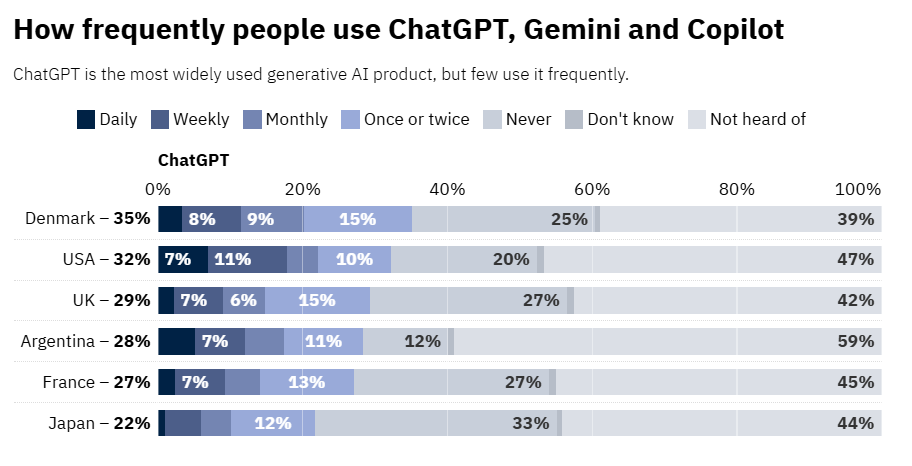
In Denmark, 61% of internet users have heard of ChatGPT, but only 1% use it daily, while 27% have tried it once or twice. 21% have not heard of AI tools such as Copilot and Gemini. The use of generative AI is slightly more prevalent among people with higher education.
66% expect that generative AI will have a major impact on the news media within the next five years. But there is low trust that sectors such as social media (21%) and news media (26%) will use AI responsibly.
Danes are more comfortable with AI-generated news about fashion (+7%) and sport (+5%) than about politics (-33%) and international affairs (-21%). In general, acceptance of AI-generated content is low among older people.
In summary, there is high awareness but also scepticism about AI’s use and impact, especially within journalism and broader societal issues.
Source: Reuters and Reuters (pdf).
 Matthias Bastian

Region Midtjylland supports several projects focusing on artificial intelligence in youth education. One of the projects receiving support is Learnmark Horsens, which focuses on ensuring that students acquire AI skills relevant to the labour market. Here they are carrying out a project to provide answers on how schools can use AI in teaching.
Niels Yde, Director of Learnmark Horsens, says: We are particularly curious about the possibilities, and we are very aware that we must equip our students for a future in which AI will be a natural work tool for many. We are therefore pleased that the project was approved, so that together with the other project participants we can develop courses that help future-proof our programmes.
Region Midtjylland has supported 15 projects, and below we have listed the five that involve artificial intelligence in teaching.
Horsens Gymnasium & HF (upper secondary school - gymnasium and HF) is applying for funding for a project that aims to investigate and find answers to how writing can be organised in a way that brings the teacher closer to students’ writing processes, and how teachers can best support and develop students in connection with the writing processes. Total project budget: 1.536 million kroner. Region Midtjylland will contribute 0.457 million kroner.
Learnmark Horsens is applying for funding for a project that aims to show how vocational schools can adapt to the growing importance of AI. Through research and development in both vocational and vocational upper secondary areas, three AI-didactic models and an AI competence model will be created.
These will provide answers on how schools can use AI in teaching to differentiate, promote learning and ensure that students acquire AI skills relevant to the labour market. Particular focus is on the language subjects in the vocational upper secondary area, as they are increasingly challenged by AI.
Total project budget: 9.735 million kroner. Region Midtjylland will contribute 5.052 million kroner.
Aarhus Business College is applying for funding for a project aimed at strengthening students’ learning by rethinking writing and considering how AI becomes a learning resource.
This will be achieved by developing in-service training modules for teachers as well as modules for students in the foundation programme, equipping them to understand AI technology and introducing them to basic prompting skills (how to communicate with AI).
Total project budget: 2.642 million kroner. Region Midtjylland (Central Denmark Region) supports with 1 million kroner.
Randers Statsskole is applying for funding for a project aimed at strengthening students' digital literacy by delivering a coherent teaching programme early in their time at upper secondary school (gymnasium). Here, students gain core subject knowledge about how digital systems are structured, our possibilities for interacting with them, and their effects on human behaviour as well as societal structures.
Total project budget: 0.554 million kroner. Region Midtjylland supports with 0.145 million kroner.
Randers Social- og Sundhedsskole is applying for funding for a project aimed at training teachers at the participating educational institutions to understand and use artificial intelligence as a tool to support students' learning.
The participating teachers will be introduced to AI and its applications, after which the partnership will develop teaching materials and activities that introduce students to AI, its potentials and pitfalls, with a focus on responsible and effective use.
Total project budget: 1.027 million kroner. Region Midtjylland supports with 0.492 million kroner.
Read more on the region's website:


OpenAI has just introduced ChatGPT Edu, a new version of ChatGPT designed for universities and intended for students, researchers and administrative staff.
OpenAI states that ChatGPT Edu includes built-in features such as data analysis, web browsing, enhanced language capabilities, document summarisation, creation of GPTs and higher message limits than the free version. At the same time, there is an emphasis on data protection, group permissions, SSO, SCIM 1 and administration of GPT models.
Jonathan Kemper
 Timothy Papandreou


 See Tanya's profile

 rietsdu.dk

 Text: Morten Jest Photo: Jacob Nielsen
 Steffen Elias Severin-Nielsen
 by Birgitte Vedersø, chair of the expert group on chatGPT and exams, independent adviser and consultant, former upper secondary school (gymnasium) principal
 Matthias Bastian
 Maximilian Schreiner