This Week's News: Are We Teaching Our Young People to Prefer a Robot?
While Danish schools adopt safe AI tutors, new research warns that students are increasingly using the technology as a digital friend or romantic partner.
This article has been machine-translated into English. Therefore, there may be nuances or errors in the content. The Danish version is always up-to-date and accurate. Read the original Danish article here.
Here is an overview of last week’s most important news on artificial intelligence in education. For many it’s the autumn break, but those of you who are at work shouldn’t miss out on a bit of news.
Last week, Helene Friis Ratner, Thomas Telving and Mikkel Flyverbom were on Deadline, where they discussed whether AI is making students ‘dumber’. If you haven’t seen the segment, I recommend taking the time, as the debate offered many good points and nuances.
This raises a crucial question about how we ensure that AI remains a pedagogical tool and does not become a social substitute that creates vulnerability and dependency. This dilemma is reflected in this week’s debate, where Pernille Knudsen from Dansk Erhverv (the Danish Chamber of Commerce) and Allan Kortnum from Danske Erhvervsskoler og Gymnasier (the association of vocational colleges and upper secondary schools) argue for full integration of AI in teaching. In contrast, Professor Justin Reich from MIT warns against repeating past technological missteps.
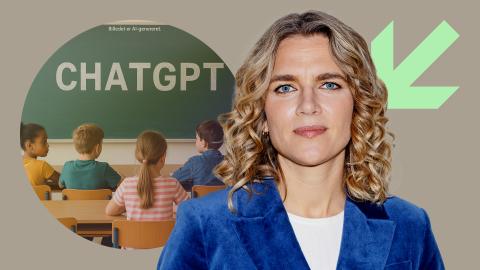
While many school staff are curious and are experimenting with the technology, a report from the US warns that students are increasingly using AI as a digital friend or even as a boyfriend/girlfriend. The report shows that one in five American high school students has had a romantic relationship with an AI, and as many as 42 percent have used AI for companionship or as a digital friend. There appears to be a link between schools that use a lot of AI and the number of students who use the technology in that way.
It is also alarming when another article from the US describes very young children aged three to six getting a new playmate in the form of ChatGPT. At the same time, it has emerged that OpenAI has entered into a partnership with Mattel, so AI will be integrated into even more toys (source).
Here are this week’s three key points.
From tool to friend New reports from the US show that AI is not only an academic tool but increasingly a social actor in young people’s lives. This places entirely new demands on schools’ focus on digital literacy and wellbeing.
Controlled frameworks are the way forward Danish initiatives such as U/NORD’s secure AI tutor and KP’s specialised bot show how AI can be designed for pedagogical purposes and how to avoid the pitfalls of open models.
We must learn from the past The debate underlines that successful integration of AI requires a smart strategy: avoiding blind enthusiasm and instead focusing on humility, experimentation and proven impact.
Enjoy the newsletter.
This week’s commentary: When AI moves from tool to friend
I am a little alarmed, though not surprised, by reports from the US showing how AI has become young people’s best friend and, for some, even their boyfriend/girlfriend. The technology is relational too and can meet both social and emotional needs if we let it.
Teaching with AI can inadvertently normalise a technology that also operates relationally outside school. Do we risk creating young people who isolate themselves? Vulnerable students are especially at risk.
Even so, the answer is not to keep AI out of teaching, because educational institutions must involve AI as part of teaching. If young people use AI as their best friend or partner, they need to learn to understand the technology’s limitations. And when AI offers an easy but simulated relationship, the school must insist on genuine human presence in the classroom. The school’s foremost task is formation and character education, but in a time marked by digital loneliness the school’s role as a community and meeting place takes on renewed importance. That means we should use AI as a prompt to talk about what real relationships are, rather than pretending the technology does not exist.
Do smart machines make students stupid?
On Deadline, Helene Friis Ratner, Thomas Telving and Mikkel Flyverbom discussed how chatbots and other forms of generative AI affect education and learning.
A central view was that AI often tends to reduce education to mere information transfer, overlooking the human and social dimensions of learning.
U/NORD gives 4,500 students access to Danish-developed AI platform
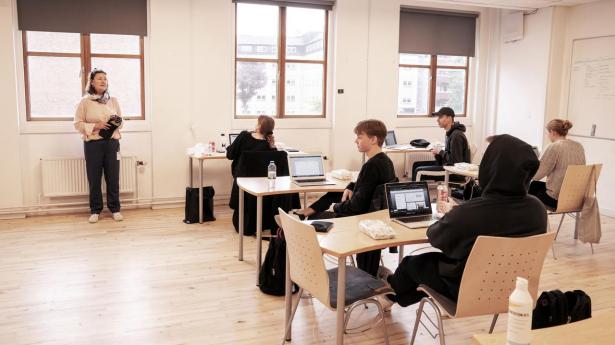
The educational institution U/NORD is investing in the Danish AI platform Miira, which will henceforth be used by both students and staff at the institution’s schools in, among other places, Lyngby and Hillerød. From 1 November 2025, all 4,500 students will have access to their own AI tutor, which is intended to support them in solving tasks without providing ready-made answers. The aim is to promote a responsible use of AI in teaching that strengthens subject learning.
The project will be rolled out during the 2025/2026 academic year and is part of U/NORD’s strategy to equip students for a future labour market focused on creativity, efficiency and innovation.
The AI bot Poul trains students in realistic communication
Københavns Professionshøjskole (University College Copenhagen, KP) has developed the AI bot Poul, which is used to train students in professional communication on the Sundhedsadministrativ koordinator (SAK) programme (Health Administration Coordinator). Poul differs from more generic chatbots by being context-specific and based on a theoretical foundation. This means the bot can respond realistically, for example by ending the conversation if a student behaves rudely.
The aim is to simulate authentic conversations with patients, which challenges students academically and strengthens their capacity for reflection. Initial tests from January 2025 showed positive results with increased engagement and better alignment between theory and practice. The AI bot was first presented at a conference in March and will be showcased in December 2025 at the international OEB conference in Berlin.
The research group is now working further to develop a pedagogical model so that AI simulation of this kind can be integrated widely into teaching. According to KP’s head of department, Martin Sønderlev Christensen, the project is an example of how AI can be used innovatively and didactically to create practice-oriented teaching at scale.
An opinion piece in Børsen, written by Pernille Knudsen from Dansk Erhverv (Danish Chamber of Commerce) and Allan Kortnum from Danske Erhvervsskoler og Gymnasier (the Danish association of vocational schools and upper secondary schools), argues that AI should be an integrated part of teaching, both in upper secondary school (gymnasium) and already from primary school. The authors emphasise that AI is no longer a tool of the future, but a necessary competence in today’s and tomorrow’s working life. Therefore, students should not be prevented from using AI for writing assignments and problem-solving in school.
What AI in schools can learn from past failed technology initiatives
Professor Justin Reich from MIT warns in an opinion piece against getting carried away by the AI hype in education without thorough testing and evidence. Drawing on historical examples, from Edison’s filmstrips in the 1920s to the rise of the internet and failed web literacy strategies, Reich shows how new technologies are often oversold before their impact is examined.
He points out that AI has not been invited into school once the pedagogy is in place. As he writes:
“It crashes the party and then starts rearranging the furniture.”
That places heavy demands on teachers, who, according to Reich, should not be left alone with the responsibility for figuring out how AI should be used.
Based on interviews with around 100 teachers in the US, he identifies three principles for a sensible way forward: humility, experimentation and ongoing evaluation. Teachers and schools should test AI in small, controlled experiments, document the impact, and be open to adjusting practice along the way.
Google launches Gemini Enterprise and Google Skills
Google has launched Gemini Enterprise, a new AI platform that brings together all the company’s AI tools in a single solution. The aim of Gemini Enterprise is to make it easier for organisations to leverage AI across teams, workflows and data sources.
The platform serves as a central point of access to AI for employees via a chat interface, supporting automation, data analysis and integration with both Google Workspace and Microsoft 365.
Google has also launched the Google Skills platform, which brings together nearly 3,000 courses and labs from various Google initiatives. This includes, among others, Google Cloud, Google DeepMind and Google for Education.
The platform is designed to provide access to AI learning for students, educators, developers and businesses.
New report from the US shows how AI affects students’ wellbeing
The report Hand in Hand – Schools’ Embrace of AI Connected to Increased Risks to Students draws on extensive surveys of teachers, students and parents in the US. It documents how AI in schools is used for teaching, administration and personal support. At the same time, it shows how the technology creates new forms of vulnerability.
According to the report, nearly one in five U.S. high school students say that they or a friend have had a romantic relationship with AI. As many as 42 per cent report that they have used AI as a form of companionship or digital friend. This trend is particularly widespread among students at schools with extensive use of AI.
This raises important questions about wellbeing, especially because 31 per cent of students report using school-issued devices or software for private conversations with AI. According to Laird, this is because students often do not realise that they are interacting with a tool rather than a person. Moreover, their AI literacy is limited. She warns that “our research shows that most students and teachers receive only very basic training in AI.”
In The Guardian, Julia Carrie Wong describes how more and more families with children are using AI tools such as ChatGPT to tell stories, draw pictures and hold conversations with their children.
Researchers and experts in the article express concern, pointing out that early exposure to generative AI may make it difficult for children to distinguish between reality and fantasy. Children between three and six years old already find it hard to understand the difference between living beings and technology, and some even believe that AI can “talk” to them and has its own feelings and intentions.This can create the illusion of a genuine relationship and empathy, which in the worst case can develop into emotional dependency.
OpenAI and Mattel have already teamed up on AI-powered products (source), while new startups are developing everything from interactive teddies to storytelling devices that learn children’s interests and create tailored stories.