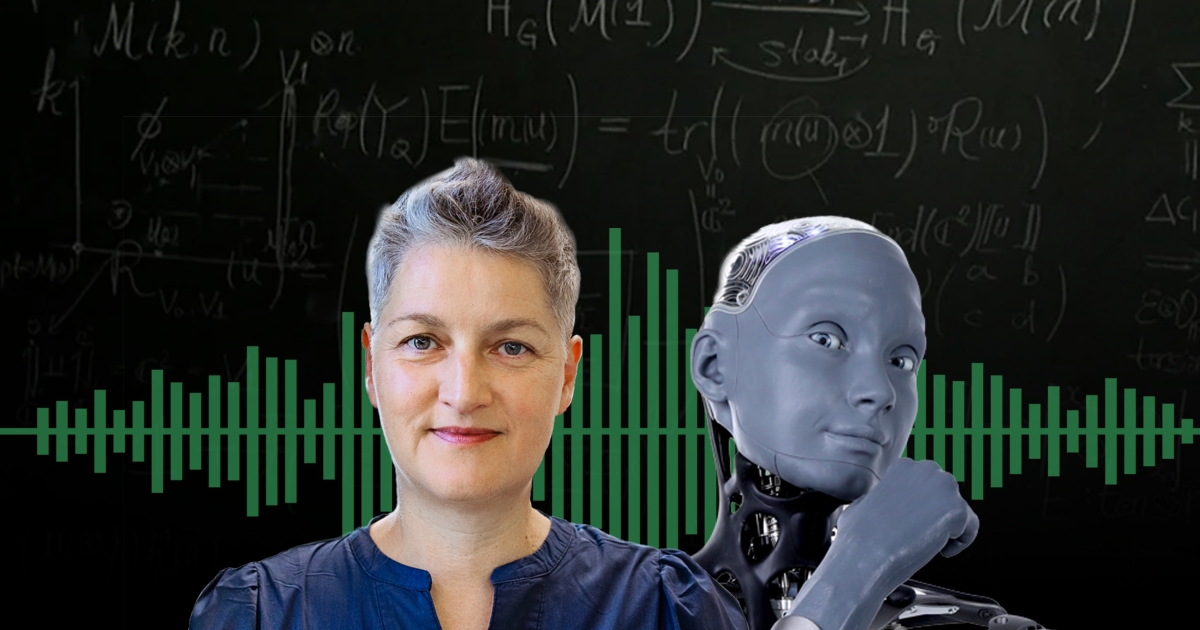
Exams are losing their value, a homework researcher wants to bring homework into the classroom, and debate is raging over what teachers should actually spend their time on. This week, it's about what AI reveals about the system we've built—and what we should be measuring instead.
This article has been machine-translated into English. Therefore, there may be nuances or errors in the content. The Danish version is always up-to-date and accurate. Read the original Danish article here.
Here is this week’s newsletter on artificial intelligence in the education system.
This raises the question of what teachers should actually spend their time on. An upper secondary school (gymnasium) teacher, Anja Lea Olsen, explains in the podcast Lærerværelset how she uses self-developed chatbots to mark assignments and plan teaching thereby freeing up time for what cannot be automated.
The message is the same. We need to rethink assessment formats and teaching so that we evaluate process, reflection and judgement rather than the flawless end product.
When AI can write assignments in minutes, the traditional written exam loses its value as a measure of academic ability. An op-ed from the leadership at Arts at Aarhus Universitet (Aarhus University) argues that universities must rethink examination formats, teaching and collaboration with the labour market.
The op-ed highlights three challenges. Written assignments can no longer measure individual competence. Degree programmes must prepare students for a labour market shaped by AI. The disciplines must also change themselves. Here, the humanities are highlighted as particularly well placed, because these subjects already train critical analysis and evaluation—competences that become central when text production is automated.
The op-ed rejects a return to bans and pen-and-paper exams. Instead, it argues for embracing the development and placing critical evaluation and the interplay between humans and AI at the centre.
Homework researcher wants to move homework into school time because of AI
In an interview with Uddannelsesmonitor, Flemming B. Olsen, who has researched homework for more than 15 years and completed a PhD on the topic at Syddansk Universitet (University of Southern Denmark), argues that it no longer makes sense to have students in upper secondary programmes do homework. According to him, developments in AI have made the issue acute because many students use AI to complete their assignments at home.
He also rejects the idea that homework in its current form necessarily teaches students to work independently. Many experience homework as compulsion in subjects they are not interested in, and therefore choose AI as a shortcut. If the work takes place in school, the teacher can follow the process, talk to students about their use of AI, and to a greater extent assess the work process rather than the finished product.
The proposal will change the teacher’s role. Teachers should to a greater extent assess process, reflection and use of tools rather than only the final result. According to Flemming B. Olsen, this requires new solutions, which may vary from subject to subject, but he points to projects where the model has already been tested with positive experiences.
Podcast: Upper secondary teacher has developed her own chatbots for marking and planning
The podcast Lærerværelset focuses on how teachers can use AI outside the classroom. The guest in this episode is Anja Lea Olsen, cand.scient. in biophysics and a physics teacher (lektor) at H.C. Ørsted Gymnasium in Lyngby. She has developed a number of specialised chatbots that help her mark student work, write emails, plan teaching sequences and analyse data.
For Anja Lea Olsen, the chatbots act as a kind of digital assistant that can free up time in a busy working day. They are used, among other things, to create variation in teaching and to streamline administrative tasks. In this way, AI becomes a tool that supports the teacher’s preparation and overview rather than the teaching situation itself.
When the teacher marks the work, relationships and learning are strengthened
In the American magazine EdSurge, Masheika Allgood describes her work as a 7th-grade English teacher at a school in Florida. She used systematic diagnostic testing and targeted feedback to raise every student’s attainment.
By mapping students’ actual competences from the start of the year, she was able to plan teaching precisely and adjust it continuously. According to her, it was this close coupling between assessment and instruction that created academic progress.
The article contrasts her practice with the growing use of AI for automated feedback and grading. Although AI can streamline marking, she warns against reducing assessment to efficiency. Feedback is also about relationships, judgement and responsibility.
The question, then, is what happens to learning if assessment is increasingly handed over to AI.
The gymnasium’s cheating problem with AI is a system problem
Psychologist Johnny Werngreen writes in an opinion piece in Politiken that the most remarkable thing about EVA’s new study is not that upper secondary students use AI, but that the school system is still organised as if they do not. The gymnasium is exam-driven, and when examinations still rest on a pre-AI logic, teaching follows suit. The result is that students experience the tasks as meaningless rituals rather than genuine learning.
He is critical of the education minister, Mattias Tesfaye’s, comments about “the intellectual luminaries among headteachers”, which he believes implicitly place responsibility with schools while the ministry itself keeps hold of the levers of control. Heads can interpret and adjust, but they cannot on their own change exam formats or national objectives.
The solution requires a rethink of exam formats, clearer learning objectives, and giving schools a genuine mandate to trial new forms of assessment. If we continue as now, it will end with students being blamed for navigating rationally in a system that has not adapted to the reality they live in.
AI must be framed so that learning is not reduced to production
Lars Frisdahl, education consultant at Fonden for Entreprenørskab (the Danish Foundation for Entrepreneurship), and Mathias Lund, AI project lead and learning consultant at CBS (Copenhagen Business School), argue that AI is already a fixed part of everyday life in schools and educational institutions. Therefore, dialogue about responsible use is not enough. A clear pedagogical and strategic direction is needed.
They point out that AI easily pushes teaching towards more output, for example faster submissions and slicker products. But more production is not the same as more learning. If the school focuses one-sidedly on what can be measured and delivered, there is a risk of weakening the work on judgement, understanding and democratic participation. The question should therefore be who students are learning for, and how their knowledge can create value for others.
The opinion piece highlights that Bildung (dannelse) without action competence can become abstract, while action orientation without Bildung can become empty production. Entrepreneurship and innovation pedagogy are mentioned as approaches that can connect knowledge with responsible action in real-world contexts. When students work with concrete recipients outside school, the nature of the task changes because purpose, ethics and audience become central elements. In this way, technological understanding and critical judgement are linked to concrete action.
AI challenges assignments in upper secondary school (gymnasium)
Anja Lea Olsen writes in Gymnasieskolen (the Danish upper secondary school magazine) about how generative AI tools have challenged trust in the major written assignments as documentation of students’ independent competences.
If AI is seen as a cheating problem, the solution points towards more control and surveillance, but that can create mistrust and artificial working conditions.
If, on the other hand, AI is integrated openly, its relevance for higher education and the labour market increases, but it also changes what the grade measures and makes assessment more complex.
With reference to VIVE’s evaluation (the Danish Center for Social Science Research), it is highlighted that students use AI in a nuanced way and often experience uncertainty about the rules. The point is that we cannot maximise control, fairness, authenticity and feasibility all at once. AI and assessment are therefore not a problem with a final solution, but a basic condition that requires conscious prioritisation.
In the podcast Bæredygtig Business, host Steffen Max Høgh talks with media analyst Christiane Vejlø about fear, hope and responsibility in the development of AI. The conversation revolves around several levels of concern, including the risk of job losses, threats to humanity, and more existential questions about what it means to be human in a time when technology can extend life and change our relationships. For schools, the importance of teaching consequence analysis, source criticism and ethics is underlined, so that more than just the technologically inclined students gain insight into AI.
A daughter’s question led to a new AI learning platform
When Kim Østergaard’s daughter asked whether he could build a platform that could help her do better at school, he set about developing SkoleElev.ai.
In just three weeks, the first version was ready for testing. The platform adapts teaching to the individual student using a learning-style test based on the VARK model and an assessment of the student’s academic level. Content and difficulty adjust automatically, so students can work at different year levels in different subjects. Students can, among other things, have texts read aloud, take photos of exercises from their textbooks and get explanations or new practice tasks generated. There are built-in reward elements designed to support students’ motivation.
There have been a few errors and critical questions, including about copyright, but the response from teachers is described as predominantly positive.
At the same time, Kim Østergaard calls for a broader debate about AI in school, shifting the focus towards strengthening students’ creative and human competences rather than primarily talking about cheating.
Over the last four years, a great many new learning systems have appeared. Especially since “vibe coding” (where you code using AI) broke through, development has exploded. Suddenly, engaged parents and enthusiasts can build in three weeks what previously took large tech companies several years.
That kind of curiosity and drive is exactly what challenges our usual assumptions about the school system. We should welcome it, because if we just carry on as we always have, we will not move forward.
But we need to take a critical look at the trend that many new AI-driven systems bring with them. Here we often see a very instrumental view of learning and a massive focus on learning dashboards where you can track every part of learning.
And with vibe coding it has become easier to collect data, display them in graphs and make progression visible. But who has time to interpret them in a hectic everyday life, and do we just end up collecting irrelevant data in the belief that it makes us better?
In my master’s thesis from 2017, I worked with students’ formative feedback and used machine learning (a form of AI) to process data from teaching and present them in a meaningful way for the teacher.
The challenge was that the radar charts and my “learning pulse” were hard to interpret for both the teacher and the students, because they had to be explained again and again. It created a layer between the student and the teacher and weakened precisely the relationship that arises in the direct encounter. And it is worth noting that the technologies measure vanishingly little of what really happens in teaching.
I therefore think we must take care not to end up with tunnel vision, where we confuse what is measured with what really happens in teaching.