This week’s news: Are we educating a generation to settle for 'approximate knowledge'?
As AI use in education rises sharply, researchers warn about the risk of superficial learning. Read about the critical balance between the technology’s potential and the need for deep understanding, and why 70 percent of teachers still lack experience with AI.
This article has been machine-translated into English. Therefore, there may be nuances or errors in the content. The Danish version is always up-to-date and accurate. Read the original Danish article here.
Here is this week’s newsletter focusing on developments in artificial intelligence in the education sector.
This week I begin with a report from the US AI company Anthropic (source). They have examined how their language model Claude is used, and the results show that programming still dominates. However, tasks related to education and science have risen from 9.3% to 12.4% of total use between January and August 2025. We are therefore seeing a global increase in the use of AI in teaching, both for planning and in students’ work.
That very development raises a fundamental question currently being debated at Aarhus Universitet (Aarhus University), for even if students are allowed to use AI, should they always do so? Researchers point out that the technology can amplify academic disparities, with strong students getting stronger while others risk getting stuck in superficial “approximate ‘roughly-right’ knowledge”.
Special consultant Ove Christensen responds to the widespread claim that knowledge is losing its value in the AI age. In a comment on the statement by Microsoft’s Danish CEO he warns against equating information from AI with the deep knowledge that requires human understanding and critical thinking.
One possible explanation for why we risk ending up with superficial knowledge can be found in the phenomenon of automation bias (see also AI Safety and Automation Bias). It concerns our tendency to trust too much that what a computer writes is correct. For example, we often trust the GPS more than our own observations. I believe we should build strong awareness of this in teaching to ensure ownership and critical thinking.
That responsibility for guiding students falls heavily on teachers, who currently face a double challenge. On the one hand, there is pedagogical uncertainty about how best to use the technology. On the other hand, there is now a clear legal clarification on copyright. A new report from Kulturministeriet (the Danish Ministry of Culture) states that the exception for copying for private use does not apply in education, which places even greater demands on us.
The question is how we balance the potential with the associated pitfalls.
Here are this week’s three key takeaways.
From information to knowledge We must draw a sharp distinction between AI’s ability to deliver quick answers and the deep, meaningful knowledge that is the goal of education.
The decisive role of teachers Teachers’ competences are key, and without a concerted effort on continuing professional development we risk students’ use of AI outpacing teachers’ ability to guide them.
A system in transition We need a coherent strategy that equips every link in the education chain, from the youngest pupils to university students, for a future with AI.
Comment of the week: Students show the way forward
While OpenAI announces technical restrictions on young people’s access to increase safety, the reality in my classroom suggests that approach may already be outdated. I shared the news with my first-year students on Friday in three classes, and their reactions ranged from “ugh” to “we’ll just use another AI”. This confirms an important point for me: real change does not start with external technical restrictions, but with what we do together in the classroom. Students’ reality shows that the sustainable solution is to strengthen their competences rather than put up yet another fence.
This shift in focus points directly to where we need to act nationally. We need a long-term strategy for technology understanding that starts already in the Danish primary and lower secondary school (folkeskole). Initiatives such as the new ultrabit initiative show the way and lay a strong foundation. The next logical step must be to build on that ambition and ensure that technology understanding becomes an integrated part of all students’ Bildung rather than just an elective.
Our task is to ensure that we create a generation that not only consumes technology, but also understands and actively shapes it.
Enjoy the newsletter.
Should students use AI just because they are allowed to?
At Aarhus Universitet (Aarhus University), AI is permitted for both study work and exams, but that does not mean the researchers are unreservedly enthusiastic. Several of them emphasise in an article on Omnibus that the technology can be a useful tool for, for example, exercises and feedback, but also a tempting shortcut that weakens real learning.
In the piece, researchers such as Carsten Bergenholtz and Cathrine Hasse point out that AI can amplify academic differences. Strong students get an extra boost, while weaker ones risk getting stuck with superficial answers and thus learning less. Others emphasise that lecturers should take an active role in guiding students so the technology is used critically rather than uncritically.
In a LinkedIn post, special consultant Ove Christensen responds to Microsoft director Mette Kaagaard’s statement that the value of knowledge is approaching zero because AI provides quick access to information. He points out that it is a misunderstanding to equate knowledge with information. Knowledge is not just about being able to look up facts, but about asking meaningful questions, understanding connections and creating meaning.
He emphasises that generative AI cannot replace subject-matter insight. AI models generate plausible formulations, but they do not contain actual knowledge. This means the output is often uncertain and can create a form of “approximate knowledge” that risks polluting the information flow. Precisely for that reason, there is still a need for well-educated people with deep domain knowledge.
A long-awaited report from the expert group at Kulturministeriet (the Danish Ministry of Culture) on copyright and AI has just landed, and it carries clear messages for the education sector. The most important conclusion is entirely unequivocal: the exception in the Copyright Act for copying for private use does not apply in education.
In practical terms, this means that neither teachers nor students may upload copyright-protected material – such as excerpts from books, articles or teaching resources – to AI services like ChatGPT or Claude. The responsibility for securing the necessary licences, typically through agreements with Copydan, rests with each institution.
However, the report recognises that institutions should not be left alone with the complex legal responsibility. The expert group therefore recommends, among other things:
Clear guidelines: Official guidance and materials should be developed to help schools and teachers navigate the rules.
Responsibility for providers: The tech giants should be required to take greater responsibility by building in technical barriers (so-called "guardrails") to prevent the upload of protected material.
Finally, the report expresses concern that large language models could dilute the Danish language and culture, underscoring the need to work with Danish-language content and to strengthen critical thinking in teaching.
A shared language about AI at Silkeborg Gymnasium (upper secondary school)
At Silkeborg Gymnasium all teachers have received professional development in generative AI. This has created a shared understanding of how the technology works and how it can be used in teaching. The initiative began with expert presentations, continued in subject teams and concluded with a staff seminar. The aim has been to see AI as a learning tool rather than focusing solely on the risk of cheating.
Three teachers explain how AI has already been integrated into their teaching. In physics, AI is used to explain complex concepts and create models that were previously difficult to produce. In the language subjects, students work with AI dialogues instead of traditional set questions. In English and social studies, AI is used both to prepare teaching and to provide students with support so that the gap between stronger and weaker students can be narrowed.
Common to the teachers is that AI should not replace the fundamentals of teaching, but be used purposefully where it makes sense. They emphasise that students must still learn to engage with processes and practice and not simply jump straight to a finished result via AI.
Gymnasieskolen has interviewed Tine Wirenfeldt Jensen, Per Størup Lauridsen, as well as the chairs of Gymnasieskolernes Lærerforening (the Danish Upper Secondary School Teachers’ Association) and Danske Gymnasier (Danish Upper Secondary Schools) about their views on how AI challenges teaching and why continuing professional development (CPD) is necessary. All point to the need for a systematic effort so that teachers can both understand the technology, use it didactically, and help students adopt a critical approach to AI.
According to Tine Wirenfeldt Jensen, the need for CPD is massive because AI is changing the very preconditions for teaching. She warns that teachers cannot equip students for higher education without experience with AI because universities already allow the technology in many examination contexts.
However, there are large differences in teachers’ knowledge. While some are far ahead in integrating AI into teaching, surveys show that up to 70 per cent of teachers have only limited experience. As a result, students’ use of AI risks outpacing teachers’ competences, which can create imbalance and a lack of frameworks for its use.
Both teachers and organisations therefore highlight the need for time, resources and funding so that CPD in AI does not come at the expense of other areas.
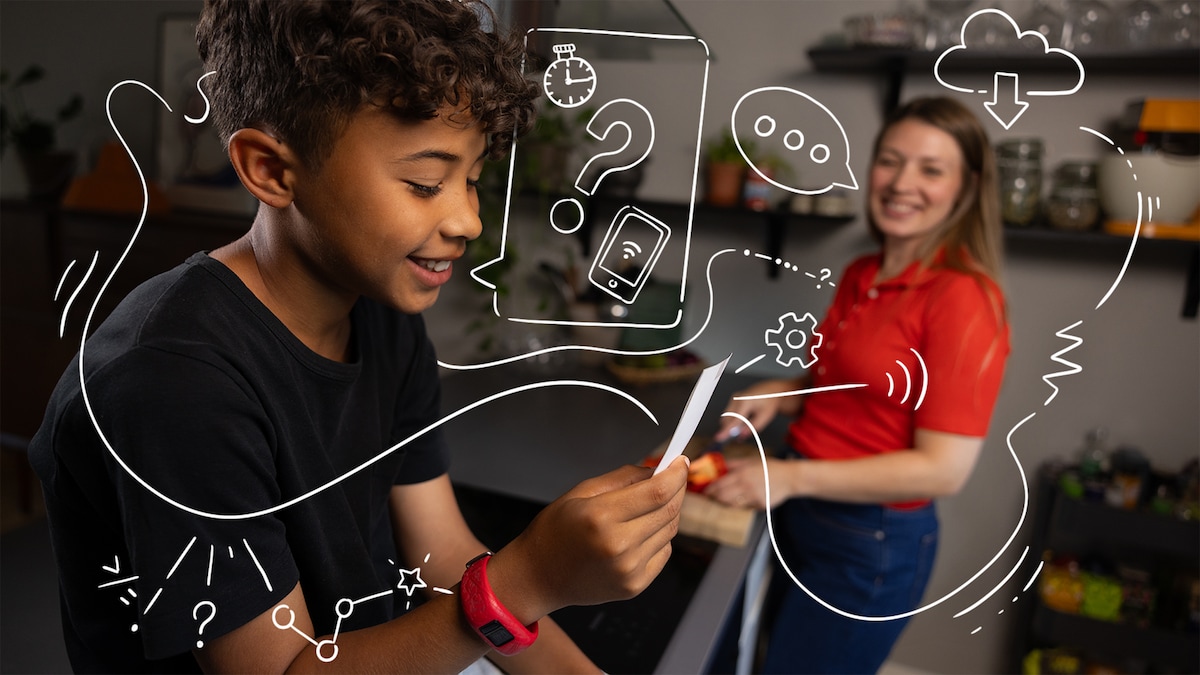
DR (Danish Broadcasting Corporation) is expanding the well-known ultra:bit project in collaboration with Center for Undervisningsmidler (Centre for Teaching Materials), Aarhus Universitet (Aarhus University) and LIFE Fonden (the LIFE Foundation). With a grant of 50 million kroner from Novo Nordisk Fonden (Novo Nordisk Foundation) and Villum Fonden (Villum Foundation), a new four-year initiative from 2025 to 2029 will equip pupils in Years 1 to 6 to be both critical and creative in a digital future.
The goal is to strengthen children’s technological understanding and digital literacy across school, home and leisure. The project builds on experience from ultra:bit, which since 2018 has given 100,000 children access to microcomputers. This time, 3,600 resource kits will be distributed to 800 schools, supplemented by teaching materials, digital universes and learning events. At the same time, 196 professional development courses will be delivered for up to 3,000 teachers.
An important element is to involve parents and create conversations about technology outside school. This will include conversation cards and content on DR’s children’s channels. The ambition is to give children and adults tools to understand and discuss datasets, algorithms and artificial intelligence.
OpenAI to restrict young people's access to ChatGPT
OpenAI plans to introduce a series of changes aimed specifically at users under 18. The goal is to increase safety for young users, even if that means privacy and freedom are deprioritised.
The system, which is still under development, will automatically infer a user's age from their usage patterns. If a user is assessed to be under 18, or if the system is in doubt, they will be given access to a special restricted version of ChatGPT. ID-based age verification, such as MitID (Danish digital ID), may also be introduced.
Stricter rules will apply for young users. Content of a sexual nature, as well as conversations about suicide and self-harm, will be blocked, even when it takes place in a fictional context. If the system detects signs of a serious mental health crisis, OpenAI will try to contact parents and, ultimately, possibly the authorities.
At the same time, parents will have more options to control children’s use of ChatGPT. This could, for example, be through parent-linked accounts, deactivation of chat history or the AI’s memory, as well as setting times when the app cannot be used.
The features are expected to be ready by the end of the month.
Professor Claes Holger de Vreese from Digital Democracy Centre at Syddansk Universitet (University of Southern Denmark) has received 3.6 million kroner from TrygFonden (the Tryg Foundation) for a project to map Danes’ knowledge of and attitudes to AI. The background is that the development of AI is moving quickly, while there is still only limited knowledge about how the public understands and evaluates the technology.
The researchers will develop questionnaires for ongoing population surveys. These will examine Danes’ acceptance, understanding and trust in AI both in general and across different areas. In addition, perceptions of AI’s strengths and weaknesses relative to humans will be illuminated.
The results are intended to strengthen an evidence-based public debate, inform political decisions and provide input for the development of teaching about AI, especially in upper secondary education. The survey will be repeated every six months, so that changes in Danes’ attitudes and knowledge can be tracked over time.
The article can be read in the print edition of Kristeligt Dagblad (a Danish newspaper) on 22 September 2025 under the headline Grant funding for increased public debate on AI.
Videnskab.dk publishes an article about an Oxford lecturer who let an AI teach him his own subject. The experiment shows that AI can create personal and challenging learning pathways, but also that the human teacher will continue to play a central role in the school of the future.
At the same time, it is emphasised that AI does not replace the teacher, but rather makes the teacher’s role even more important. Teachers should guide the learning experience, create personal contact and use AI as a resource that can be adapted to each student’s needs. For younger educators without an extensive publication record, AI can be used to develop course ideas and broaden subject expertise.
The article points to a central paradox, namely that AI can both threaten and strengthen learning. It can make students dependent on technology, but it can also enable more tailored teaching, greater motivation and new forms of reflection. Teaching in the future may therefore be a combination of learning with AI and human guidance.