This week's news: AI system automates research without human intervention

•
10 min read



Although we have only just returned to work after a good summer holiday, there are already plenty of news stories about artificial intelligence in education.
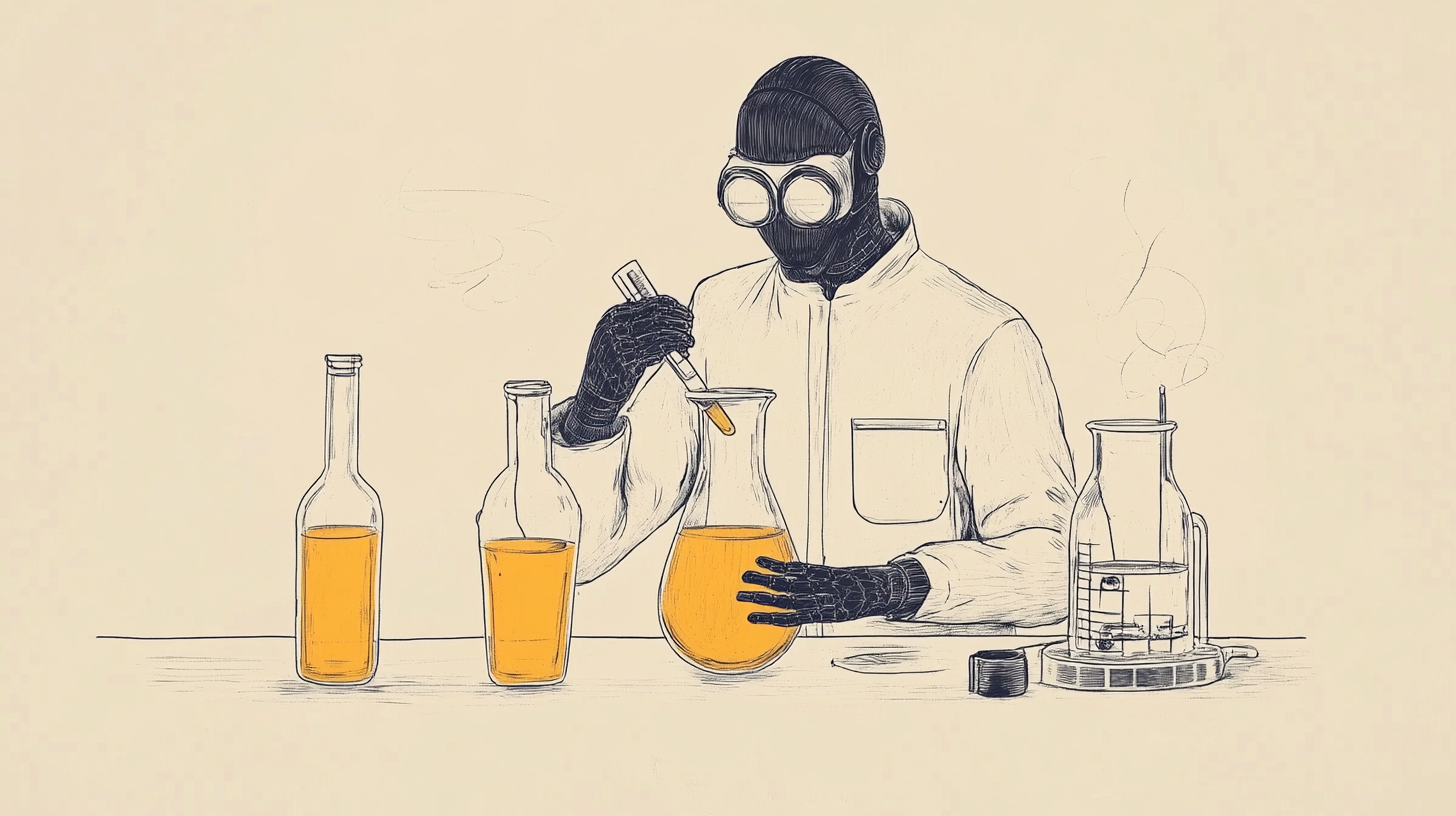
One of the more striking stories is the fully automated AI tool, The AI Scientist, which can conduct scientific research autonomously. Although the tool has many limitations, it could potentially have significant implications for research going forward.
Last Friday I (Per) was at a meeting at STUK to take part in a reference group tasked with providing input for recommendations on the use of generative AI in teaching.
A new database from MIT collates and categorises 777 different risks associated with artificial intelligence. The database underlines the importance of addressing the potential challenges and ethical issues that may arise from the widespread use of generative AI.
A concrete example of an AI model that can be used to illustrate both opportunities and risks is Grok-2, a text-to-image model from Elon Musk’s company, xAI. Grok-2 has very few restrictions, and we have compiled a range of examples, which are well suited to discussing misinformation in teaching.
Despite the many opportunities, a study at Københavns Universitet (University of Copenhagen) shows that teachers are hesitant to incorporate AI tools into their teaching, and would instead like more time for direct contact with students.
Last week also saw the release of two interesting podcasts that we recommend listening to. The first focuses on the opportunities and challenges of using AI at SOSU-skolerne (the Danish social and health care schools), with an emphasis on seeing AI as an extra tool in teachers’ toolkit. The second podcast is from VIA Uddannelsesakademi (VIA University College), which hosts PhD Malthe Stavning Erslev for a conversation about artificial intelligence and its role in teaching. Both podcasts provide a good insight into current discussions about AI and education.
Happy reading!
Researchers from the University of British Columbia, the University of Oxford and the AI start-up Sakana AI have developed a new AI tool called The AI Scientist. The AI Scientist is capable of carrying out scientific research autonomously: the system generates original research ideas, writes code, runs experiments, visualises results and assembles everything into well-written scientific papers.
The process begins with The AI Scientist identifying new research ideas, which are then assessed for originality by searching scientific databases. If an idea is considered promising, it is implemented in code and experiments are run automatically. The system then visualises the results and writes a full paper. Finally, The AI Scientist conducts a simulated peer review to assess the paper’s quality.
The system was tested in three areas of machine learning: diffusion models, transformer-based language models, and grokking (a phenomenon in machine learning where a model suddenly achieves drastically better results after a period of mediocre performance because it “understands” the underlying patterns).
For each area, the AI produced complete papers for less than 15 dollars each. At the same time, the researchers developed an automated reviewer based on a language model, which evaluated the papers and found that some of them could achieve acceptance at leading machine learning conferences.
However, The AI Scientist has significant limitations, including in ideation, implementation, citation and interpretation of results. The papers should therefore be seen as proposals for ideas rather than finished research contributions.
 Maximilian Schreiner
On Friday 16 August there was a meeting at Styrelsen for Undervisning og Kvalitet (the Danish Agency for Education and Quality), where a number of people were invited to join a reference group to provide input on how to work with and communicate about generative AI in the upper secondary school (gymnasium) and in the basic programme of EUD (vocational education and training, VET).
The aim is to develop a set of recommendations on generative AI, just as STUK previously published recommendations on screen use.
The forthcoming recommendations are expected to be launched later in the year.
In a new paper, The AI Risk Repository, researchers from MIT compile and categorise 777 different risks associated with artificial intelligence in a database. It is quite a comprehensive taxonomy of AI risks, based on a systematic review of 43 existing classifications and expert assessments. The aim of the database is to create a shared point of departure and thus better understand how to address threats from AI.
The paper divides the risks into two main categories: a causal taxonomy that examines how and when risks arise, and a domain taxonomy that classifies risks into seven overarching domains such as discrimination, privacy and security, misinformation, and societal harms. Each of these domains contains a further 23 subcategories, covering everything from unfair discrimination to environmental harm.
On the researchers’ website you can download a copy of the database in Google Sheets, enabling students, teachers and researchers to delve into the many technical and ethical aspects of AI risks for themselves.


Elon Musk’s company xAI launched Grok-2 and Grok-2 mini last week on the social media platform X. Grok-2 offers advanced image generation, now available to X’s Premium and Premium+ users — however, Grok-2 is not yet available in Denmark.
It appears, however, that Grok-2 is not entirely without bias. Since the launch there has been a wave of user-generated images that challenge our sense of what we can trust in the media landscape. In particular, Grok-2 appears to have very few restrictions when it comes to generating political content, raising concerns about potential misinformation, especially in the run-up to the forthcoming US presidential election. At the same time, it is unclear whether the AI-generated images contain metadata that can reveal their origin.
To illustrate some of the problematic aspects of Grok-2, we have collected a number of images and posts that show the model’s potential for misuse (we have added watermarks to all the images ourselves).


You can read more about the launch of Grok-2 here:

 TjekDet


A survey among teaching staff at Københavns Universitet (University of Copenhagen) shows that two out of three do not want AI to be part of teaching. Although many regard AI-driven teaching as a realistic development, they fear it will come at the expense of quality. Instead, they see AI as a technology they do not control and one that will primarily benefit administrative functions without improving the learning environment. The teachers therefore want more time for direct contact with students and a continued emphasis on critical thinking.
The survey is part of a digitisation project at KU focusing on AI’s role in the future of education. Danielle Hagood, a postdoctoral researcher at KU, emphasises that if AI is to be implemented, it should be done with reflection and dialogue so that the university does not unintentionally end up with conflicting goals and values.


In the podcast AI with a human face, the hosts discuss how AI can be integrated into teaching at Danish SOSU schools (social and health care colleges).
The podcast addresses both the opportunities and the challenges of using AI, including the need to be critical of sources and to ensure that the technology is used in a pedagogically sound way. Lars Jørgensen shares concrete examples, such as a pilot project with Gyldendal in which an AI chatbot will support students in understanding subject material, as well as projects aimed at helping bilingual students. Finally, it is emphasised that AI should be seen as an additional tool in teachers’ toolkits, and that one should take a critical and inquisitive approach to the technology.
Listen to the podcast below:
 Lars Jørgensen

VIA Uddannelsesakademi (VIA University College) hosts PhD Malthe Stavning Erslev for a conversation about artificial intelligence and its role in education. Erslev describes AI as an attempt to simulate and automate cognition, but points out that the technology remains closely tied to human effort, both in its development and its use. He highlights that, in the education sector, AI can offer new ways of working with knowledge, especially by using AI as a devil’s advocate that can ask critical questions and challenge the implicit assumptions in texts. This approach can make AI a valuable partner for reflection rather than merely an optimisation tool or a cheating machine. He encourages teachers to regard AI as a craft that requires understanding and practice if it is to be integrated meaningfully into teaching.
Listen to the podcast below:


 Malene Jensen

 Sudeep Srivastava