This Week's News: AI - New Opportunities and Challenges in Education

•
12 min read



In our newsletter we continually aim to focus on artificial intelligence and teaching, while fully aware that we can only provide a very condensed overview. Things are moving incredibly fast at the moment 🚀
In the past week, SkoleGPT was updated with a new underlying language model. At Viden.AI we are very pleased with the substantial work being done to expand opportunities to use language models in teaching—especially because there is such strong emphasis on doing so responsibly and without data collection.
OpenAI showcased its latest model, GPT-4o, which, besides being fast, can also hold a very human-like conversation. In this newsletter, however, we focus on the fact that OpenAI, together with Sal Khan from Khan Academy, presented GPT-4o as a maths tutor in a demonstration video. Although it points towards the possibilities for the technology in education, many have been critical of the hype it has generated.
OpenAI has also announced that they are integrating Google Drive and Microsoft OneDrive into ChatGPT, enabling you to write alongside documents.
The day after OpenAI revealed its new capabilities, Google held its developer conference. Among other things, they showcased LearnLM, a family of new models that can be used for learning. We have compiled an overview of the most important new technologies.
Anders Høeg Nissen stopped by Odense Tekniske Gymnasium (an upper secondary school (gymnasium)) to hear more about how AI is being integrated into a new study programme in the gymnasium.
Following the conference, “How the tech giants and artificial intelligence control your access to knowledge on the internet”, a white paper has been published summarising the main points.
On the more scientific side, two researchers tested three AI systems to see whether they can pass the Turing test, and people struggled to distinguish between content written by ChatGPT-4 and by humans.
Finally, we have a link to Matthew Wemys’ article, where he reflects on artificial intelligence in education.
Happy reading
SkoleGPT has been updated with a new language model and has implemented Mixtral-8-7b, which makes SkoleGPT better at handling Danish. The new model, Mixtral-8-7b, is expected to perform better, especially in Danish, and is better than ChatGPT 3.5. Although the user interface is unchanged, the quality of the answers has improved markedly.
SkoleGPT, developed by Future Classroom Lab and CFU ved Københavns Professionshøjskole. (Centre for Teaching Materials at University College Copenhagen) The switch of language model also entails a technical upgrade, with hosting now taking place on servers at Dansk BiblioteksCentral (the Danish Library Centre) (DBC) in Ballerup.
Future plans include fine-tuning the model with a Danish dataset and potentially adding new modalities such as audio and images, depending on funding.


On Monday, OpenAI announced its latest model, GPT-4o (“o” as in “omni”), and we have written an article about the opportunities it presents for teaching.
Read our full overview below:
 Per Størup Lauridsen

Benjamin Riley has written an interesting piece criticising the pedagogical potential that OpenAI highlights in its GPT-4o presentation video.
OpenAI GPT-4o math with Sal and Imran Khan from Khan Academy
In the demo, GPT-4o asks for a non-existent “side alpha”, and the model gives confusing instructions. Riley questions the chatbot’s ability to handle real learning situations, as such responses can confuse students. He also notes that both Sal Khan and his son frequently interrupt GPT-4o, which can set poor norms for student behaviour. According to Riley, OpenAI’s demo reduces teaching to merely conveying basic concepts and correcting mistakes. He also points out the philosophical problems of relying on AI in education, such as reinforcing gender stereotypes and lacking the ability to understand students’ thinking. Riley urges caution about the hype surrounding artificial intelligence in education.
 Benjamin Riley

Also read Dan Meyer’s critical questions about GPT-4o’s real impact on learning:
 Dan Meyer

OpenAI has improved its data analysis feature in ChatGPT, and it is now possible to upload files directly from Google Drive and Microsoft OneDrive. At the same time, you can interact with tables and charts in ChatGPT simply by writing what you want it to do.
Below is a video showing the new capabilities:
The feature is currently being rolled out to ChatGPT Plus, Team and Enterprise users. If you use the feature as a ChatGPT Plus user, it is up to you to opt out of having data used for training.
 Dave LeClair

Last week, Google launched LearnLM, a new family of models designed to help improve learning using artificial intelligence. The models are based on Gemini and are designed to make learning activities more active, personalised and engaging. We’ve gathered the key new features below.
Google Classroom
In Google Classroom, they are working to simplify lesson planning to help teachers find new ideas and differentiate their teaching.
Circle to Search
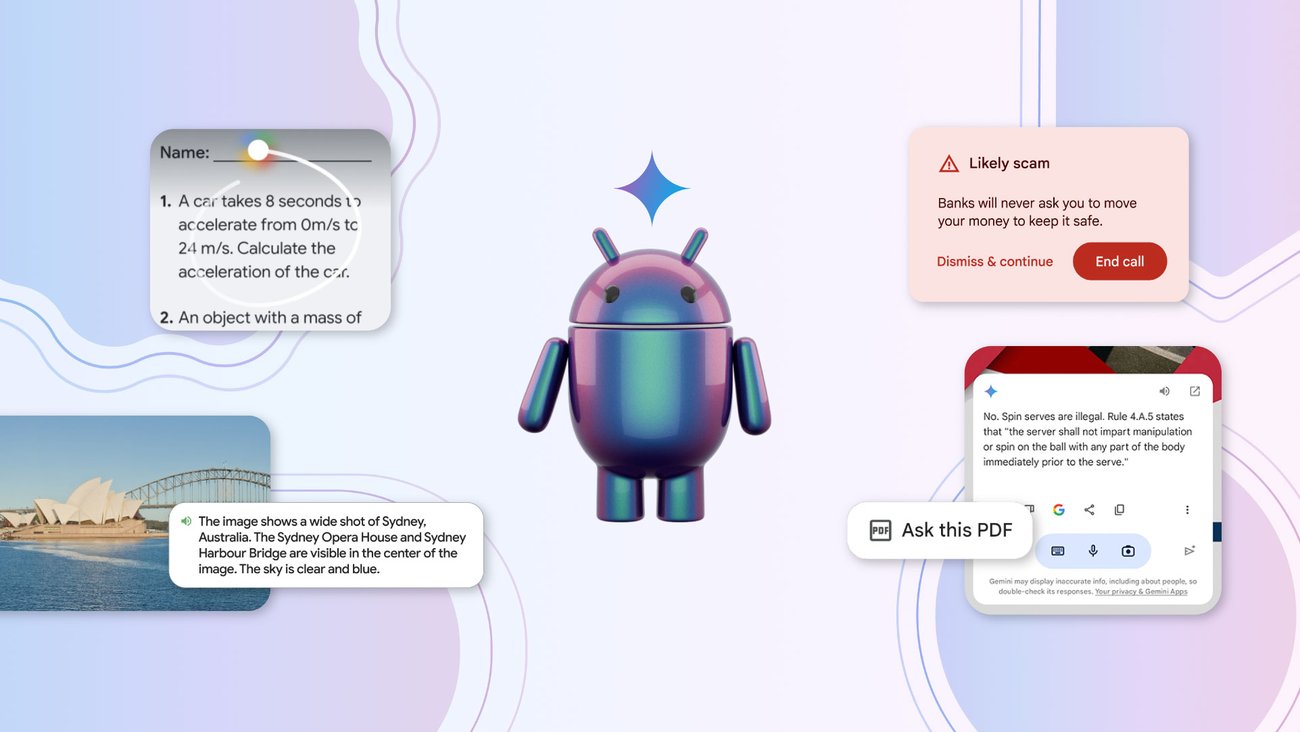
On Android devices, they have updated their Circle to Search, which can help solve maths and physics problems. Later this year, they will extend the capabilities to handle more complex tasks involving symbols, diagrams and graphs.
 Sameer Samat
YouTube
On YouTube, a new AI conversation tool is on the way, making it possible to ask questions, get explanations or take quizzes while you watch academic videos. At present, the feature is only available in English for US YouTube Premium members aged over 18.
Google Illuminate
Google Illuminate can break down research papers into short audio conversations.
Read more about LearnLM on Google’s blog:
Ben Gomes
The seemingly inexorable AI wave is of course also hitting schools, upper secondary schools (gymnasier) and other educational institutions, where people are wrestling with the threat of cheating on steroids, but where many are also exploring how to teach about and with AI.
At least that’s the view at Odense Tekniske Gymnasium (OTG, a technical upper secondary school (gymnasium)), where the first cohort of students will start this autumn on a study programme in AI, in an effort to prepare them for school, work and everyday life in a world of artificial intelligence.
Recently, Anders Høeg Nissen visited OTG to talk to two of the teachers, Claus Scheuer-Larsen and Per Størup Lauridsen, and we were also joined by the principal, Birgitte Veje Bredahl. They told us much more about the background, the vision and the plans for the forthcoming AI study programme.


On 3 April 2024, Lex, Danmarks nationalleksikon (the Danish national encyclopedia), together with Danske Universiteter, Danske Professionshøjskoler, Danske Gymnasier, Danmarks Biblioteksforening and Danske Medier, organised the conference “How the tech giants and artificial intelligence control your access to knowledge on the internet”. In this connection they have published a white paper that sums up the conference’s main points.
You can watch the full conference here.


 Martin Jørgensen marjojv.dk


 13 May 2023 at 8:05

 Ines Kajkus
 Ines Kajkus

 Mette Lundberg

 Selver Elezovic
 Martin Hamann

 Jens Mouvielle jenskobenhavnliv.dk

 James Wang

Cameron R. Jones and Benjamin K. Bergen from the Department of Cognitive Science at UC San Diego have just published a study in which they tested three AI systems in the Turing test. Each test was randomised, and 500 participants had to judge, on the basis of a 5-minute conversation, whether they were conversing with a human or a machine.
Participants in the study used small talk and questions about personal experiences, as well as social and emotional factors, as indicators when assessing humanness. The study highlights that AI systems such as GPT-4 can deceive people in realistic conversations.
Read the full study here:
 Cameron R. Jones

In the article "Dear Google and OpenAI, We Need to Talk About My Job", teacher Matthew Wemyss describes his reflections on AI’s growing role in teaching. He especially addresses the major challenges associated with rapid technological development, which particularly affects those who are not technologically savvy. He stresses that there is a need for clear guidance and comprehensive in-service training in the use of artificial intelligence. According to Wemyss, investment in professional development is needed to ensure a considered transition to AI-integrated teaching methods.
The article emphasises that teaching is about more than merely transmitting information - it is about relationships and guidance.
https://matthewwemyss.wordpress.com/2024/05/16/dear-google-and-openai-we-need-to-talk/





