This week’s news: AI is already in the classroom — the rules aren’t
AI is already in the classroom, but the rules are missing. As a result, decisions fall to individual teachers and students, and it takes a toll on trust. This week’s newsletter tackles the question of who actually gets to decide.
This article has been machine-translated into English. Therefore, there may be nuances or errors in the content. The Danish version is always up-to-date and accurate. Read the original Danish article here.
Here are this week’s selected news and articles on artificial intelligence in education.
AI is already part of everyday life in the classroom, but the rules have not always kept pace. Until a national AI strategy arrives, the task rests with each individual school. Schools therefore end up drafting their own AI strategy and ensuring that staff know enough about the technology to use it.
And it is about more than technical skills. Teachers and leaders also need to understand what AI does to the trust between pupil and teacher, and identify the points in teaching where there should be friction. The ability to judge when not to use AI also requires continuing professional development.
So I have gathered this week’s news around one question: Who decides how AI may be used in school when the rules have yet to be written?
We start with a new report from Syddansk Universitet (University of Southern Denmark), which shows how urgent the task is. 37% of upper secondary students (gymnasium) in the study find it hard to get started on an assignment without AI. The report is based on responses from 6,000 students and 209 teachers and has not yet been published.
Professor Ane Qvortrup believes that students are not only cheating others but also themselves, and she warns against responding with bans alone.
When the framework is missing, decisions end up with the individual teacher and pupil, and that costs trust. At Gefion Gymnasium, head of education Tine Studstrup describes how teachers and pupils are talking past each other: pupils feel under suspicion, and teachers are losing trust in their pupils. The school is trying various solutions, including draft notebooks and locked text fields.
The lack of clarity also affects those who need assistive tools. Politiken reports that students with dyslexia can lose access to AppWriter’s grammar support during exams because upper secondary schools confuse the tool with AI. This is particularly a problem in everyday teaching, where tests and assessment have become part of the lessons. At the same time, research is lacking into what impact AI may have on pupils with dyslexia. Ordblindeforeningen (the Danish Dyslexia Association) is calling for clear national rules.
Last week, the Minister for Children and Education, Magnus Heunicke, and the Minister for Higher Education and Science, Christina Egelund, met representatives of 11 student organisations at Erhvervsakademi København to hear what young people want from a national AI strategy. The message from the student organisations was clear. The learning crisis will not be solved with less AI. Students want teaching in how to use the technology, and exams that reflect practice so they can show how they use AI, rather than having to sit pen-and-paper tests.
Andreas Thorsager from Landssammenslutningen af Handelsskoleelever (the National Union of Business College Students) also pointed to a new form of inequality. He himself pays 200 kroner a month for a better version of ChatGPT.
In Region Midtjylland (Central Denmark Region), 13 educational institutions are joining forces to provide continuing training for 114 teachers in using AI as a didactic tool. The project aims to reach around 12,000 students and result in 36 teaching programmes. Project manager Lene Madsen from Aarhus HF & VUC says that the debate has so far been defensive, and that the focus now should be on reflective didactic solutions.
A few rules are, however, on the way. The cross-party gymnasium agreement group (Gymnasieforligskredsen) has agreed that, from January 2027, hf students must sit an oral examination after the major written assignment. This affects around 9,000 students a year, and 5 million kroner has been allocated annually.
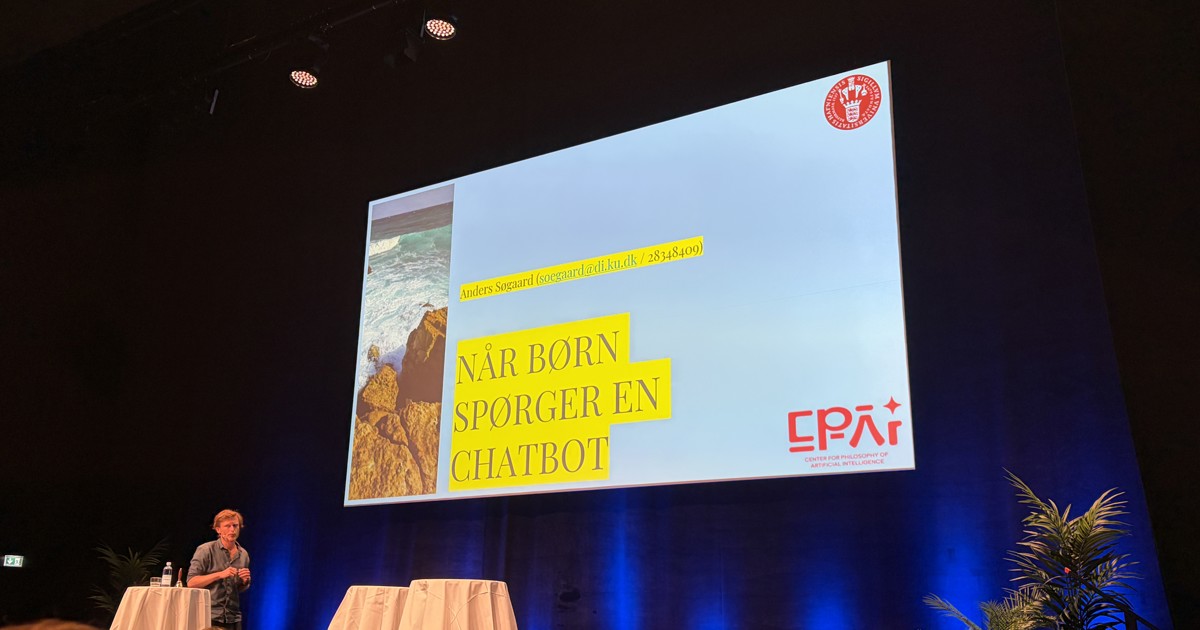
But common frameworks for teaching are still lacking, also in the Danish primary and lower secondary school (folkeskole). At KL’s (Local Government Denmark) folkeskole conference, schoolteacher and independent educational consultant Mikkel Aslak described how schools and teachers are heading off in different directions because attitudes to AI vary widely. He called for common frameworks and pointed to relationships and the teacher’s professional judgement as some of the things to hold on to. Professor Anders Søgaard reminded us that AI tools are not developed for children.
In the United States, you can see what happens when cities set the rules themselves. Boston aims to make all students AI-literate and has allocated 1 million dollars for a curriculum for grades 7 to 12, while New York has introduced a one-year ban on student-facing generative AI from pre-school through 8th grade. MIT researcher Justin Reich believes the difference lies mainly in the rhetoric, and that both cities are, in practice, conducting an experiment that should be evaluated.
What the articles in this newsletter have in common is that AI is already in the classroom, while rules, exam formats and continuing professional development lag behind. As Justin Reich points out, each school and each country is, in practice, running its own experiment. So we might as well find out what works.
In this week’s commentary, I look at why AI in school is not a race – and why the work with the technology should begin within the subjects.
Enjoy the newsletter.
This week’s commentary: AI in school is not a race
This week I have written an opinion piece in Uddannelsesmonitor (a Danish education news site) about something that also recurs in several of the stories in this newsletter: the notion that schools and teachers must hurry so as not to be left behind by AI developments.
My point is that AI is not an IT project, and that continuing professional development is not primarily about getting all teachers to the same technical level. Work with AI needs to be embedded in the subjects. What must pupils still be able to do themselves? What is indispensable in the subject? And where does AI actually make sense?