This Week's News: AI in Education — Partnership or Threat?
In this week's newsletter on AI in education, we explore the tension between AI as a learning partner and a potential threat.
The newsletter curates the latest Danish research findings, debates, and tools to help educators navigate this complex landscape with a critical eye.
This article has been machine-translated into English. Therefore, there may be nuances or errors in the content. The Danish version is always up-to-date and accurate. Read the original Danish article here.
In this week’s newsletter, we have primarily selected Danish news and articles about artificial intelligence in education.
A quick note on our own newsletter. When we select content, we do not take a position on whether the articles we link to have a particular angle or focus. You will therefore find articles both for and against AI in school. We also provide a brief introduction to the articles and hope that readers will delve into the details via the link. Our own assessments appear in the introduction and in information boxes alongside the articles.
The first article we would like to highlight is Christian Dalsgaard and Christopher Neil Prilop’s interesting piece in the journal Læring og Medier (Learning and Media, LOM). Do we actually know how students use AI, or do we simply assume they use it uncritically? Christian and Christoffer have investigated this and provide insight into how students use AI as an active sparring partner in their learning process.
Peter Svarre has launched a new tool that highlights the key ethical, legal and practical challenges of using AI. It is not intended as teaching material as such, but it can usefully be employed in teaching to prompt deeper reflection and discussion.
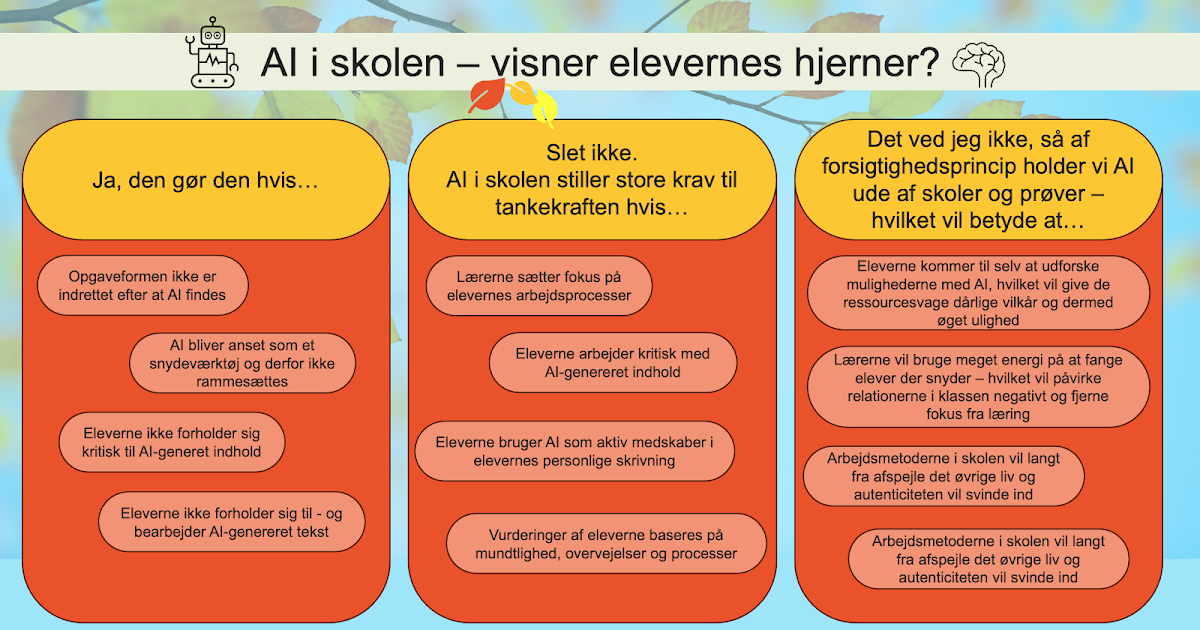
Mikkel Aslak writes on his blog that students’ creative and critical thinking is strengthened — not weakened — by an active and reflective use of AI in school.
Researchers from the ADD-projektet (the Algorithms, Data & Democracy project) emphasise that AI can threaten democracy if society does not regulate the development actively and purposefully.
If you did not attend this year’s Lex conference “Reliable knowledge in the age of AI”, you can watch the entire conference on Lex.dk. There are many good talks to delve into. At the conference, Lex also announced that they are developing a Danish chatbot trained on Lex.dk in order to ensure trustworthy knowledge.
In this context we are also linking to our webinar today, Monday 28 April 2025, 15:30–16:30. It builds on many of the presentations from the Lex conference and looks at what happens when searches move over to chatbots.
We also include two international news items in the newsletter:
A new study from Cambridge shows that students opt out of AI such as ChatGPT for ethical and environmental reasons rather than concerns about cheating. One of their arguments is also that, having paid a lot of money for their education, why let a chatbot do the work?
Upper secondary students form partnerships with AI in their schoolwork
Christian Dalsgaard and Christopher Neil Prilop from Aarhus Universitet (Aarhus University) have investigated how Danish upper secondary students use generative AI tools as cognitive partners in their schoolwork.
The study includes survey data from 546 students and interviews with 18 students from three upper secondary schools (gymnasiums). The results show that students primarily use AI to get explanations, support for problem-solving, idea generation and revision of their work — and to a lesser extent for directly producing assignments.
Six overarching modes of work were identified: production, preparation, inspiration, revision, feedback and explanation. Students use AI as a means to understand complex topics, improve texts and develop new ideas.
The study showed that students largely use AI purposefully and consciously — more often as support than as a shortcut to avoid learning.
Four user profiles were identified: intensive, specifically moderate, generally moderate and minimal users.
The analysis also shows that students increasingly perceive AI tools as human-like partners, e.g. as assistant teachers, sparring partners or editors.
Therefore, Christian Dalsgaard and Christopher Neil Prilop argue that schools should actively develop students’ ability to navigate these new learning partnerships, where AI is not just a technical tool but an actor in students’ knowledge practices.
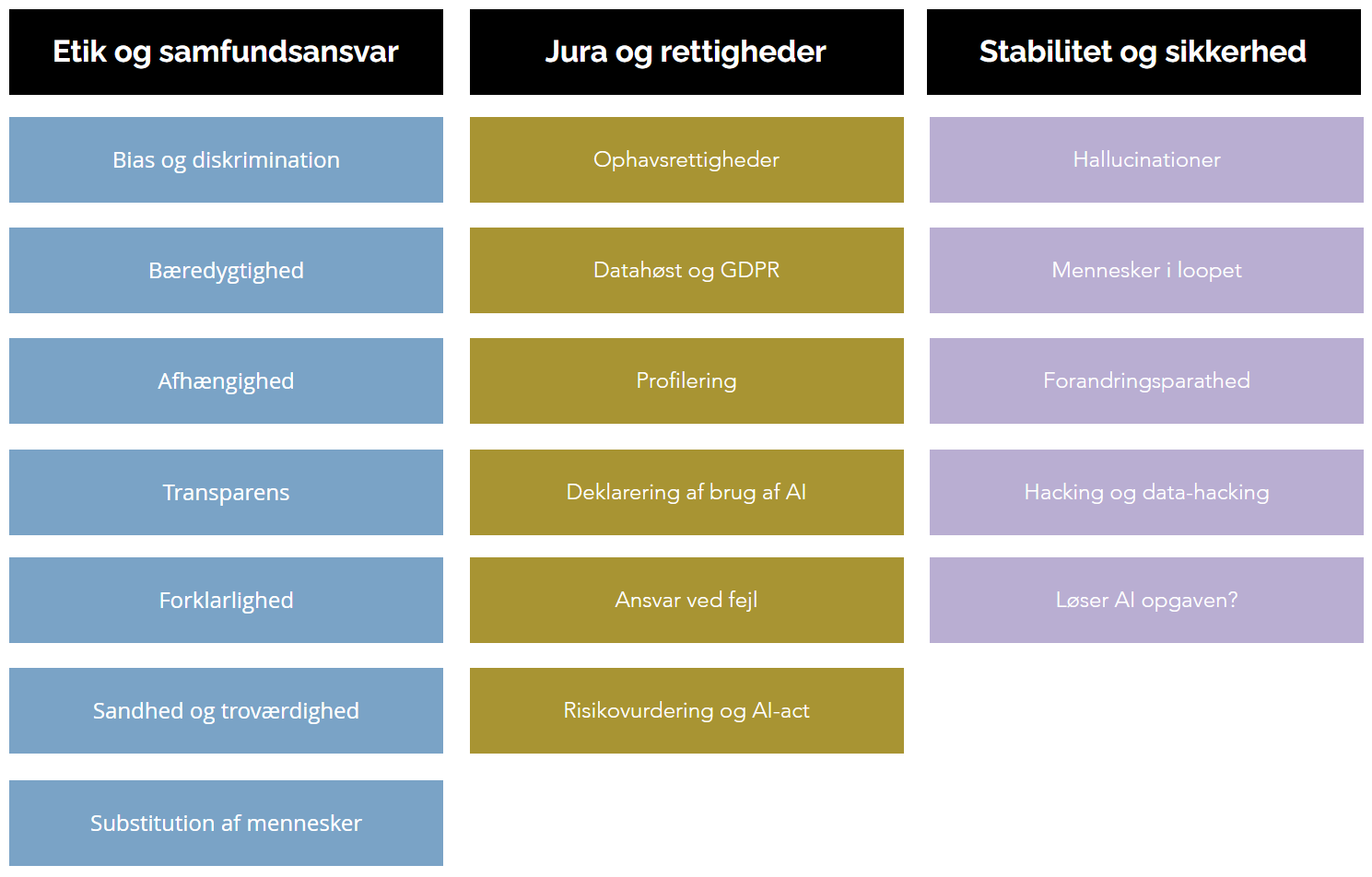
Author and digital expert Peter Svarre has launched the website AI Aware, which focuses on the most important ethical, legal and practical challenges in using AI.
The tool is designed as an interactive checklist with 18 themes, divided into three main categories: ethics and social responsibility, law and rights, and stability and security. Each theme is briefly introduced and can serve as a starting point for teaching, reflection and discussion.
AI Aware is freely available online and can be used both as inspiration for teaching sequences and as concrete teaching material in the classroom. It addresses a broad audience of educators, pupils, students and others who work with or are interested in AI. The website also contains extended chapters.
The tool is well suited for subjects such as social studies, informatics/computer science, communication and IT, Danish and philosophy, where it can support work with both technological understanding and digital literacy.
Using AI in school calls for a critical approach — not bans
Mikkel Aslak discusses concerns about AI’s role in school. He understands why many fear that the use of chatbots can lead to less independent thinking and creativity among students. Nevertheless, he argues that the problem does not lie in the technology itself, but in the way we choose to use it.
He warns against black-and-white thinking and emphasises that critical reflection and deliberate framing are key if AI is to strengthen students’ participation, insight and creativity.
AI chatbots and large language models in higher education
In an op-ed by Sine N. Just, Christina Lioma, Torben Elgaard Jensen, Helene Ratner, Alf Rehn and Leonard Seabrooke, research leaders in Algoritmer, Data & Demokrati (the Algorithms, Data & Democracy, ADD project), a warning is issued about AI’s impact on democracy.
They describe how AI technologies can shift the balance between democratic participation and control, and point out that this technological development can weaken the foundations of democracy if it is not governed responsibly.
Examples from the USA highlight how economic interests and technological development blend together and challenge political institutions. They warn that AI, like earlier technological advances, entails inherent risks — unintended and potentially harmful consequences.
Their main point is that AI neither automatically saves nor destroys society. They therefore call for active democratic action to ensure that AI supports — and does not undermine — democracy and participation.
LEX conference: Reliable knowledge in the age of AI
On 23 April 2025, Lex – Danmarks Nationalleksikon (Denmark’s National Encyclopaedia) – held a conference on reliable knowledge in the age of AI.
The conference brought together researchers, experts and politicians to discuss how information seeking is changing with AI, what challenges this creates for democratic access to knowledge, and how society can ensure open and reliable information flows.
Participants were introduced to concrete methods for critical information searching and the need for clear frameworks for the use of AI. Among the speakers were, among others, the Minister for Digitalisation Caroline Stage and international experts such as Shelly Palmer, who explained how AI is transforming search engines into answer engines.
Other presentations addressed the ownership of the internet’s infrastructure, the risks of information distortion on social media, and how misinformation spreads via emotions and algorithmic systems.
The panel debate rounded off the day with a discussion of how best to ensure free access to reliable knowledge in an AI-driven future, where the need for digital literacy and responsible use of technology was highlighted as central themes.
Lex.dk is developing a new Danish chatbot based on trustworthy sources
Lex.dk is collaborating with the Center for Humanities Computing at Aarhus Universitet (Aarhus University) to develop a Danish chatbot based on Lex’s own articles, written by Danish researchers and professionals. The goal is to create a chatbot that offers trustworthy, well-sourced answers as an alternative to commercial AI solutions. The chatbot will make knowledge easily accessible to all target groups – from children to educators – with options for both quick overviews and in-depth exploration.
Webinar today: AI-generated web search – challenges and opportunities for teaching
This SIG webinar is about how artificial intelligence is revolutionising the way we search for and process information on the web.
In the webinar, Per Størup Lauridsen and Claus Scheuer-Larsen, using search engines such as Perplexity.ai, Bing Chat and Google’s Deep Research as a starting point, analyse the didactic potentials and challenges that arise when AI summarises knowledge from the internet into readable and seemingly authoritative texts.
The webinar is aimed at educators and others interested in how generative AI can be integrated into teaching in ways that support the development of source evaluation skills, creativity and collaboration.
Students at Cambridge are opting out of AI due to environmental and ethical concerns
A survey of 333 students at Cambridge University shows that AI tools such as ChatGPT are primarily being rejected for ethical reasons and environmental concerns – not out of fear of being caught cheating. Many students find the use of AI incompatible with the purpose of a university education and express opposition to Big Tech as well as concern about the large resource consumption AI requires – especially the water use for server cooling.
“Are we really so eager to let our minds stagnate for the profit of a few tech CEOs?”
The results show that only a third have used ChatGPT for assessed work, while 61 per cent have used it to some extent in their studies. Uses range from text summarisation and assignment guidance to language checking and information searching. Several students point out, however, that AI’s outputs are often inaccurate, especially in disciplines requiring specialised knowledge, such as archaeology and literature.
“I have zero interest in using any sort of AI in my work. Not only is it absolutely terrible for the environment, it uses gallons upon gallons of water, but why would you come to uni and pay £9,000 a year to get a computer to do the work that you’re meant to do yourself?”
Overall, the attitudes reflect a growing reluctance to let technology take over academic work, as well as increased awareness of AI’s potential negative consequences for both individuals and society. A few students also express concern that a high academic standard may be suspected as AI use, creating uncertainty around assessment.
The USA launches a national strategy for AI education in schools and for teachers
The US President, Donald Trump, has issued a new executive order aimed at strengthening AI education for young Americans. The goal is to ensure that pupils acquire skills and knowledge about AI from an early age to prepare them for the future labour market. A key focus is also to equip teachers to both teach about and use AI in their daily work.