This week's news: AI—groundbreaking technology or an intellectual crutch?

•
13 min read



This week’s selected news on teaching and generative AI is now out, and there are many interesting articles to read. We are very aware that our newsletters can be a little long, but we want to provide a thorough insight into what is happening.
In higher education, artificial intelligence has already made inroads, but in an article in Berlingske Just Kjærgård Pedersen highlights that students who use AI often struggle to remember subject-specific concepts.
This stands somewhat in contrast to the fact that a new survey from Djøf (the Danish Association of Lawyers and Economists) shows that many students use AI as a regular part of their studies. And while the use of AI tools such as ChatGPT is rising sharply, many students miss clear guidelines on how they may use AI in their studies and in exams.
There is also growing concern that artificial intelligence may lead to intellectual laziness by offering quick answers to complex questions. One possible solution could be for language models to act more like teachers and focus on guidance, which requires a pedagogical adaptation of the AI models.
The big question, however, is whether these technologies are really so revolutionary in education, or whether their impact is in fact limited.
In Germany they have just adopted new recommendations on the use of artificial intelligence in schools, which in many ways resemble the Danish recommendations from the Ekspertgruppen om ChatGPT og andre digitale hjælpemidler (the Danish Expert Group on ChatGPT and other digital tools). The Germans, however, have a broader focus on the entire education system, but both sets of recommendations underline the need for AI to support learning without replacing human interaction.
Meanwhile, the amount of AI-generated text on Wikipedia is increasing, resulting in lower-quality content and fewer sources.
Happy reading.
Just Kjærgård Pedersen, associate professor at Cphbusiness, has in his research examined the influence of artificial intelligence on teaching in higher education. In an article in Berlingske he argues that AI will not make subject knowledge redundant, but also warns that it may create a gap between learning and practice.
Just Kjærgård Pedersen highlights that students who use AI to complete assignments often find it harder to remember subject-specific concepts, even though the tasks are completed more quickly. This indicates that the use of AI does not necessarily result in a deeper understanding of the material. He draws a parallel with the difference between reading e-books and physical books, where e-books are often read faster but result in poorer retention.
He does not see a ban on AI as a viable way forward; instead, he believes that teaching should focus on showing students how to use AI appropriately.
Read the article at Berlingske:
 Just Kjærgård Pedersen, associate professor, Cphbusiness

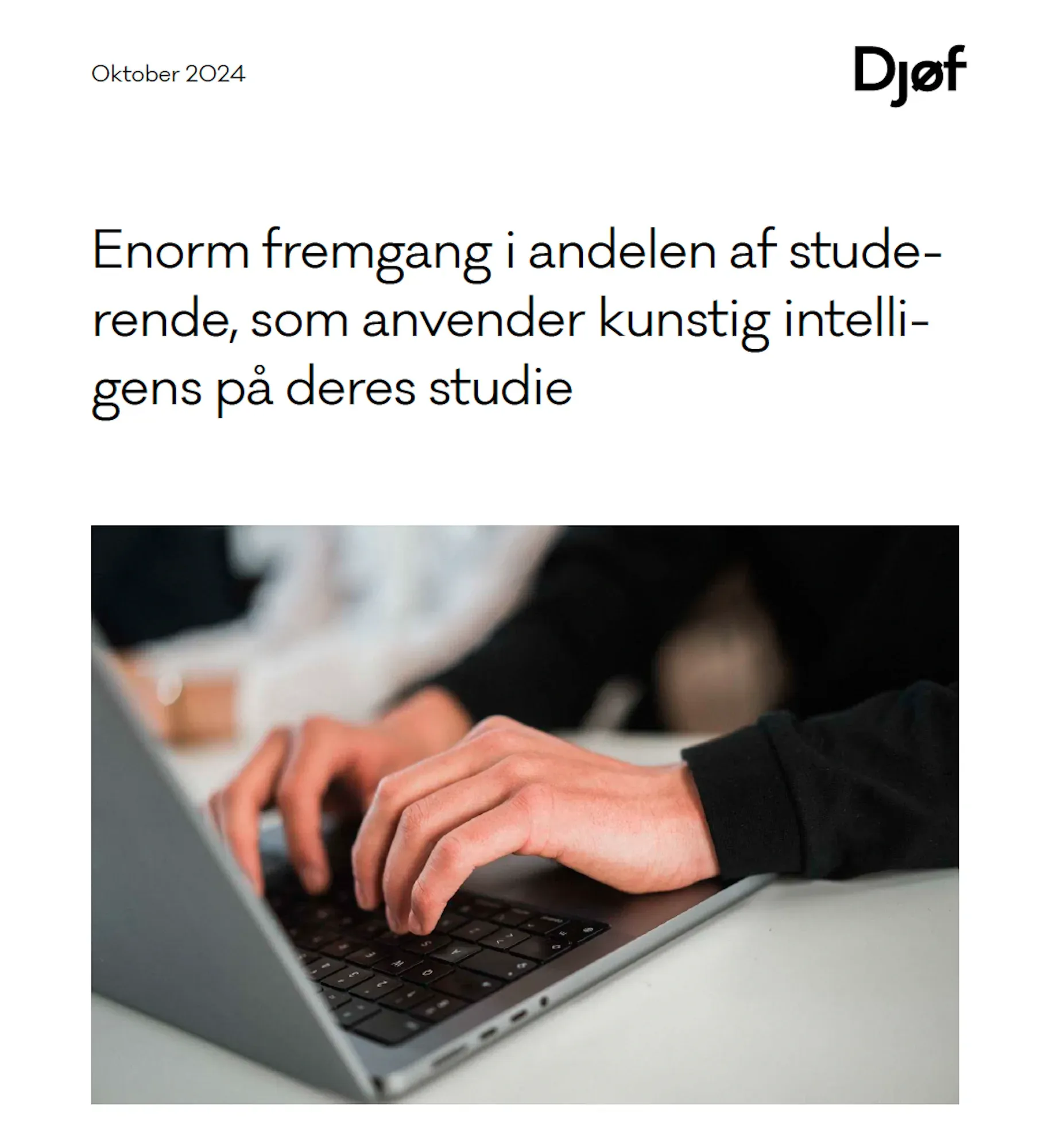
A new survey from Djøf shows that two thirds of students have used AI tools such as ChatGPT in connection with their studies, which is a marked increase from last year. At the same time, 36 % have used AI in exams – almost double the year before. Students primarily use AI as a search engine, to have difficult material explained, and as help with proofreading and translations.
Read the survey here:
Read more in the survey
A new article in Information focuses on the growing use of artificial intelligence at Danish universities. More and more students are using AI tools such as ChatGPT in their studies, and universities are now more often allowing the use of AI in exams. But are students being adequately prepared for the labour market of the future?
Despite the increased use of AI, many students find that universities lack clear guidelines. According to the survey, fewer than half of respondents believe their programme has clear rules for how AI may be used in exams. In addition, more than half feel they have not received sufficient instruction or guidance in the use of AI, which is a cause for concern.
Universities acknowledge the need to continually adjust the guidelines for AI use, but according to several students there is still confusion about when and how AI may be used. At SDU (the University of Southern Denmark), for example, it is permitted to use AI for written take-home assignments, but not for written in-person exams or oral exams, which creates uncertainty. There is an increased need for guidance, and universities face the challenge of ensuring that students are sufficiently prepared for the technological reality that awaits them after their studies. As Helle Waagepetersen, pro-rector at SDU, emphasises, it is the responsibility of universities to equip students with the necessary competencies, including in the use of artificial intelligence.
 Caspar de Mylius

In an article on Salongen, Cathrine Felix discusses how artificial intelligence such as ChatGPT can lead to intellectual latskap (laziness) by offering quick solutions that tempt us to take the easiest route. She points out that people naturally seek to conserve energy, both physically and mentally, which can lead to superficial thinking and an inability to immerse oneself in complex tasks. Technologies like ChatGPT can reinforce this tendency by delivering ready-made answers, which may risk weakening our ability to think critically and independently.
At the same time, she warns that efficiency and multitasking can be mistaken for intellectual strength. Although young people can juggle many tasks quickly, this can lead to a loss of the ability for deep understanding and prolonged reflection. She highlights the importance of intellectual stamina, which requires time and effort, and which risks being undermined by technological shortcuts. To maintain a healthy balance, Felix urges us to use AI as a tool for support and not as a replacement for our own mental effort.
Read the full article here:
 Cathrine Felix

In a new article, researchers explore how AI models can become better at teaching by helping students through guidance rather than simply giving quick answers. They call this pedagogical alignment (pædagogisk tilpasning) and it is about getting models to behave more like good teachers. At the same time, the researchers propose a new approach that creates a comprehensive dataset using techniques to generate synthetic data.
The researchers used a method in which AI models such as Llama and Mistral are trained to learn from human preferences. This makes them better at breaking complex problems into smaller parts and helping students step by step.
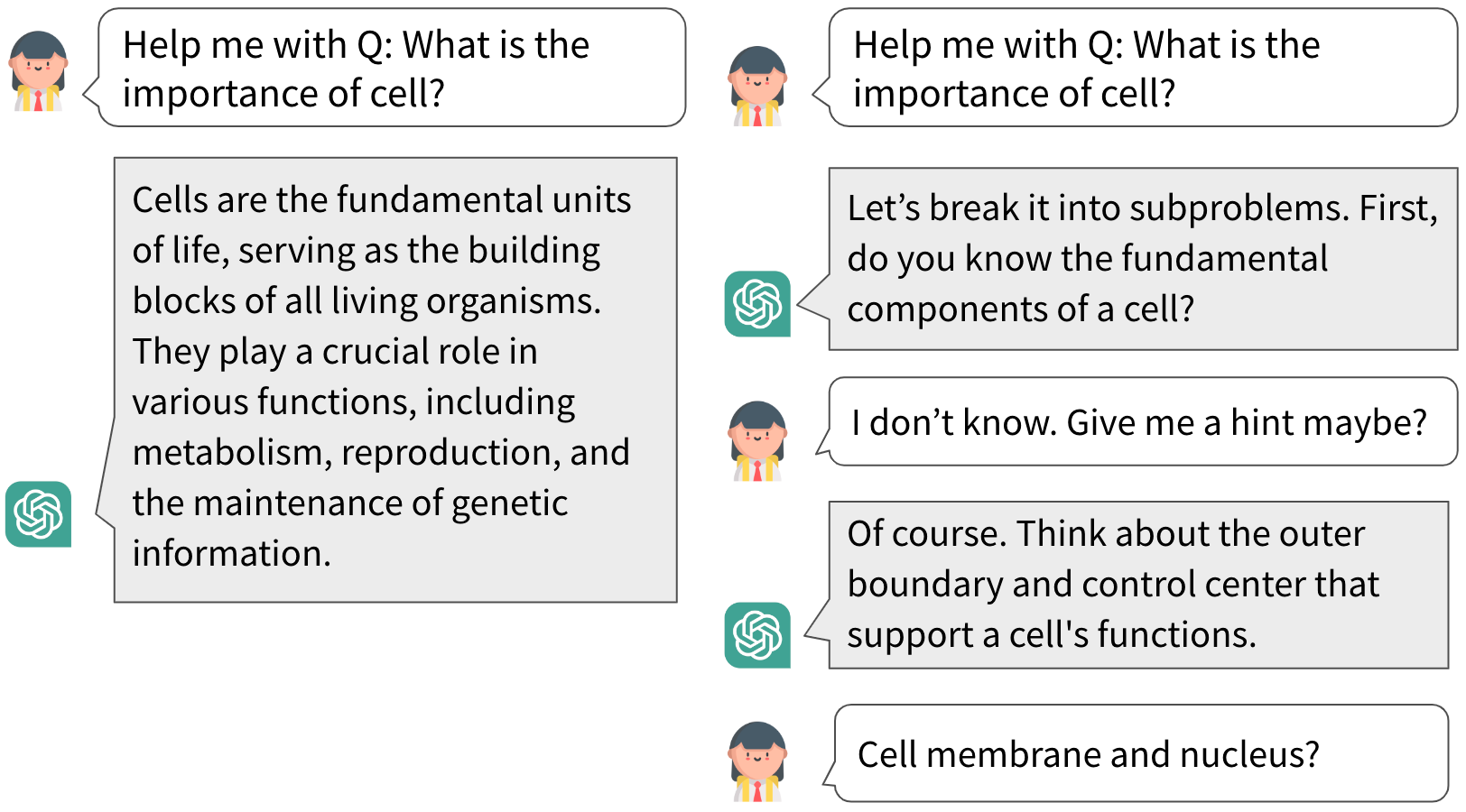
The study shows that this training makes AI models more effective as learning tools. At the same time, the researchers have developed new ways to measure how well AI models support the learning process.
Read the article here:
Shashank Sonkar
Dr Philippa Hardman has examined whether AI tools such as ChatGPT 4o, Claude 3.5 and NotebookLM genuinely support learning, or whether their impact is more limited than we think. Her research focuses on how these tools convey information, what they leave out, and how they structure content.
The findings show that while the tools are good at summarising complex content, they often oversimplify information and omit important details such as research studies and practical examples. ChatGPT and Claude can be a good starting point, but need to be supplemented with more in-depth reading. NotebookLM is suitable for quick overviews, but lacks academic depth, especially in its podcast feature.
She therefore concludes that although AI tools make knowledge more accessible, they are not yet genuine "learning tools". To support real learning, they need to implement pedagogical methods such as "spaced repetition" and active recall, where the user recalls information themselves. They must also challenge users with increasing complexity, which is important for deeper understanding.
Overall, AI tools can help us at the start of the learning process, but real learning still requires active human engagement.
 Dr Philippa Hardman

The German Conference of Ministers of Education (Bildungs-MK) has adopted a set of recommendations for the German education sector regarding the use of artificial intelligence in education. The recommendations aim to enable schools to take a constructive and critical approach to AI, while harnessing the potential of these technologies for learning and teaching.
The recommendations build on the supplementary paper from the Conference of Education Ministers of the German federal states (KMK), Teaching and learning in the digital world.
The recommendations cover several key areas:
The recommendations build on groundwork from the federal states and incorporate scientific expertise, and they represent the states’ shared position on handling AI applications in school teaching. The recommendations also emphasise that AI tools must not replace vital human interaction in teaching, but should instead support and complement the learning process.
Read more here:


A study from Princeton University shows a marked increase in AI-generated content on Wikipedia, especially after the release of GPT-3.5 in 2022. The researchers used two tools to detect AI content – GPTZero and Binoculars – and found that over 5% of new English Wikipedia articles in August 2024 contained AI-generated text. In other languages such as German, French and Italian, the proportion was lower, but still significant.
Articles flagged as AI-generated were often of lower quality, with fewer sources and less integration into the Wikipedia network. Some of these articles were also used for self-promotion or to push particular political agendas. The researchers also noted that AI-driven translations created additional challenges, as they could propagate errors and biases across languages.
Creston Brooks Jeppe Klitgaard Stricker

 Knut Jørgen Vie


 Elizabeth Gehrman
 Mathilde Meile
 ABC News